
Why This Chapter Matters
Let's start with a number. In the CBSE Class 10 Board exam, 8 to 12 marks every single year come from this one chapter alone. That is roughly 10-15% of your entire Science paper decided here. For NEET foundation students, this chapter sets up almost everything you will see in Class 11 (Plant & Human Physiology). So this chapter is not just biology — it is exam currency.
Why does it carry such weight? Because Life Processes is the chapter that explains how a living body actually works. It blends:
- Cell biology — diffusion, osmosis, enzymes.
- Anatomy — every Class 10 diagram (heart, lungs, kidney, digestive tract, leaf) is here.
- Physiology — how each organ system functions.
- Comparative biology — unicellular Amoeba vs the complex human body.
And running through everything is one big idea: every living organism — bacterium to elephant — must perform the same set of life processes, just with different tools. A bacterium uses simple diffusion. A human uses a four-chambered heart pumping blood through specialised arteries, veins, and capillaries. Same job, different machinery.
By the end of this chapter, you should be able to look at any living organism and answer: How does it get food? How does it get energy? How does it move materials around? How does it remove wastes? That's the goal.
A note on NCERT-canonical phrasing: Examiners reward verbatim NCERT language. Throughout this chapter, you'll see direct NCERT quotes flagged like this — memorise these word-for-word. They are mark-winners.
What Does It Mean To Be 'Alive'?
Pause for a moment. How do you actually tell whether something is alive or not?
You might say: "It moves." But plants barely move. "It breathes." But many things — like flames — appear to consume oxygen too. "It grows." But so do crystals and stalactites.
The NCERT answer is more careful. There are visible criteria and invisible criteria for life:
Visible criteria (sometimes useful, sometimes misleading)
- Movement — a running dog is clearly alive. But a sleeping dog also is. And a moving river is not.
- Growth — most plants grow, most animals grow. But so do non-living crystals.
- Response to stimuli — touch a sensitive plant (Mimosa pudica) and it folds; touch a coal and nothing happens. But this is also imperfect — viruses respond to environments.
None of these alone is enough. The truly defining feature is invisible.
The invisible criterion — molecular movements
"Visible movements are not necessarily evidence of being alive. Plants for example, are alive even though they do not visibly move. The molecular movements that maintain the order in the cell are characteristics of all living organisms."
That NCERT quote captures the real answer. At the cellular level, molecules are constantly being broken down, repaired, replaced. Proteins are synthesised. DNA is repaired. Membranes are maintained. This requires energy. And it requires the input of raw materials.
In other words: a living body is constantly using energy to fight disorder. The moment that stops, the body decays.
So what does 'being alive' really need?
To keep a living body running, you need:
- Energy — for all the molecular maintenance and growth.
- Raw materials — to build new molecules.
- A way to remove waste — because reactions produce by-products.
- A way to detect and respond to the environment.
- A way to make new individuals — so the species continues.
These five needs are exactly what the six life processes address. Let's meet them now.
[Board Important] "Why is movement not a reliable criterion of life?" Because plants don't move visibly but are alive; rivers move but aren't. Use the NCERT phrase about molecular movements in your answer.
The Six Life Processes
NCERT identifies six fundamental life processes that every living organism performs in some form. Memorise this list — it is the spine of the entire chapter.
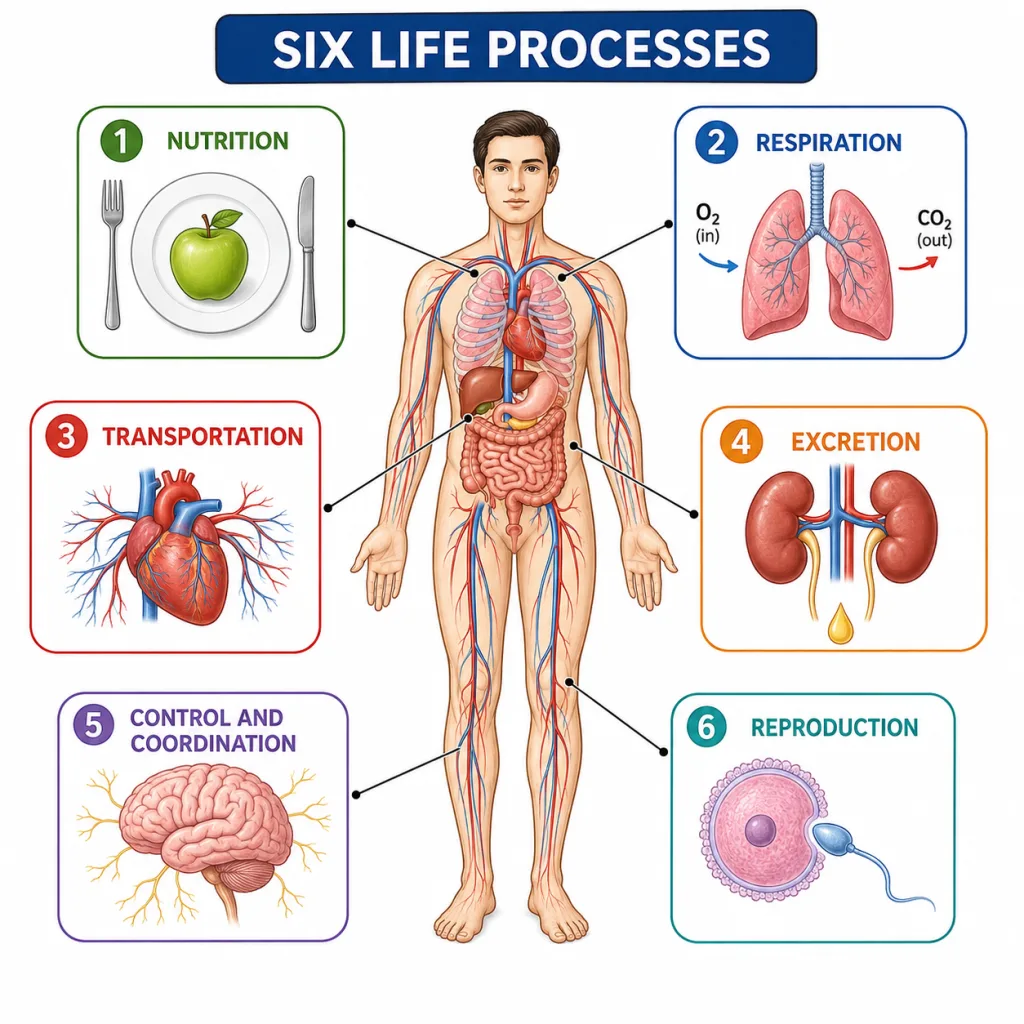
1. Nutrition
'Nutrition' = the process by which organisms obtain food (organic molecules) and use it to build their bodies and provide energy.
- Plants make their own food from sunlight, CO₂, and water (photosynthesis — Section 2).
- Animals eat plants or other animals (heterotrophic — Section 3).
2. Respiration
'Respiration' = the breakdown of food (typically glucose) to release energy in the form of ATP.
- Aerobic respiration uses O₂.
- Anaerobic respiration doesn't (e.g., yeast fermentation, muscle cramps).
3. Transportation
Moving materials (nutrients, gases, wastes, hormones) from one part of the body to another.
- Humans use blood (heart + arteries + veins + capillaries).
- Plants use xylem (water) + phloem (food).
4. Excretion
Removing the metabolic wastes (urea, CO₂, excess salts) produced by the body.
- Humans use kidneys (urine), lungs (CO₂), skin (sweat).
- Plants use stomata (transpiration), gum, resin, leaf shedding.
5. Control and Coordination
Sensing the environment and responding to it; keeping internal organs in sync.
- Humans use the nervous system + endocrine (hormonal) system.
- Plants use plant hormones (auxin, gibberellin, etc.) and tropisms.
(This is the topic of Chapter 6, not Chapter 5.)
6. Reproduction
Producing offspring — essential for continuation of species.
(This is the topic of Chapter 7.)
What Chapter 5 covers vs. doesn't
| Life process | Where it's covered |
|---|---|
| Nutrition | Chapter 5 (Sections 2-4) |
| Respiration | Chapter 5 (Section 5) |
| Transportation | Chapter 5 (Sections 6-7) |
| Excretion | Chapter 5 (Section 8) |
| Control and Coordination | Chapter 6 |
| Reproduction | Chapter 7 |
So Chapter 5 focuses on the first four life processes. The last two are entire chapters of their own.
[Board Important] List the six life processes. This is a standard 2-mark question. Always list all six — even though only four are studied in this chapter.
Single Cell vs Whole Body — Two Strategies
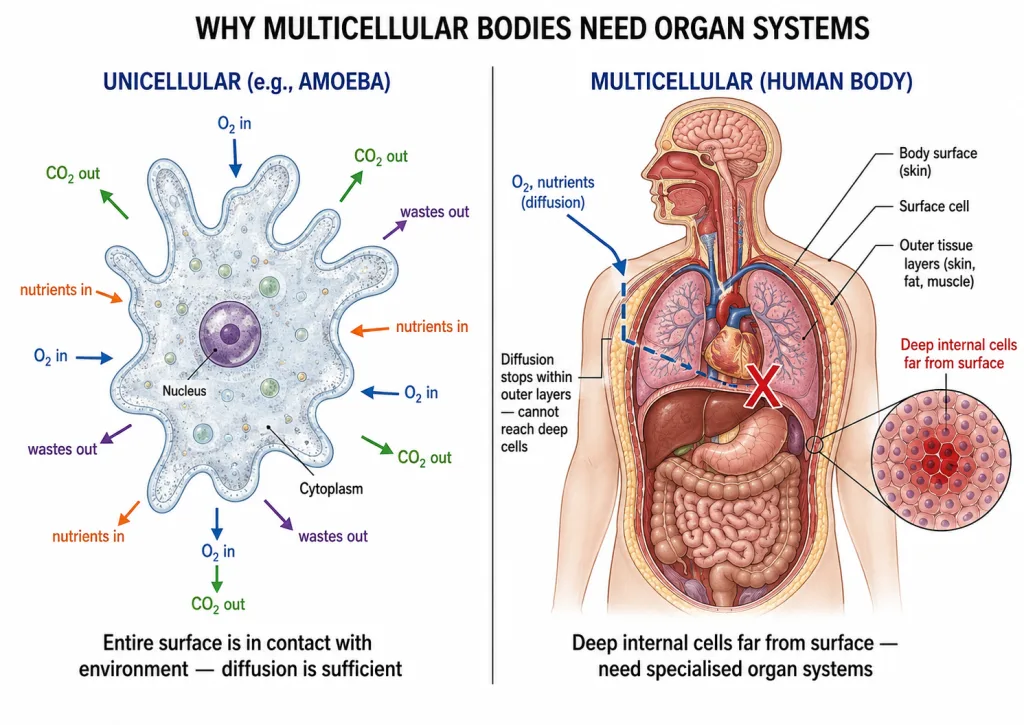
Here is one of the most beautiful comparisons in Class 10 Biology. A bacterium is alive. So is a blue whale. Both perform the same six life processes. But the machinery they use is radically different.
Why this matters
The answer depends on one principle: diffusion is slow.
Diffusion is the movement of molecules from a region of high concentration to one of low concentration. It is the simplest, most ancient method of moving materials. But it has a limit — it only works fast enough over very short distances (a few cell diameters).
In a unicellular organism (like Amoeba)
- The entire surface of the cell is in direct contact with the environment.
- Oxygen diffuses in across the membrane.
- CO₂ diffuses out the same way.
- Nutrients enter; wastes leave.
- No specialised organ is needed.
Diffusion is fast enough because no molecule has to travel more than a few micrometres.
In a multicellular organism (like a human)
Now consider a cell deep inside your liver. It is centimetres away from the surface of your skin. Diffusion across centimetres would take hours to days — far too slow to keep the cell alive.
So evolution built specialised organ systems to deliver materials quickly:
- Respiratory system — brings O₂ to the body's surface (alveoli).
- Circulatory system — pumps O₂-rich blood to every deep cell.
- Digestive system — breaks food into absorbable molecules.
- Excretory system — collects wastes from all cells.
Each of these is a delivery service that overcomes the slowness of diffusion.
The takeaway sentence
Unicellular organisms use diffusion. Multicellular organisms use specialised organ systems. That is the single most important contrast in this chapter.
Comparison table
| Feature | Unicellular (e.g., Amoeba) | Multicellular (e.g., Human) |
|---|---|---|
| Surface area | Whole cell membrane | Specialised surfaces (lungs, intestine, kidney) |
| Transport | Diffusion alone | Blood + heart + vessels |
| Gas exchange | Across cell membrane | Lungs + RBC + haemoglobin |
| Waste removal | Diffusion out of cell | Kidneys + sweat + lungs |
| Food intake | Phagocytosis / endocytosis | Mouth → digestive tract |
| Energy/efficiency | Limited by size | Can support a large body |
[NEET-foundation] This 'diffusion vs organ systems' contrast is the foundation for Class 11 Biology. Lock it in now.
The Roadmap of the Chapter
The whole chapter is one continuous story — a journey from food entering to waste leaving. Let me give you the roadmap so that whenever you're in a particular section, you know where you are in the big picture.
Phase 1 — Getting food in (Sections 2-4)
Nutrition. Two big strategies:
- Autotrophic (Section 2) — plants make their own food via photosynthesis.
- Heterotrophic (Section 3) — animals eat. We trace nutrition in Amoeba, Paramecium, and humans.
- Human digestive system (Section 4) — the full anatomy from mouth to anus, with every enzyme and every junction.
Phase 2 — Burning food for energy (Section 5)
Respiration. How the food is broken down inside the cell to release ATP. We cover aerobic vs anaerobic respiration, the human respiratory system, and the gas exchange that happens at the alveoli.
Phase 3 — Delivering materials (Sections 6-7)
Transportation. Two parallel topics:
- In humans (Section 6) — the four-chambered heart, double circulation, blood, lymph.
- In plants (Section 7) — xylem (water) and phloem (food), transpiration and translocation.
Phase 4 — Removing wastes (Section 8)
Excretion. The human kidney and nephron in detail, dialysis, and how plants get rid of wastes.
Why this matters for you as a student
When you study Section 5 (Respiration), you should already be primed by Section 4 (Digestion) — because the glucose burned in respiration is what digestion delivered. When you reach Section 6 (Transportation), you'll see how the body moves the O₂ from the lungs (Section 5) to every cell. Each section sets up the next. Treat them as one continuous narrative, not 8 isolated topics.
One-line takeaway for the chapter: A living body must obtain food (nutrition), burn it for energy (respiration), distribute materials (transportation), and remove wastes (excretion) — and multicellular bodies need specialised organ systems to do all of this fast enough.
Small Memory Capsule — Section 1
A compact recap to lock in before moving to Section 2.
Core ideas
- A living body must constantly use energy to maintain molecular order (NCERT phrase).
- Visible criteria (movement, growth) are unreliable. Invisible criterion = molecular movements.
- Five needs of a living body: energy, raw materials, waste removal, response to environment, reproduction.
The six life processes
- Nutrition — getting food.
- Respiration — releasing energy from food.
- Transportation — moving materials around.
- Excretion — removing wastes.
- Control and coordination — sensing + responding (Chapter 6).
- Reproduction — making offspring (Chapter 7).
Unicellular vs multicellular
| Feature | Unicellular | Multicellular |
|---|---|---|
| Surface | Whole cell | Specialised organs |
| Transport | Diffusion | Blood / xylem-phloem |
| Why? | Distance is small | Distance is too large for diffusion alone |
Roadmap of Chapter 5
- Sections 2-4: Nutrition (plants, animals, human digestive system).
- Section 5: Respiration.
- Sections 6-7: Transportation (humans, plants).
- Section 8: Excretion.
Board-essential facts
- This chapter contributes 8-12 Board marks every year.
- The single most important comparison: unicellular diffusion vs multicellular organ systems.
- Always list all six life processes when asked — not just the four in this chapter.
One-line takeaway
To stay alive, every cell must constantly fight molecular disorder using energy from food — and the bigger the body, the more elaborate the machinery needed to deliver food, oxygen, and waste removal to every cell.
Solved Examples
Example 1: Why movement is not a reliable indicator of life
A student says: "Anything that moves is alive." Give two arguments why this is wrong.
Solution:
Two clean counter-examples:
Argument 1 — non-living things move: A river flows. A cloud drifts. A car moves. Volcanic lava flows. None of these are alive. Movement alone cannot define life because non-living systems also move (driven by physical forces like gravity or pressure).
Argument 2 — living things may not visibly move: Plants, fungi, and many sessile animals (e.g., corals, sponges) don't visibly move. Yet they are unambiguously alive. They grow, respire, excrete, and reproduce. Their lack of visible movement does not make them non-living.
The real criterion
NCERT explains: "The molecular movements that maintain the order in the cell are characteristics of all living organisms."
In other words, what defines life is invisible molecular activity — the constant breakdown, repair, and rebuilding of proteins, DNA, and membranes inside every cell. This requires energy, which is why every living organism needs to perform the life processes.
Answer: Movement alone is not a reliable indicator of life because (1) non-living systems like rivers and machines also move, and (2) plants and many animals don't visibly move yet are clearly alive. The true criterion of life is molecular movements inside cells that maintain order — invisible to the naked eye but essential.
[Board Important] This is a classic 2-3 mark CBSE question. Always cite the NCERT phrase about molecular movements.
Example 2: Listing the six life processes
List the six life processes performed by all living organisms. Which of these are studied in detail in this chapter?
Solution:
The six life processes, with one-line definitions:
| # | Process | One-line meaning |
|---|---|---|
| 1 | Nutrition | Obtaining food (energy + raw materials) |
| 2 | Respiration | Releasing energy from food |
| 3 | Transportation | Moving materials around the body |
| 4 | Excretion | Removing metabolic wastes |
| 5 | Control and Coordination | Sensing environment and responding |
| 6 | Reproduction | Producing offspring |
Studied in Chapter 5 (this chapter):
- Nutrition (Sections 2-4)
- Respiration (Section 5)
- Transportation (Sections 6-7)
- Excretion (Section 8)
Studied in later chapters:
- Control and Coordination — Chapter 6
- Reproduction — Chapter 7
Answer: Six life processes are nutrition, respiration, transportation, excretion, control & coordination, and reproduction. Chapter 5 covers the first four; control & coordination is Chapter 6; reproduction is Chapter 7.
[Board Important] Frequent 2-mark question. Always list all six even though only four are in this chapter.
Example 3: Why Amoeba doesn't need lungs
Why does an Amoeba get along just fine without specialised organs like lungs, hearts, or kidneys?
Solution:
The reason is its small size combined with reliance on diffusion.
Let me build the argument:
1. What Amoeba needs to do: Like every living thing, Amoeba must take in oxygen, take in food, expel CO₂, and expel waste. These are non-negotiable needs.
2. Distance argument: Amoeba is a single cell, typically ~200 micrometres across. Every point inside its cytoplasm is, at most, a few hundred micrometres from the cell membrane. Across such tiny distances, diffusion is fast — molecules can move from environment to deep cytoplasm in fractions of a second.
3. Therefore: The entire cell membrane serves as the respiratory surface (O₂ in, CO₂ out). Food is engulfed by pseudopodia and digested inside a food vacuole. Wastes diffuse out across the membrane. No specialised organ is needed.
4. Why this strategy fails in larger bodies: A human's deep liver cell is centimetres from the skin. Across such distances, diffusion would take hours — too slow to keep the cell alive. Hence evolution built lungs (to maximise gas exchange surface), the heart (to pump materials quickly), and kidneys (to filter waste). These are workarounds for the slowness of diffusion over large distances.
Answer: Amoeba is a single, tiny cell (~200 micrometres). Its entire surface is in direct contact with water, so diffusion is fast enough to bring in O₂ and food and remove CO₂ and waste. No specialised organs are needed. In a large multicellular body like a human, distances from the body surface to deep cells are too large for diffusion alone — hence the evolution of specialised respiratory, circulatory, digestive, and excretory systems.
[NEET-foundation] This 'why simple-vs-complex' contrast is foundational for Class 11 Biology. Memorise the diffusion-distance argument.
Example 4: The NCERT 'molecular movements' phrase
Reproduce and explain NCERT's definition of what makes molecular activities characteristic of all living organisms.
Solution:
NCERT's verbatim phrase:
"The molecular movements that maintain the order in the cell are characteristics of all living organisms."
Unpacking this sentence:
(a) 'Molecular movements' — Inside every living cell, molecules are in constant motion. Proteins are being synthesised on ribosomes. DNA is being repaired. Membranes are being patched. Old cell components are being broken down and recycled. Hundreds of thousands of chemical reactions per second happen in a single cell.
(b) 'Maintain the order' — Without constant energy input, all systems tend toward disorder (the Second Law of Thermodynamics). In a non-living object, once you arrange the molecules in a particular pattern, they stay that way (or randomly decay). In a living cell, the order — DNA in chromosomes, proteins in specific structures, membranes in specific shapes — is actively maintained. Energy is continuously spent to keep things organised.
(c) 'Characteristic of all living organisms' — Every living thing — from the simplest bacterium to the largest whale — does this. Even a plant that does not move visibly is, internally, a hive of molecular activity. This is why plants are alive even though they don't run around.
Where the energy comes from
It comes from food, broken down via respiration. The molecule that delivers usable energy is ATP. So:
Answer: NCERT's phrase is: "The molecular movements that maintain the order in the cell are characteristics of all living organisms." This means every living cell uses energy (from food, via respiration) to maintain its internal molecular order — synthesising proteins, repairing DNA, maintaining membranes. Without this constant activity, the cell decays. Plants, though they don't visibly move, are doing this internally just as actively as animals.
[Board Important] Memorise this NCERT sentence word-for-word — it appears in 3-5 mark Board questions and is a standard mark-winner.
Example 5: NCERT in-text — Why do multicellular organisms need specialised organs?
NCERT asks: "Why are organs (and organ systems) needed in multicellular organisms when single-celled organisms manage with just one cell?"
Solution:
The answer rests on the distance limitation of diffusion.
Step 1: Diffusion is fast only over short distances. Diffusion is the random movement of molecules from high to low concentration. It works very well over distances of a few micrometres — i.e., across one or two cells. But beyond about a millimetre, diffusion alone becomes too slow.
Step 2: Unicellular organisms are small. An Amoeba is ~200 micrometres. The longest journey any molecule must make is from the outside surface to the deepest part of the cytoplasm — well under a millimetre. Diffusion handles this in seconds.
Step 3: Multicellular organisms are large. A human is over a metre long. A cell deep inside the liver is centimetres from the body surface. Across centimetres, diffusion would take hours or days — far too slow. A cell that depends on slow diffusion would die before its oxygen arrived.
Step 4: The evolutionary solution — specialised organ systems. To solve the distance problem, evolution built delivery systems:
| Need | Specialised system |
|---|---|
| Get food | Digestive system (mouth → intestines) |
| Get O₂ | Respiratory system (lungs) |
| Move materials | Circulatory system (heart + blood vessels) |
| Remove waste | Excretory system (kidneys) |
Each system has a large surface area at the body's exterior boundary (e.g., alveoli, intestinal villi) and a transport network to carry materials quickly through the body.
Step 5: The broader principle. This is why complex animals like humans, fish, birds, and mammals all have heart-and-lung-and-kidney designs. It is not a coincidence — it's the only way large bodies can solve the distance problem.
Answer: Multicellular organisms need specialised organs because their large body size means deep cells are far from the body surface. Diffusion alone is too slow over such distances. Specialised organ systems (respiratory, circulatory, digestive, excretory) provide large surface areas for exchange and transport networks to deliver materials quickly to every cell — overcoming the speed limitation of simple diffusion.
[Board Important] This 5-mark Board favourite tests both the diffusion concept AND the comparative anatomy. Always mention 'distance' + 'diffusion is slow' + 'need for organ systems'.
Example 6: Mapping the roadmap
Arrange the following life processes in the order in which a meal you eat is processed by your body:
(i) Excretion of urea by kidneys (ii) Absorption of glucose in small intestine (iii) Breaking glucose down in mitochondria to release ATP (iv) Chewing food in mouth (v) Transport of glucose by blood to muscle cells
Solution:
This question tests whether you can trace a single nutrient (glucose from a meal) through the entire chain of life processes — across all four sections of this chapter.
Following the meal:
- (iv) Chewing food in mouth — Ingestion (Section 3, 4). Salivary amylase begins starch digestion here.
- (ii) Absorption of glucose in small intestine — Digestion + absorption (Section 4). Final digestion happens here; glucose enters blood via villi.
- (v) Transport of glucose by blood to muscle cells — Transportation (Section 6). Blood carries glucose to every cell, including muscles.
- (iii) Breaking glucose down in mitochondria — Respiration (Section 5). Cellular respiration releases ATP for muscle work.
- (i) Excretion of urea by kidneys — Excretion (Section 8). Urea (waste from protein breakdown) is filtered out by kidneys.
Answer: .
Order: chewing → absorption → blood transport → cellular respiration → urea excretion.
Notice how a single bite of food activates all four life processes covered in this chapter — and we haven't even talked about how the body decides to chew (control & coordination, Chapter 6) or how new cells are made from this food (reproduction, Chapter 7).
[NEET-foundation] Cross-section questions like this are common. The trick is to follow the molecule (glucose here) and ask: where does it go next?