
Sign Convention for Lenses
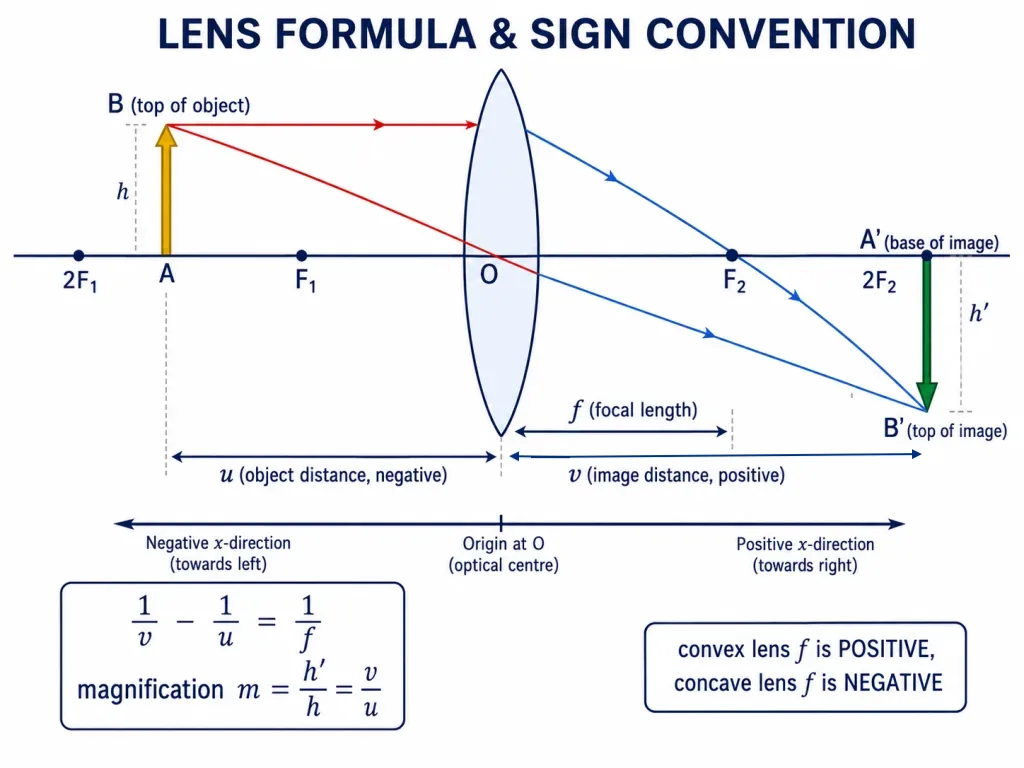
Lenses use the same New Cartesian Sign Convention as mirrors, but all distances are measured from the optical centre O:
- The object is on the left, so is negative.
- Distances measured in the direction of incident light (to the right) are positive; against it (left) are negative.
- Heights above the axis are positive; below are negative.
Crucially:
- Convex lens: focal length is positive.
- Concave lens: focal length is negative.
The Lens Formula
The object distance (), image distance () and focal length () of a lens are related by the lens formula:
Note the minus sign — this is the key difference from the mirror formula (which has a plus). The lens formula works for all lenses and all object positions, with the correct signs.
[NEET Important] Compare: mirror ; lens . Mixing them up is the most common exam mistake.
Magnification for Lenses
For a lens, magnification is again the ratio of image height to object height, and is related to and by:
(Notice: for a lens it is , with no minus sign, unlike the mirror's .)
Reading the sign:
- positive → image virtual and erect (convex lens with object inside F, or any concave lens).
- negative → image real and inverted.
- enlarged; diminished.
Key Point: Lens magnification (no minus). Mirror magnification .
Memory Capsule — Section 7
Quick revision: lens formula and magnification.
1. Sign convention: measure from O; negative; convex positive, concave negative. 2. Lens formula: (note the minus — opposite of mirror). 3. Magnification: (no minus, unlike mirrors). 4. virtual/erect; real/inverted; enlarged. 5. Remember: mirror has and ; lens has and .
Solved Examples
Example 1: NCERT — Concave Lens (Example 9.3)
A concave lens has focal length 15 cm. At what distance should the object be placed so the image forms 10 cm from the lens? Find the magnification.
Solution: Given: cm (virtual, same side), cm (concave).
The object is 30 cm from the lens. Magnification: .
The positive shows the image is virtual and erect, one-third the object's size.
Takeaway: A concave lens gives a positive m (virtual, erect) and a diminished image.
Example 2: NCERT — Convex Lens (Example 9.4)
A 2.0 cm tall object is placed 15 cm from a convex lens of focal length 10 cm. Find the nature, position, size and magnification of the image.
Solution: Given: cm, cm, cm (convex).
Positive ⇒ image on the other side, real and inverted.
Magnification: . Height cm.
So the image is real, inverted, enlarged (2×), 4.0 cm tall, 30 cm from the lens.
Takeaway: Negative m and h' confirm a real, inverted image; |m| = 2 means twice enlarged.
Example 3: NCERT Exercise — Converging Lens, Object at 25 cm
A 5 cm long object is held 25 cm from a converging lens of focal length 10 cm. Find the position, size and nature of the image.
Solution: Given: cm, cm, cm.
; height cm.
The image is real, inverted and diminished, about 3.3 cm tall, 16.7 cm on the other side of the lens.
Takeaway: Object beyond 2F (25 > 20) gives a diminished, real, inverted image.
Example 4: NCERT Exercise — Concave Lens, Image at 10 cm
A concave lens of focal length 15 cm forms an image 10 cm from the lens. How far is the object from the lens?
Solution: Given: cm, cm.
The object is placed 30 cm from the lens.
Takeaway: Same setup as Example 9.3 — a concave lens forms a virtual image between the object and the lens.
Example 5: Magnification and Image Height
A convex lens forms an image with magnification of an object 2 cm tall. What is the image height and nature?
Solution: Image height: cm.
Since is negative, the image is real and inverted; , so it is enlarged.
The image is 6 cm tall, real, inverted and 3× enlarged.
Takeaway: ; the sign of m tells you real/virtual, its size tells you enlarged/diminished.