
Refractive Index of One Medium w.r.t. Another
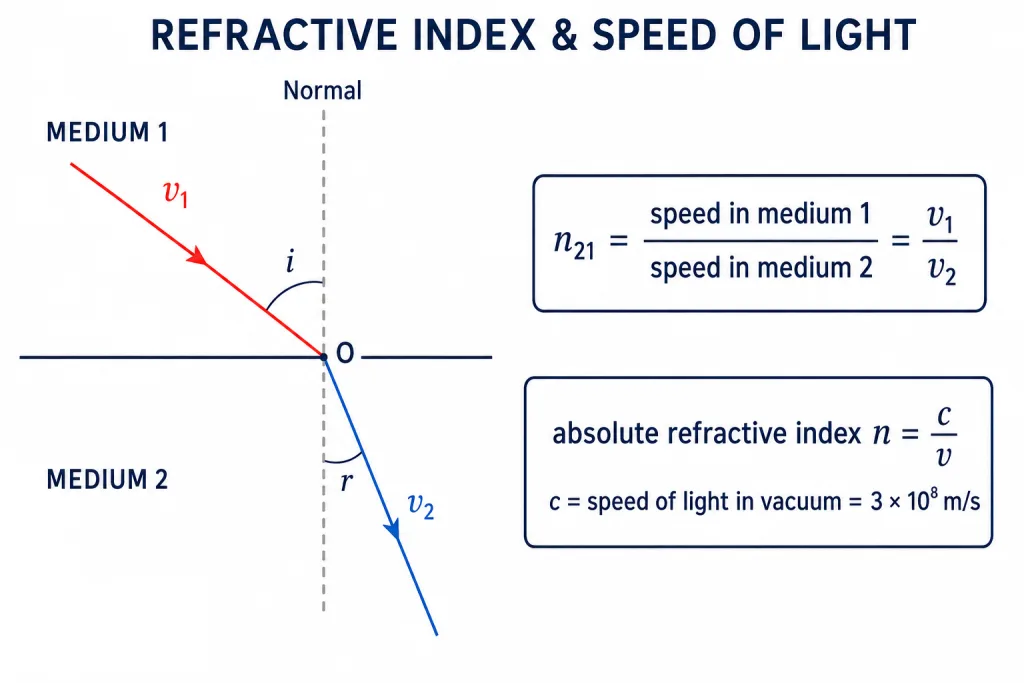
Light travels at different speeds in different media. The refractive index measures how much a medium changes the direction (and speed) of light.
If is the speed of light in medium 1 and in medium 2, the refractive index of medium 2 with respect to medium 1 is:
Similarly, (medium 1 with respect to medium 2).
Key Point: — the speed in the first medium over the speed in the second.
Absolute Refractive Index
Light travels fastest in vacuum, at m/s. When medium 1 is vacuum (or air), the refractive index of a medium is called its absolute refractive index ():
Examples (you need not memorise the table): water , crown glass , diamond .
So "" means light travels 1.33 times faster in air than in water.
[NEET Important] Rearranging, the speed of light in a medium is . A higher refractive index ⇒ a slower speed of light in that medium.
Optical Density (not the same as Mass Density)
"optically denser" and "optically rarer" refer to a medium's refractive index, not its mass density:
- Of two media, the one with the larger refractive index is optically denser; the other is optically rarer.
- Light travels faster in a rarer medium and slower in a denser medium.
A surprising example: kerosene () is optically denser than water (), even though kerosene's mass density is lower than water's.
Key Point: Optical density ↔ refractive index, not mass density. Higher = optically denser = slower light.
Memory Capsule — Section 5
Quick revision: refractive index.
1. (speed in medium 1 over speed in medium 2). 2. Absolute refractive index: , with m/s. 3. So — higher means slower light. 4. Water , crown glass , diamond (highest optical density; light slowest). 5. Optical density ≠ mass density. Kerosene is optically denser than water though lighter.
Solved Examples
Example 1: NCERT — Speed of Light in Glass
Light enters from air to glass of refractive index 1.50. What is the speed of light in the glass? (Speed of light in vacuum = m/s.)
Solution:
The speed of light in the glass is m/s.
Takeaway: Use ; the higher the index, the slower the light.
Example 2: NCERT — Meaning of Refractive Index of Diamond
The refractive index of diamond is 2.42. What does this statement mean?
Solution: It means the speed of light in vacuum (or air) is 2.42 times the speed of light in diamond. Equivalently, light travels 2.42 times slower in diamond than in air. Diamond has a very high refractive index (highest in the common table), so it is optically the densest of these media.
Takeaway: n = 2.42 ⇒ light is 2.42 times slower in diamond than in air.
Example 3: NCERT — Fastest Medium
You are given kerosene (), turpentine () and water (). In which does light travel fastest?
Solution: Since , light travels fastest in the medium with the lowest refractive index. Water has the lowest (), so light travels fastest in water.
Takeaway: Lowest refractive index ⇒ fastest light (optically rarest).
Example 4: NCERT — Highest and Lowest Optical Density
From the refractive index table, which medium has the highest optical density, and which the lowest?
Solution: The medium with the highest refractive index has the highest optical density, and the one with the lowest refractive index has the lowest optical density. In the standard NCERT table, diamond () has the highest optical density and air () has the lowest.
Takeaway: Highest n = diamond (densest); lowest n = air (rarest).
Example 5: Refractive Index from Speeds
The speed of light in medium 1 is m/s and in medium 2 is m/s. Find the refractive index of medium 2 with respect to medium 1.
Solution:
The refractive index of medium 2 with respect to medium 1 is 1.2.
Takeaway: — speed in the first medium divided by speed in the second.