
What is Refraction?
When light travels obliquely from one transparent medium into another, its direction changes at the boundary. This bending of light is called refraction.
You have seen its effects everywhere:
- The bottom of a pond looks raised (shallower than it is).
- Letters look raised under a thick glass slab.
- A pencil looks bent/displaced where it enters water.
- A lemon in water looks bigger from the side.
- A coin at the bottom of a bowl becomes visible again when water is poured in.
Refraction happens because light changes speed when it goes from one medium to another. The bending is different for different pairs of media.
Key Point: Refraction = change in direction of light due to a change in its speed at the boundary of two media.
Bending Towards or Away from the Normal
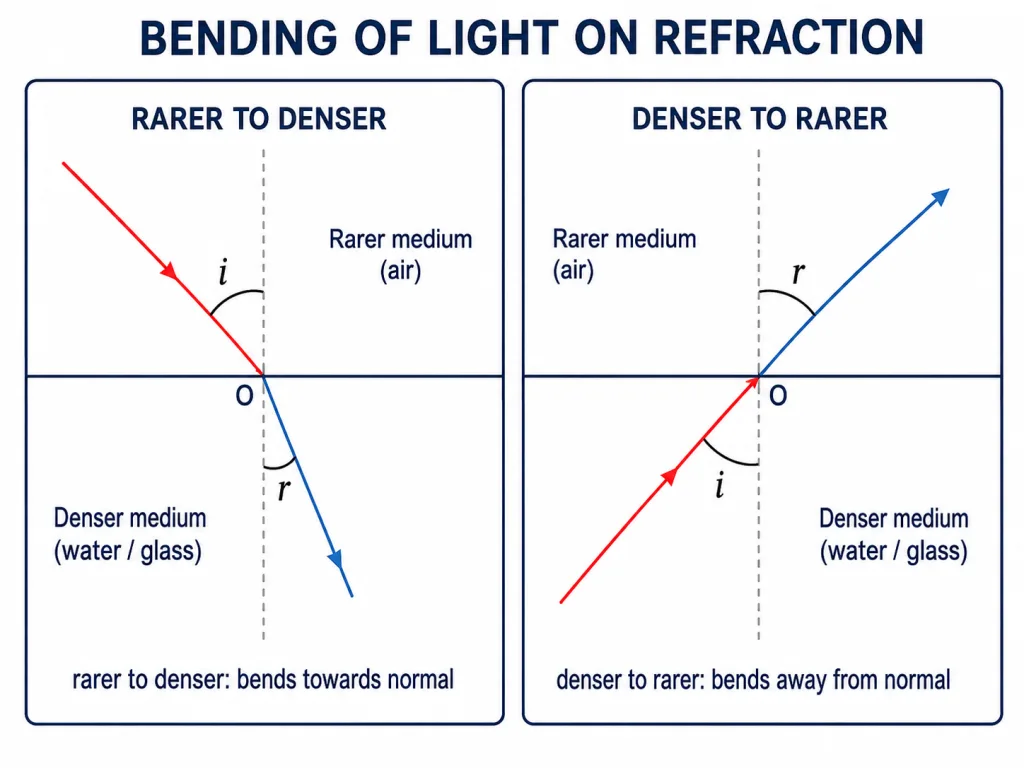
Which way light bends depends on the optical density of the media:
- Going from a rarer medium to a denser medium (e.g. air → glass), light slows down and bends towards the normal.
- Going from a denser medium to a rarer medium (e.g. glass → air), light speeds up and bends away from the normal.
(A ray hitting the surface along the normal, i.e. at 90° to the surface, passes straight through without bending.)
[Board Trap] "Rarer to denser → towards the normal; denser to rarer → away from the normal." Memorise this pair — it is asked constantly.
Refraction through a Rectangular Glass Slab
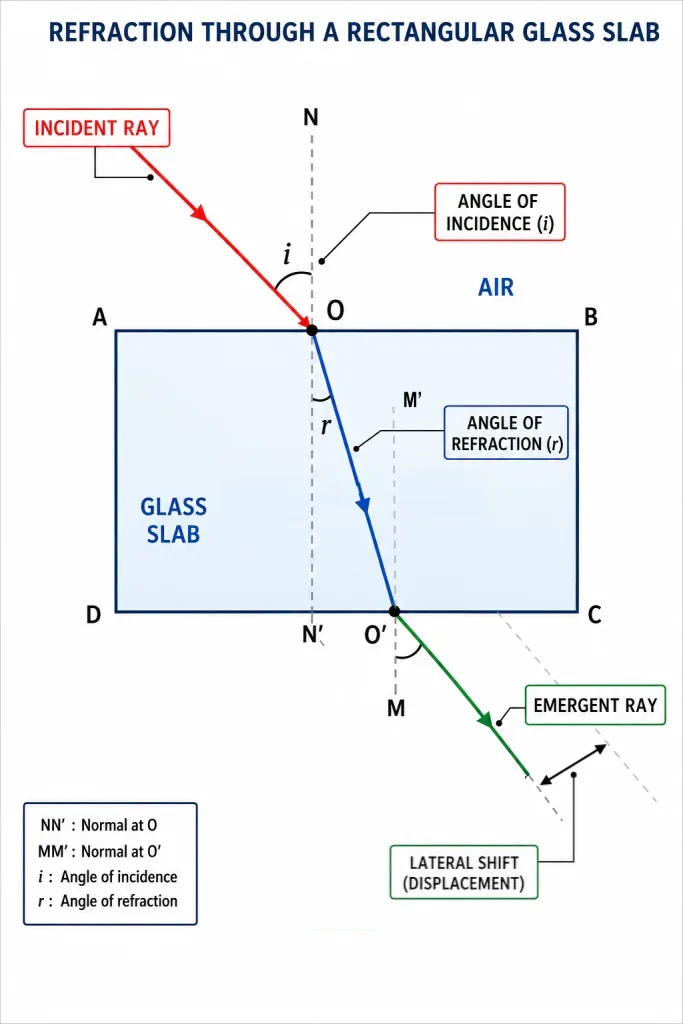
When a ray passes through a rectangular glass slab, refraction happens twice:
- At the air–glass face, it bends towards the normal (rarer → denser).
- At the glass–air face, it bends away from the normal (denser → rarer).
The bending at the two parallel faces is equal and opposite, so the emergent ray is parallel to the incident ray — but shifted sideways by a small lateral displacement.
The three rays are named: incident ray (hitting the slab), refracted ray (inside the glass) and emergent ray (leaving the slab).
The Laws of Refraction (Snell's Law)
Refraction follows two laws:
- The incident ray, the refracted ray and the normal at the point of incidence all lie in the same plane.
- The ratio of the sine of the angle of incidence to the sine of the angle of refraction is a constant for a given pair of media (and a given colour of light). This is Snell's law:
where is the angle of incidence and the angle of refraction. This constant is the refractive index of the second medium with respect to the first (next section).
[NEET Important] Snell's law holds for . When light enters normally (), there is no bending.
Memory Capsule — Section 4
Quick revision: refraction and its laws.
1. Refraction = bending of light due to change of speed on changing medium. 2. Rarer → denser: towards the normal (slows down). Denser → rarer: away from the normal (speeds up). 3. Along the normal (): no bending. 4. Glass slab: refracts twice; emergent ray parallel to incident ray, shifted sideways (lateral displacement). 5. Laws of refraction: (i) incident ray, refracted ray, normal in one plane; (ii) Snell's law (constant).
Solved Examples
Example 1: NCERT — Air to Water
A ray of light travelling in air enters obliquely into water. Does it bend towards or away from the normal? Why?
Solution: It bends towards the normal. Water is optically denser than air, so light slows down on entering water; a ray going from a rarer to a denser medium always bends towards the normal.
Takeaway: Air → water = rarer → denser = bends towards the normal.
Example 2: Emergent Ray through a Slab
Why does the emergent ray from a rectangular glass slab come out parallel to the incident ray?
Solution: The ray bends towards the normal at the air–glass face and away from the normal at the glass–air face. Because the two faces are parallel, these two bendings are equal and opposite, so the emergent ray is parallel to the incident ray — only shifted sideways (lateral displacement).
Takeaway: Equal and opposite bending at parallel faces ⇒ emergent ray parallel to incident ray.
Example 3: The Coin in the Bowl
A coin at the bottom of a bowl becomes visible again when water is poured in. Explain.
Solution: Light from the coin travels from water (denser) to air (rarer) and bends away from the normal. These bent rays reach the eye, making the coin appear slightly raised and bringing it back into view. This is due to refraction of light.
Takeaway: The coin appears raised because refraction bends the light away from the normal at the water surface.
Example 4: State the Laws of Refraction
State the two laws of refraction of light.
Solution:
- The incident ray, the refracted ray, and the normal to the interface at the point of incidence all lie in the same plane.
- Snell's law: the ratio is a constant for a given pair of media and a given colour of light; this constant is the refractive index of the second medium with respect to the first.
Takeaway: Learn both laws verbatim; the second is Snell's law.