
Rules for Drawing Ray Diagrams
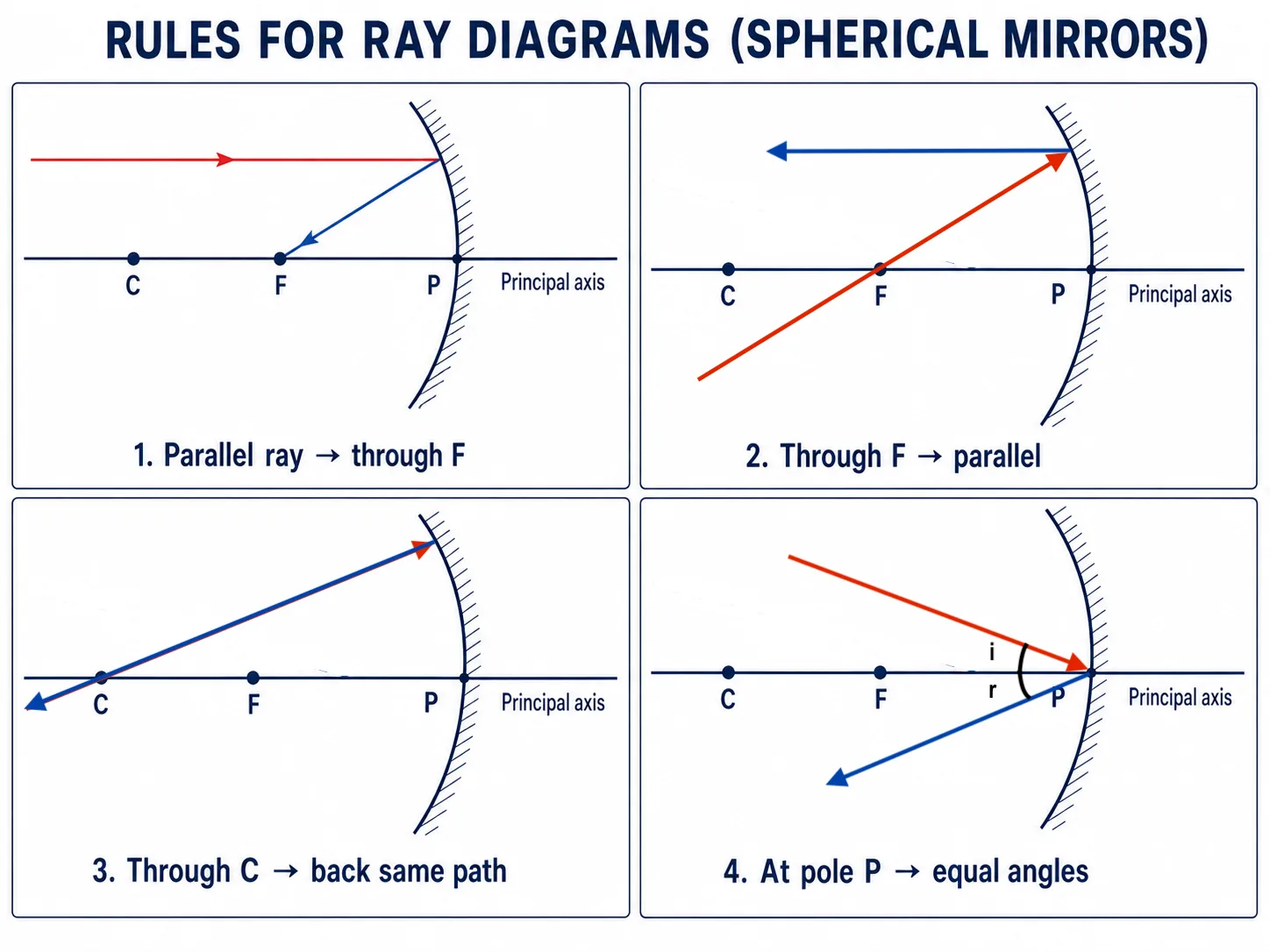
To locate an image, we trace any two of these standard rays; where they meet is the image. For a concave mirror:
- A ray parallel to the principal axis reflects through the focus F. (For a convex mirror it appears to come from F.)
- A ray through the focus F reflects parallel to the principal axis.
- A ray through the centre of curvature C reflects back along the same path (it hits the mirror normally).
- A ray striking the pole P reflects making equal angles with the principal axis.
Key Point: Any two of these rays fix the image position — you don't need all four.
Image Formation by a Concave Mirror
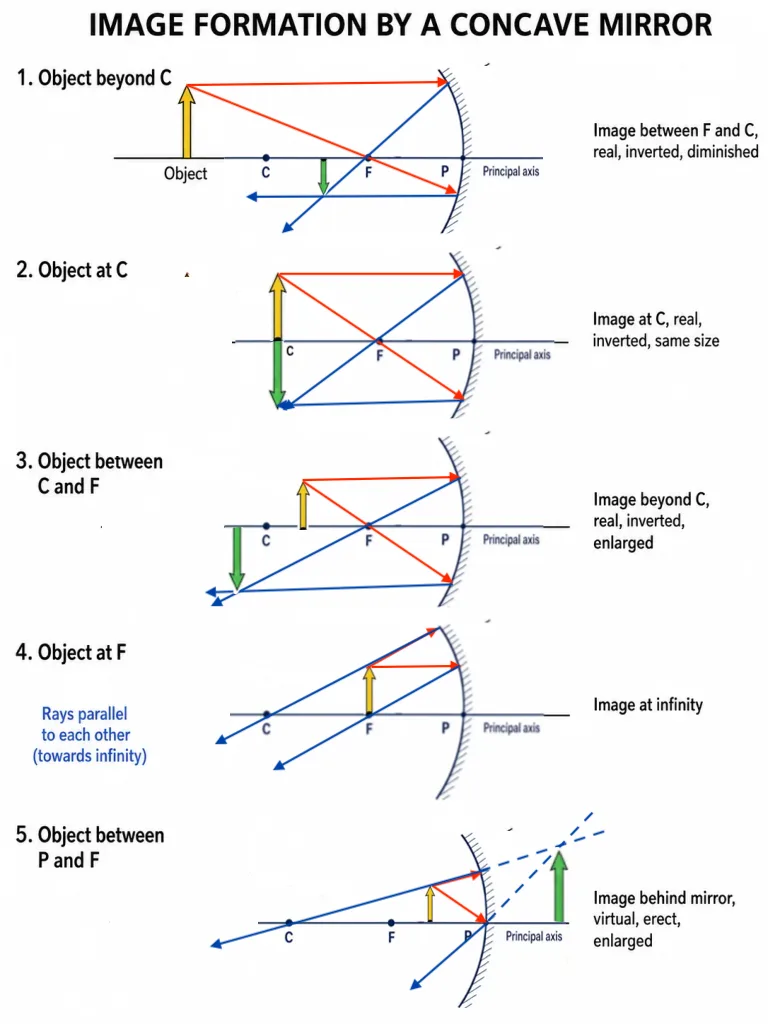
The image from a concave mirror depends on where the object is relative to P, F and C:
| Object position | Image position | Size | Nature |
|---|---|---|---|
| At infinity | At F | Highly diminished (point) | Real, inverted |
| Beyond C | Between F and C | Diminished | Real, inverted |
| At C | At C | Same size | Real, inverted |
| Between C and F | Beyond C | Enlarged | Real, inverted |
| At F | At infinity | Highly enlarged | Real, inverted |
| Between P and F | Behind the mirror | Enlarged | Virtual, erect |
[Board Trap] A concave mirror gives a virtual, erect, enlarged image only when the object is between P and F (this is the shaving-mirror / dentist-mirror position).
Image Formation by a Convex Mirror
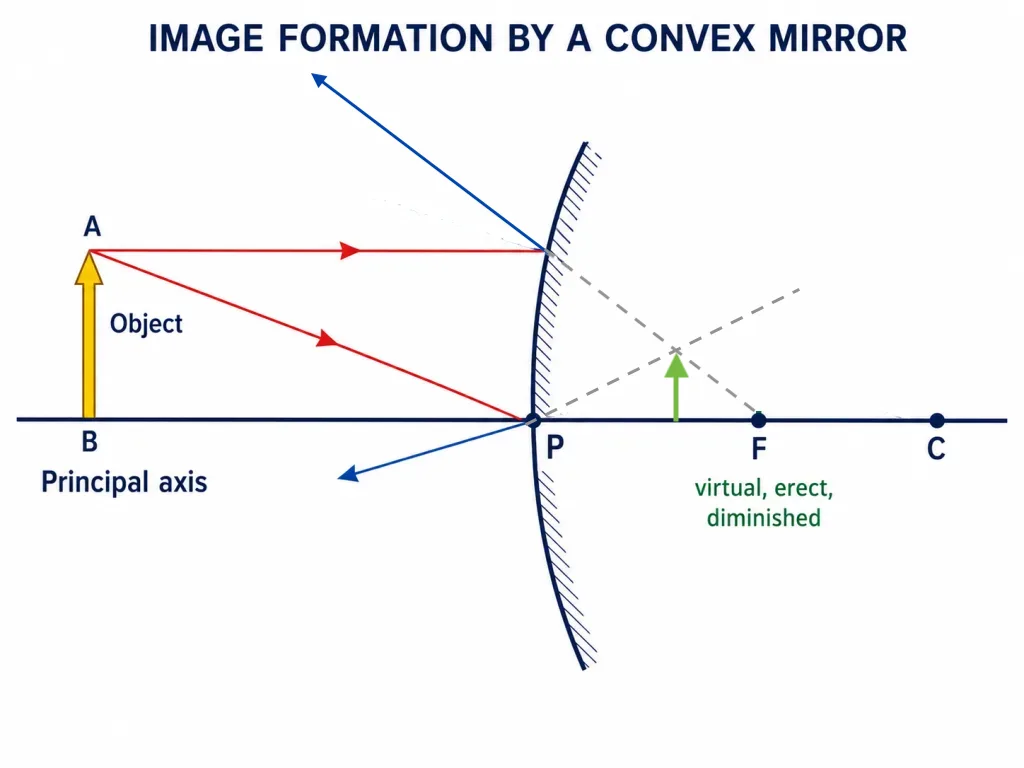
A convex mirror is simpler — it forms only one kind of image:
| Object position | Image position | Size | Nature |
|---|---|---|---|
| At infinity | At F (behind mirror) | Highly diminished (point) | Virtual, erect |
| Between infinity and P | Between P and F (behind) | Diminished | Virtual, erect |
So a convex mirror always gives a virtual, erect, diminished image, wherever the object is. This is why it gives a wide field of view.
Uses of Concave and Convex Mirrors
Concave mirrors
- Torches, search-lights, vehicle headlights — to get powerful parallel beams (source placed at focus).
- Shaving mirrors and dentists' mirrors — to see an enlarged, erect image (object between P and F).
- Solar furnaces — large concave mirrors concentrate sunlight to produce heat.
Convex mirrors
- Rear-view (wing) mirrors in vehicles — they always give an erect, diminished image and have a wider field of view, so the driver sees more traffic behind.
[Board Trap] Convex mirror as a rear-view mirror: give both reasons — (1) always erect image, (2) wider field of view.
Memory Capsule — Section 2
Quick revision: image formation by mirrors.
1. Ray rules: parallel→through F; through F→parallel; through C→back; at P→equal angles. Use any two. 2. Concave mirror image: real & inverted for object beyond F; virtual, erect, enlarged only for object between P and F. 3. At C → image same size at C; between C and F → enlarged; beyond C → diminished. 4. Convex mirror: always virtual, erect, diminished; wide field of view. 5. Uses: concave → headlights, shaving/dentist, solar furnace; convex → rear-view mirror.
Solved Examples
Example 1: NCERT — Erect and Enlarged Image
Name a mirror that can give an erect and enlarged image of an object.
Solution: A concave mirror gives an erect and enlarged (virtual) image when the object is placed between the pole (P) and the focus (F). This is why concave mirrors are used as shaving mirrors and by dentists.
Takeaway: Erect + enlarged image → concave mirror, object between P and F.
Example 2: NCERT — Convex Mirror as Rear-View Mirror
Why do we prefer a convex mirror as a rear-view mirror in vehicles?
Solution: Because a convex mirror:
- Always forms an erect (though diminished) image, so objects behind look upright.
- Has a wider field of view (it is curved outward), letting the driver see a much larger area of traffic behind than a plane mirror would.
Takeaway: Two reasons — always erect image + wider field of view.
Example 3: Object at the Centre of Curvature
An object is placed at the centre of curvature (C) of a concave mirror. Describe the image.
Solution: When the object is at C, the image is formed at C as well, is the same size as the object, and is real and inverted.
Takeaway: Object at C → image at C, same size, real, inverted (magnification = -1).
Example 4: NCERT Exercise — Erect Image, Any Distance
No matter how far you stand from a mirror, your image appears erect. The mirror is likely to be — (a) only plane (b) only concave (c) only convex (d) either plane or convex.
Solution: (d) either plane or convex. A plane mirror always gives an erect image, and a convex mirror always gives an erect (diminished) image for any object position. A concave mirror gives an erect image only for objects between P and F, so it is ruled out.
Takeaway: Always-erect image ⇒ plane or convex mirror.
Example 5: NCERT Exercise — Mirror for Each Use
Name the type of mirror used in: (a) headlights of a car, (b) side/rear-view mirror, (c) solar furnace. Give reasons.
Solution: (a) Concave mirror — a bulb at its focus gives a powerful parallel beam of light. (b) Convex mirror — gives an erect, diminished image with a wide field of view. (c) Concave mirror — a large concave mirror concentrates sunlight at its focus to produce intense heat.
Takeaway: Headlight & solar furnace → concave; rear-view → convex.