
Convex and Concave Lenses
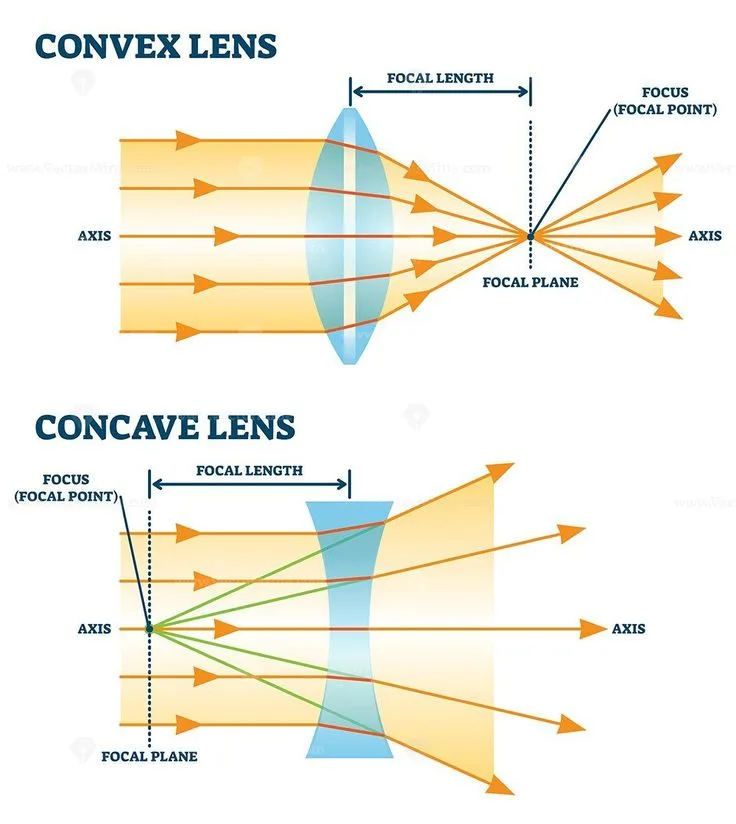
A lens is a transparent material bounded by two surfaces, at least one of which is spherical.
- A convex (double convex) lens bulges outwards, is thicker in the middle, and converges light rays. It is a converging lens.
- A concave (double concave) lens curves inwards, is thicker at the edges, and diverges light rays. It is a diverging lens.
Key terms
- Optical centre (O): the central point of the lens. A ray through O passes undeviated.
- Centres of curvature () and principal axis (line through them).
- Principal focus (F): a lens has two foci (), one on each side.
- Focal length (f): distance from the optical centre to the principal focus.
[Memory Tip] Convex = thick middle = converging; concave = thin middle = diverging.
Rules for Lens Ray Diagrams
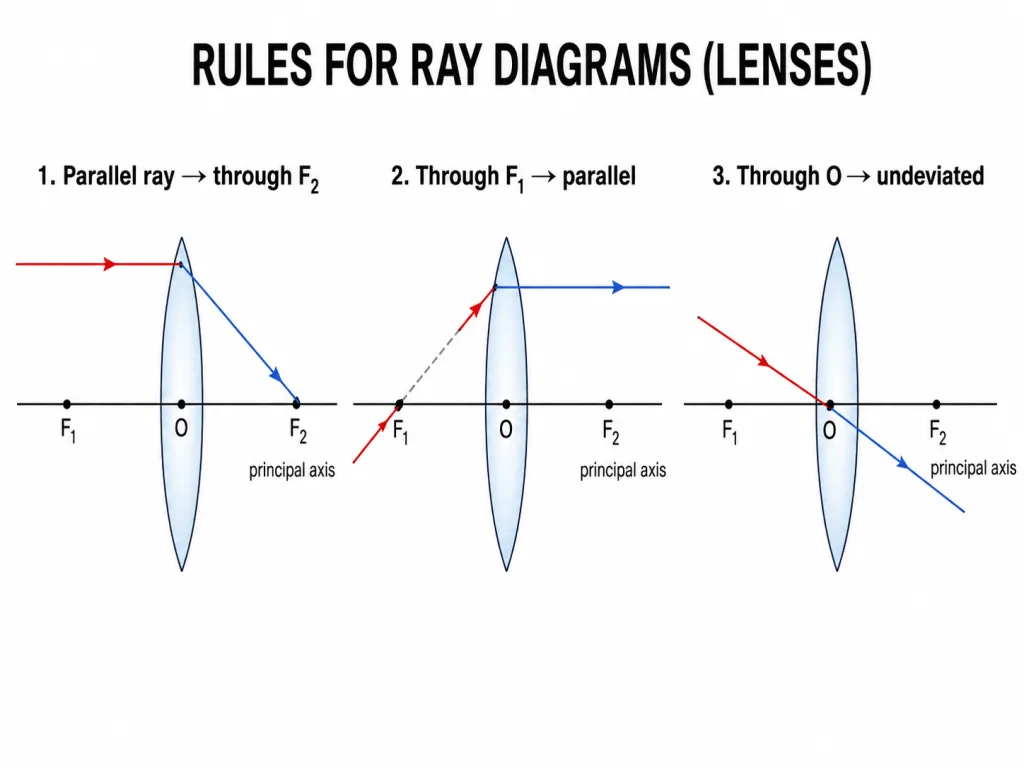
To locate an image formed by a lens, trace any two of these rays:
- A ray parallel to the principal axis refracts and passes through the principal focus on the other side (convex); for a concave lens it appears to come from the focus on the same side.
- A ray through the principal focus emerges parallel to the principal axis.
- A ray through the optical centre O goes straight through, without bending.
Key Point: The easiest ray to draw is the one through the optical centre — it never bends.
Image Formation by a Convex Lens
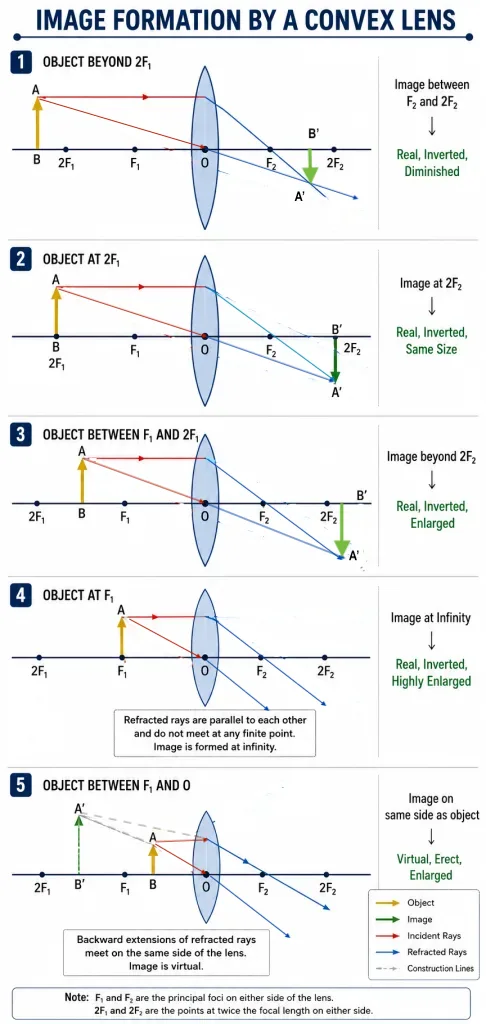
Like a concave mirror, a convex lens forms different images depending on the object's position (relative to F and 2F):
| Object position | Image position | Size | Nature |
|---|---|---|---|
| At infinity | At F₂ | Highly diminished (point) | Real, inverted |
| Beyond 2F₁ | Between F₂ and 2F₂ | Diminished | Real, inverted |
| At 2F₁ | At 2F₂ | Same size | Real, inverted |
| Between F₁ and 2F₁ | Beyond 2F₂ | Enlarged | Real, inverted |
| At F₁ | At infinity | Highly enlarged | Real, inverted |
| Between F₁ and O | Same side as object | Enlarged | Virtual, erect |
[Board Trap] A convex lens gives a virtual, erect, enlarged image only when the object is between F₁ and the optical centre O — this is the magnifying-glass position.
Image Formation by a Concave Lens
A concave lens is simple — like a convex mirror, it forms only one kind of image:
| Object position | Image position | Size | Nature |
|---|---|---|---|
| At infinity | At focus F₁ | Highly diminished (point) | Virtual, erect |
| Between infinity and O | Between F₁ and O | Diminished | Virtual, erect |
So a concave lens always forms a virtual, erect, diminished image, wherever the object is placed.
Key Point: Concave lens ↔ convex mirror: always virtual, erect, diminished.
Memory Capsule — Section 6
Quick revision: lenses and image formation.
1. Convex = thick middle = converging; Concave = thin middle = diverging. 2. Terms: optical centre O (ray through it is undeviated), F₁/F₂ (two foci), focal length f. 3. Ray rules: parallel → through F; through F → parallel; through O → straight. 4. Convex lens image: real & inverted for object beyond F₁; virtual, erect, enlarged only for object between F₁ and O (magnifying glass). 5. Concave lens: always virtual, erect, diminished.
Solved Examples
Example 1: NCERT Exercise — Reading Small Letters
Which lens would you prefer to read small letters in a dictionary? (a) convex f = 50 cm (b) concave f = 50 cm (c) convex f = 5 cm (d) concave f = 5 cm.
Solution: (c) A convex lens of focal length 5 cm. A convex lens acts as a magnifying glass (object between F and O gives an enlarged, erect, virtual image). A shorter focal length gives greater magnification, so f = 5 cm is preferred over f = 50 cm. Concave lenses always diminish, so they are ruled out.
Takeaway: Magnifier = convex lens, and shorter f = more magnification.
Example 2: NCERT Exercise — Real, Same-Size Image
Where should an object be placed before a convex lens to get a real image of the same size as the object? (a) at F (b) at 2F (c) at infinity (d) between O and F.
Solution: (b) At twice the focal length (2F₁). When the object is at 2F₁, the image forms at 2F₂, is the same size as the object, and is real and inverted.
Takeaway: Object at 2F → image at 2F, same size, real, inverted.
Example 3: NCERT Exercise — Half-Covered Lens
One half of a convex lens is covered with black paper. Will it still form a complete image of the object? Explain.
Solution: Yes, it will still form a complete image. Every part of a lens refracts light from the whole object, so even the uncovered half can form a full image. However, the image will be less bright (dimmer) because fewer rays reach it (half the aperture is blocked).
Takeaway: Covering half a lens gives a full but dimmer image, not half an image.
Example 4: NCERT Exercise — Material for a Lens
Which one cannot be used to make a lens? (a) water (b) glass (c) plastic (d) clay.
Solution: (d) Clay. A lens must be made of a transparent material so that light can pass through and refract. Water, glass and plastic are transparent, but clay is opaque, so it cannot be used.
Takeaway: A lens needs a transparent medium; opaque clay is ruled out.
Example 5: Nature of Concave-Lens Image
What kind of image does a concave lens always form?
Solution: A concave lens always forms a virtual, erect and diminished image, on the same side as the object, whatever the object's position. As the object moves far away, the image shrinks towards the focus F₁.
Takeaway: Concave lens = always virtual, erect, diminished (like a convex mirror).