
What is the Power of a Lens?
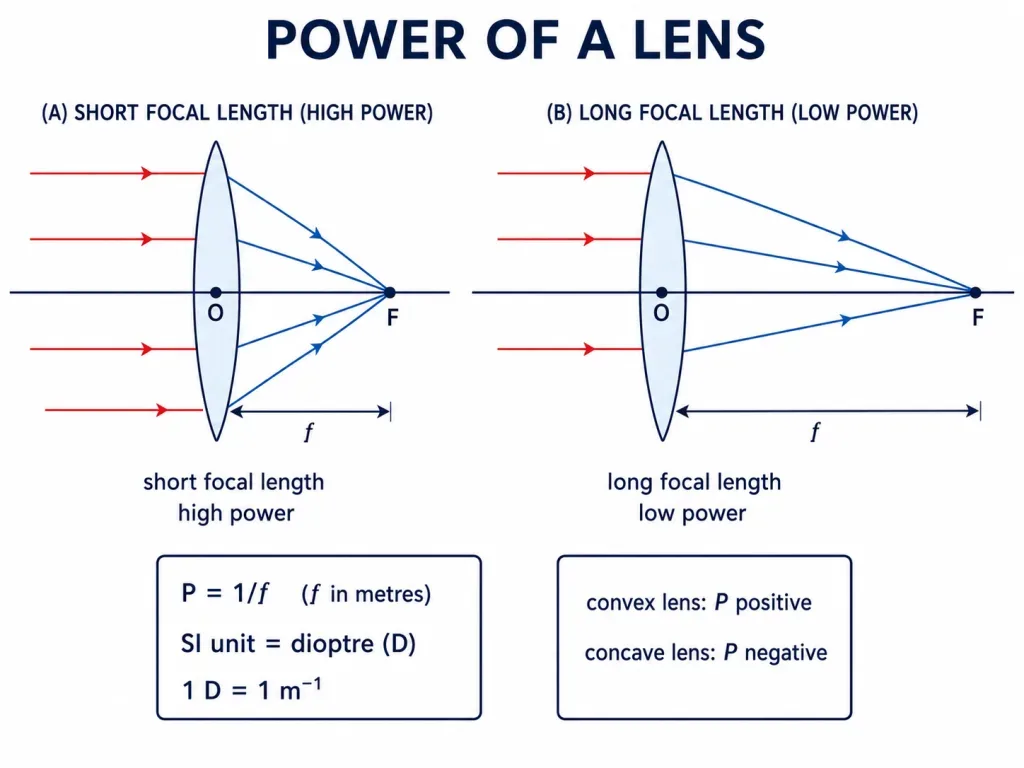
The power of a lens measures how strongly it converges or diverges light. A lens of short focal length bends rays more sharply (high power); a lens of long focal length bends them gently (low power).
Power is the reciprocal of the focal length:
where is in metres.
- Convex lens → positive power (converging).
- Concave lens → negative power (diverging).
Key Point: Shorter focal length ⇒ greater power. Power and focal length are inversely related.
The Dioptre
The SI unit of power is the dioptre (D). When is in metres, comes out in dioptres:
1 dioptre is the power of a lens whose focal length is 1 metre.
Worked examples of conversion:
- A lens of power D is convex, with m ( cm).
- A lens of power D is concave, with m ( cm).
[Board Trap] Always convert to metres before finding power. cm m gives D.
Combination of Lenses (in Contact)
Optical instruments (cameras, microscopes, telescopes) use several lenses together. When thin lenses are placed in contact, their net power is the algebraic sum of the individual powers:
For example, a D lens combined with a D lens acts like a single D lens. Opticians use this simple addition to work out the exact corrective lens a patient needs.
Key Point: Powers of lenses in contact add up (with their signs) — much easier than combining focal lengths.
Memory Capsule — Section 8
Quick revision: power of a lens.
1. Power (with in metres). 2. SI unit = dioptre (D); ; 1 D = power of a lens of m. *3. Convex lens: P positive; concave lens: P negative. *4. Shorter focal length ⇒ greater power.* 5. Lenses in contact: (add with signs).
Solved Examples
Example 1: NCERT — Define 1 Dioptre
Define 1 dioptre of power of a lens.
Solution: One dioptre is the power of a lens whose focal length is 1 metre. In symbols, , since with in metres.
Takeaway: Learn this one-line definition exactly.
Example 2: NCERT — Power of a Concave Lens
Find the power of a concave lens of focal length 2 m.
Solution: For a concave lens, m. So:
The power is D (negative, as expected for a concave lens).
Takeaway: Concave lens ⇒ negative power. Keep f in metres.
Example 3: NCERT Exercise — Focal Length from Power
Find the focal length of a lens of power D. What type of lens is it?
Solution:
The negative focal length means it is a concave (diverging) lens.
Takeaway: Negative power/focal length ⇒ concave lens.
Example 4: NCERT Exercise — Corrective Lens
A doctor prescribes a corrective lens of power D. Find its focal length. Is it converging or diverging?
Solution:
The positive power/focal length means the lens is convex (converging).
Takeaway: Positive power ⇒ convex, converging lens.
Example 5: Combination of Two Lenses
Two thin lenses of power D and D are placed in contact. Find the power and focal length of the combination.
Solution: Net power: .
Focal length: .
The combination behaves like a single convex lens of power D.
Takeaway: Add powers (with signs) for lenses in contact, then invert to get focal length.