
The New Cartesian Sign Convention
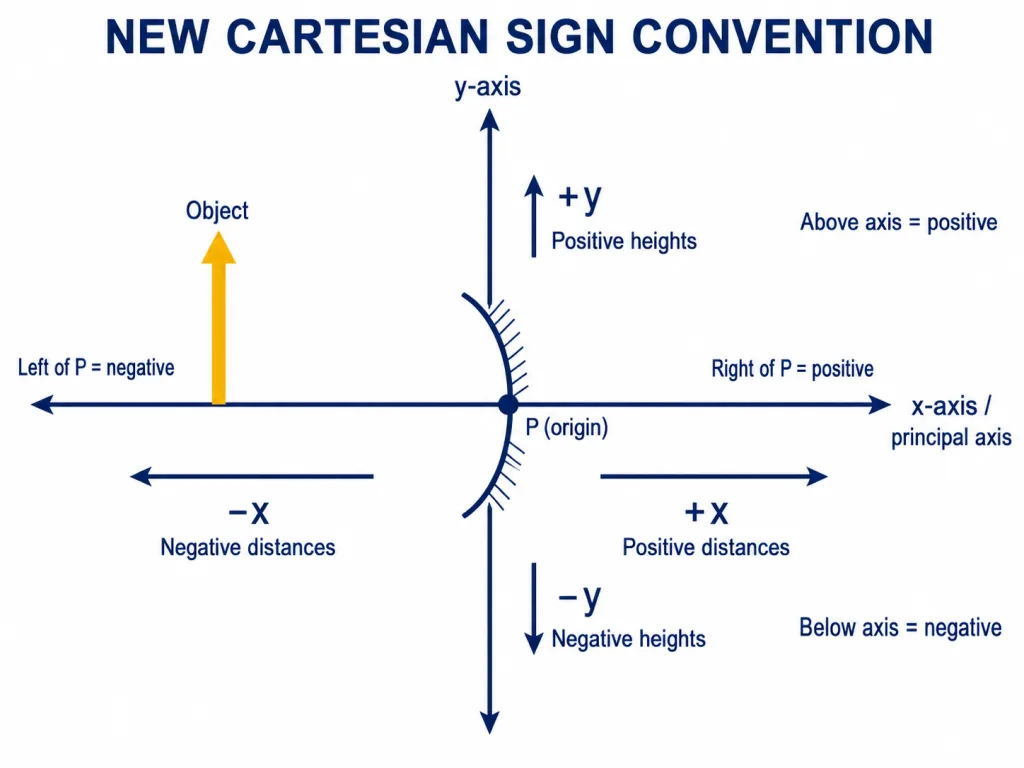
Before using any formula, we fix signs with the New Cartesian Sign Convention:
- The object is always placed to the left of the mirror (light travels left to right).
- All distances are measured from the pole (P), taken as the origin.
- Distances measured in the direction of the incident light (to the left, along ) are negative; those against it (to the right, behind the mirror) are positive.
- Heights above the principal axis () are positive; heights below () are negative.
Consequences to remember:
- Object distance is always negative (object is on the left).
- Concave mirror is negative; convex mirror is positive.
- A real image has negative (same side as object); a virtual image has positive (behind mirror).
The Mirror Formula
The object distance (), image distance () and focal length () of a spherical mirror are related by the mirror formula:
This one formula works for all spherical mirrors (concave and convex) and all object positions — provided you substitute values with the correct signs.
Also recall , so you can always convert between radius of curvature and focal length.
[NEET Important] The mirror formula and the lens formula look almost identical — the mirror formula has a plus (), the lens formula has a minus (). Don't mix them up.
Magnification
Magnification (m) tells how large the image is compared to the object. It is the ratio of image height () to object height (), and is also related to and :
How to read the sign and size of :
- negative → image is real and inverted.
- positive → image is virtual and erect.
- → enlarged; → diminished; → same size.
Key Point: For mirrors, . The minus sign is part of the formula — never drop it.
Memory Capsule — Section 3
Quick revision: sign convention, mirror formula, magnification.
1. Sign rules: object on left; measure from P; right = +, left = -; up = +, down = -. 2. always negative; concave negative, convex positive. 3. Mirror formula: (note the plus). *4. . *5. Magnification: . real/inverted; virtual/erect; enlarged.*
Solved Examples
Example 1: NCERT — Convex Rear-View Mirror (Example 9.1)
A convex mirror used as a rear-view mirror has radius of curvature 3.00 m. A bus is 5.00 m from the mirror. Find the position, nature and size of the image.
Solution: Given: m (convex), m. Focal length m.
Mirror formula:
Magnification: .
The image is 1.15 m behind the mirror, virtual, erect and diminished (about 0.23 times).
Takeaway: Positive v and positive m confirm a virtual, erect image — exactly what a convex mirror gives.
Example 2: NCERT — Concave Mirror, Real Image (Example 9.2)
An object 4.0 cm tall is placed 25.0 cm in front of a concave mirror of focal length 15.0 cm. Find the image distance, and the nature and size of the image.
Solution: Given: cm, cm, cm (concave).
So the screen is placed 37.5 cm in front of the mirror and the image is real.
Height: cm.
The image is real, inverted and enlarged, 6.0 cm tall.
Takeaway: Negative v (real image) and negative h' (inverted) — always finish by stating nature and size.
Example 3: NCERT — Focal Length of a Convex Mirror
Find the focal length of a convex mirror whose radius of curvature is 32 cm.
Solution:
(For a convex mirror the focal length is taken as +16 cm by sign convention.)
Takeaway: f = R/2 gives 16 cm; the sign is positive for a convex mirror.
Example 4: NCERT — Locate a 3x Magnified Real Image
A concave mirror produces a three-times magnified (enlarged) real image of an object placed at 10 cm in front of it. Where is the image located?
Solution: For a real image, magnification is negative: . Also , with cm.
The image is located 30 cm in front of the mirror (real image, same side as the object).
Takeaway: Real image → m is negative. Here v = -30 cm confirms a real image.
Example 5: NCERT Exercise — Convex Mirror Numerical
An object is placed 10 cm from a convex mirror of focal length 15 cm. Find the position and nature of the image.
Solution: Given: cm, cm (convex).
The image is 6 cm behind the mirror. Since is positive, the image is virtual and erect (and diminished).
Takeaway: A convex mirror always gives a positive v → virtual, erect, diminished image.
Example 6: NCERT Exercise — Concave Mirror, Screen Distance
An object 7.0 cm tall is placed 27 cm in front of a concave mirror of focal length 18 cm. At what distance should a screen be placed to get a sharp image? Find the size and nature of the image.
Solution: Given: cm, cm, cm.
The screen must be placed 54 cm in front of the mirror; the image is real.
Height: cm.
The image is real, inverted and enlarged, 14.0 cm tall.
Takeaway: Show every step with signs — the negative v and h' give a real, inverted, enlarged image.