
Light and Reflection
We see objects because they reflect light into our eyes. Light travels in straight lines (a straight-line path of light is called a ray). A highly polished surface such as a mirror reflects most of the light falling on it.
You already know the two laws of reflection:
- The angle of incidence is equal to the angle of reflection ().
- The incident ray, the normal (at the point of incidence) and the reflected ray all lie in the same plane.
These laws hold for all reflecting surfaces — flat and curved (spherical).
Image in a Plane Mirror
The image formed by a plane mirror has four fixed properties:
- It is virtual and erect.
- It is the same size as the object.
- It is as far behind the mirror as the object is in front of it.
- It is laterally inverted (left–right reversed).
Curved mirrors, however, form very different images — let's explore spherical mirrors.
Key Point: Plane-mirror image = virtual, erect, same size, laterally inverted.
Spherical Mirrors — Concave and Convex
A spherical mirror has a reflecting surface that is part of a sphere. There are two types:
- Concave mirror: reflecting surface curved inwards (towards the centre of the sphere). It is a converging mirror.
- Convex mirror: reflecting surface curved outwards. It is a diverging mirror.
(The back of a spherical mirror is shaded because it does not reflect.)
[Memory Tip] Concave = caves in (inward); convex bulges out.
Important Terms for a Spherical Mirror
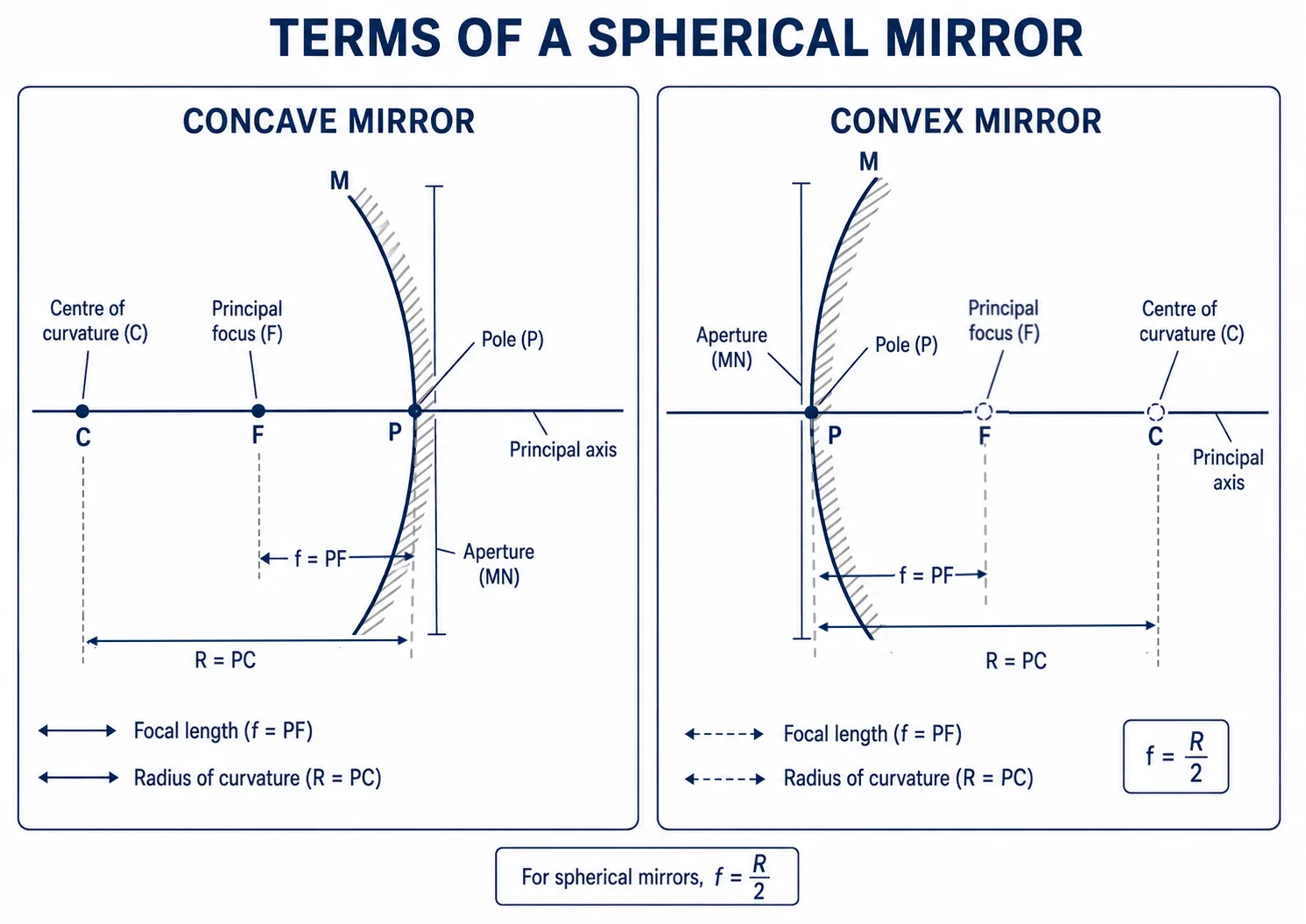
Learn these terms — every numerical and diagram uses them:
- Pole (P): the centre of the mirror's reflecting surface. It lies on the mirror.
- Centre of curvature (C): the centre of the sphere of which the mirror is a part. It is not on the mirror. (In front of a concave mirror; behind a convex mirror.)
- Radius of curvature (R): the radius of that sphere; .
- Principal axis: the straight line through the pole P and centre of curvature C. It is normal to the mirror at the pole.
- Principal focus (F): where rays parallel to the principal axis meet (concave) or appear to come from (convex) after reflection.
- Focal length (f): the distance PF (pole to focus).
- Aperture: the diameter of the reflecting surface.
Principal Focus and the R = 2f Relation
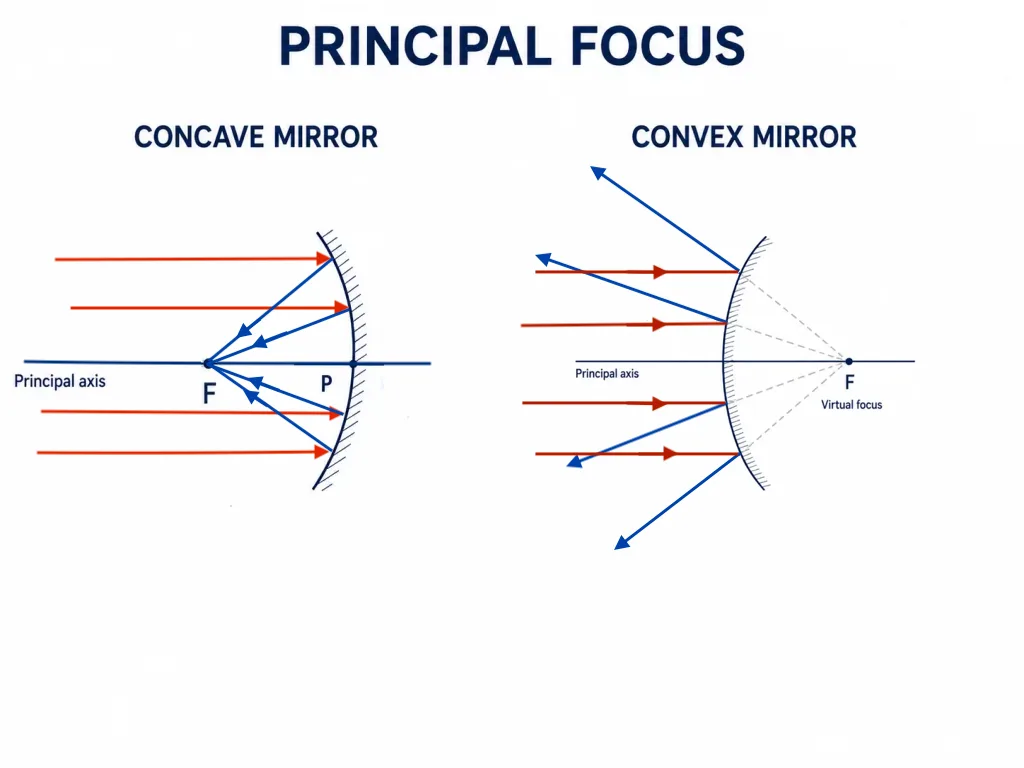
When rays parallel to the principal axis strike a mirror:
- A concave mirror converges them to a real focus F in front of the mirror.
- A convex mirror makes them diverge; they appear to come from a virtual focus F behind the mirror.
For mirrors of small aperture, the radius of curvature is twice the focal length:
So the focus lies midway between the pole P and the centre of curvature C.
[Board Trap] If cm, then cm. This one-line conversion is a guaranteed 1-mark question.
Memory Capsule — Section 1
Quick revision: reflection and spherical mirror terms.
1. Laws of reflection: ; incident ray, normal, reflected ray in one plane. 2. Plane-mirror image: virtual, erect, same size, laterally inverted. 3. Concave = curved inward (converging); Convex = curved outward (diverging). 4. Terms: P (pole), C (centre of curvature), R (radius), F (focus), f (focal length), principal axis, aperture. 5. → focus midway between P and C. Concave focus is real (front); convex focus is virtual (behind).
Solved Examples
Example 1: NCERT — Radius to Focal Length
The radius of curvature of a spherical mirror is 20 cm. What is its focal length?
Solution: Using :
The focal length is 10 cm.
Takeaway: Always halve R to get f (and double f to get R).
Example 2: NCERT — Define Principal Focus
Define the principal focus of a concave mirror.
Solution: The principal focus of a concave mirror is the point on the principal axis where rays of light parallel to the principal axis meet (converge) after reflection from the mirror.
Takeaway: For a concave mirror the focus is real; for a convex mirror the parallel rays only appear to come from the focus (virtual).
Example 3: Concave vs Convex
Which spherical mirror converges light and which diverges it? Where is the focus in each?
Solution:
- A concave mirror converges parallel rays to a real focus in front of the mirror.
- A convex mirror diverges parallel rays; they appear to come from a virtual focus behind the mirror.
Takeaway: Concave → converging → real focus; Convex → diverging → virtual focus.