
The Mains Supply: Live, Neutral and Earth
Homes receive electric power through a main supply (mains) of AC at 220 V, 50 Hz, via overhead poles or underground cables. There are three wires:
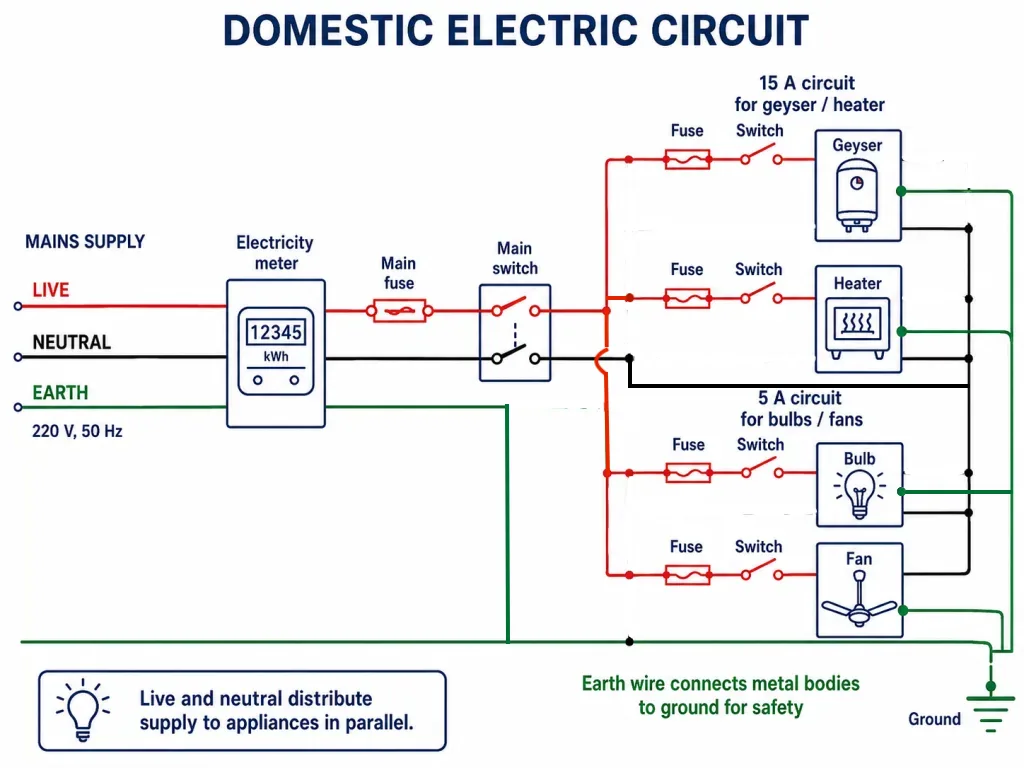
- Live wire - usually red insulation (at high potential).
- Neutral wire - usually black insulation (at low/earth potential).
- Earth wire - usually green insulation, connected to a metal plate buried deep in the ground.
The potential difference between the live and neutral wires is 220 V.
The House Wiring
At the meter-board, the live and neutral wires enter through an electricity meter and a main fuse, then a main switch, and go to the house circuits.
Usually there are two separate circuits:
- a 15 A circuit for high-power appliances (geysers, air coolers, heaters), and
- a 5 A circuit for lower-power ones (bulbs, fans).
All appliances are connected in parallel across the live and neutral wires, so each gets the full 220 V and has its own switch. The switch and the fuse for each appliance are placed on the live wire.
The earth wire is connected to the metal body of appliances (electric iron, toaster, refrigerator). It provides a low-resistance path to the ground, so if the live wire touches the metal body, the current flows to earth instead of through the user - preventing a severe electric shock. This is called earthing.
Fuse, Short-Circuiting and Overloading
The electric fuse is the most important safety device in a domestic circuit. It is connected in series on the live wire and melts (by Joule heating) if the current becomes too high, breaking the circuit and protecting the appliances.
Dangerously high current can arise from:
- Short-circuiting: when the live and neutral wires touch directly (e.g. damaged insulation or a fault), the resistance drops sharply and the current increases abruptly.
- Overloading: drawing too much current - by connecting too many appliances to one socket, or from an accidental rise in supply voltage.
To avoid overloading, do not connect too many high-power appliances to one socket, and use a fuse of a proper rating.
Key Point: Earthing protects the user; the fuse protects the circuit and appliances.
[Exam Tip] Wire colours: Live = red, Neutral = black, Earth = green. Fuse and switch go on the live wire. Earthing = safety for metal-bodied appliances.
Solved Examples
Example 1: Two safety measures
Name two safety measures commonly used in electric circuits and appliances.
Solution: (i) The electric fuse (connected in series on the live wire) protects the circuit from over-current. (ii) Earthing - connecting the metal body of appliances to the earth wire - protects the user from electric shock.
Example 2: Oven on an under-rated circuit (NCERT)
A 2 kW oven is used in a 220 V circuit rated for 5 A. What do you expect?
Solution: Current drawn A. This is far more than the 5 A rating of the circuit, so the fuse will melt (blow) and break the circuit. The oven cannot be safely used on this 5 A circuit.
Example 3: Function of the earth wire
What is the function of the earth wire, and why must metal-bodied appliances be earthed?
Solution: The earth wire provides a low-resistance path from the metal body of an appliance to the ground. If the live wire accidentally touches the metal body, the current flows safely to earth instead of through the user, keeping the body at earth potential and preventing a severe electric shock.
Example 4: When does a short circuit occur?
When does an electric short circuit occur?
Solution: A short circuit occurs when the live wire and the neutral wire come into direct contact (for example due to damaged insulation or a fault in an appliance). The resistance falls sharply and the current increases enormously, which can cause the fuse to blow or start a fire.