
Oersted's Discovery
In 1820, Hans Christian Oersted noticed that a compass needle placed near a current-carrying wire got deflected. When the current stopped, the needle returned. This showed for the first time that an electric current produces a magnetic effect - that electricity and magnetism are linked.
If you reverse the direction of the current, the compass needle deflects in the opposite direction, showing that the direction of the magnetic field also reverses with the current.
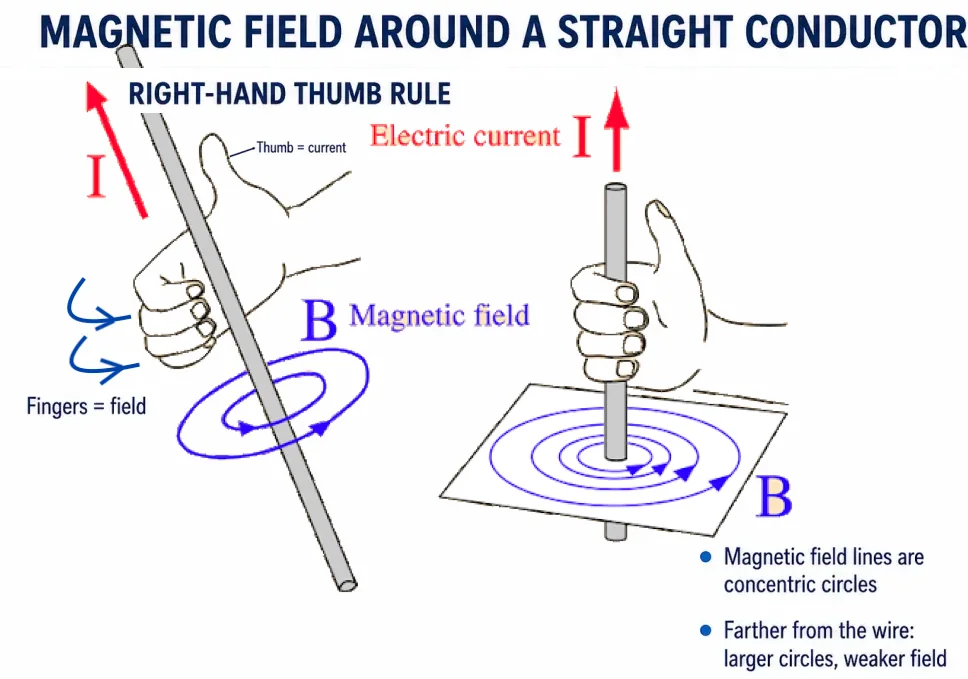
Field around a Straight Conductor
If a straight current-carrying wire is passed vertically through a card sprinkled with iron filings, the filings arrange themselves in concentric circles around the wire. These circles are the magnetic field lines of the field produced by the current.
Two important observations:
- The magnetic field increases as the current increases (the compass deflects more).
- The magnetic field decreases as the distance from the wire increases (the concentric circles get larger and the field weaker farther out).
So the field is directly proportional to the current and weaker farther from the wire.
Right-Hand Thumb Rule
To find the direction of the magnetic field around a straight current-carrying conductor, use the right-hand thumb rule:
Imagine holding the conductor in your right hand with the thumb pointing in the direction of the current. Your curled fingers then point in the direction of the magnetic field lines around the conductor.
(This is also called Maxwell's corkscrew rule: if a corkscrew is turned so it advances in the direction of the current, the direction of rotation gives the field direction.)
[Exam Tip] Right-hand thumb rule → thumb = current, curled fingers = magnetic field. Reverse the current and the field circles reverse too.
Solved Examples
Example 1: Field of a power line (NCERT 12.1)
A current through a horizontal power line flows from east to west. What is the direction of the magnetic field directly below it and directly above it?
Solution: Apply the right-hand thumb rule with the thumb pointing west (direction of current). The field lines are circles around the wire. Viewed from the east end, the field turns clockwise; below the wire the field points towards the north, and above the wire it points towards the south (the circles run in opposite directions above and below the wire).
Example 2: Effect of increasing current
How does the magnetic field at a fixed point near a straight wire change if the current is increased?
Solution: The magnetic field is directly proportional to the current, so increasing the current increases the magnetic field at that point (the compass deflects more).
Example 3: Effect of distance
What happens to the field as you move away from a current-carrying straight wire?
Solution: The field decreases with distance. The concentric field-line circles become larger and more widely spaced farther from the wire, so the field is weaker there.