
Electromagnetic Induction
We saw that a current produces a magnetic field. Michael Faraday discovered the reverse effect: a changing magnetic field can produce (induce) a current in a conductor. This is called electromagnetic induction.
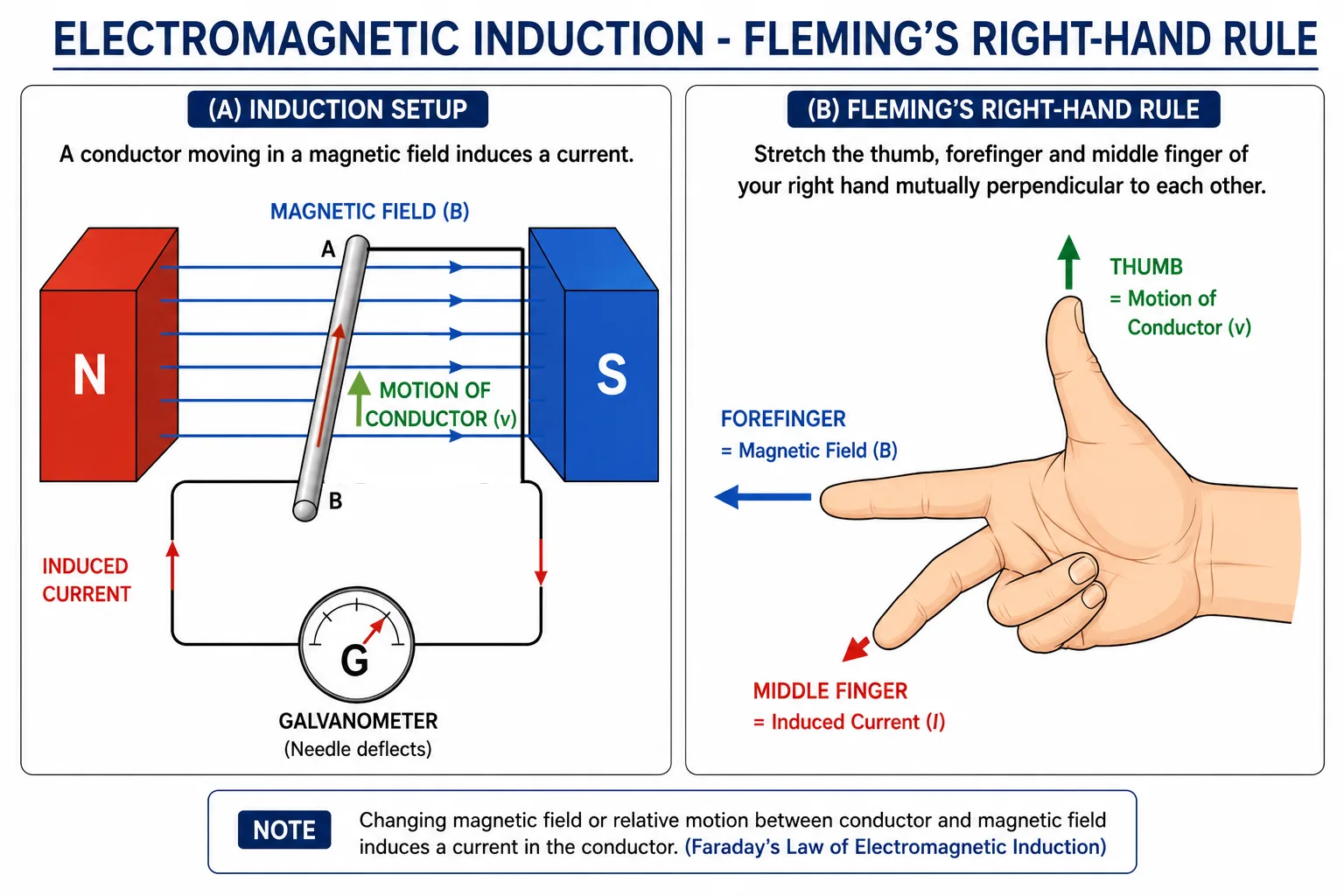
If a straight conductor is moved in a magnetic field (so that it cuts across the field lines), a current is induced in it, shown by a deflection in a galvanometer. A current can also be induced in a coil by moving a magnet towards or away from it, or by changing the current in a nearby coil - in every case what matters is a change in the magnetic field through the coil.
Fleming's Right-Hand Rule
The direction of the induced current is given by Fleming's right-hand rule:
Stretch the thumb, forefinger and middle finger of your right hand mutually perpendicular. If the forefinger points along the magnetic field and the thumb points along the direction of motion of the conductor, then the middle finger points along the direction of the induced current.
Compare the two hands:
- Left hand → force on a current (motor): field, current → force.
- Right hand → induced current (generator): field, motion → induced current.
Key Point: Induced current appears only while the magnetic field through the coil is changing.
[Exam Tip] Motor = left hand; Generator/induction = right hand. In both, the forefinger is the field.
Solved Examples
Example 1: What is electromagnetic induction?
Define electromagnetic induction.
Solution: Electromagnetic induction is the production of an induced current (or voltage) in a conductor whenever the magnetic field through it changes - for example, by moving a conductor in a field or moving a magnet relative to a coil.
Example 2: Ways to induce a current in a coil
List ways to induce a current in a coil.
Solution: (i) Move a magnet towards or away from the coil. (ii) Move the coil relative to a magnet. (iii) Change the current in a neighbouring coil (which changes the field through this coil). Each way changes the magnetic field through the coil and induces a current.
Example 3: Rule for the induced current
Which rule gives the direction of the induced current, and what do the fingers represent?
Solution: Fleming's right-hand rule: with the right hand's thumb, forefinger and middle finger mutually perpendicular - forefinger = magnetic field, thumb = motion of the conductor, middle finger = induced current.
Example 4: Deflection reversal
A magnet is pushed into a coil, then pulled out. What happens to the galvanometer?
Solution: While pushing the magnet in, the galvanometer deflects one way (a current is induced). While pulling it out, the field change is reversed, so the current - and the galvanometer deflection - is in the opposite direction. When the magnet is stationary, there is no induced current.