
Magnetic Field due to a Circular Loop
When a straight wire is bent into a circular loop and a current is passed through it, the field lines are circles around every part of the wire. As we approach the centre of the loop, these arcs appear almost as straight lines, all pointing in the same direction (perpendicular to the plane of the loop).
Every part of the loop adds its field in the same direction at the centre, so the field there is strong. If the coil has n turns, the field at the centre is n times that of a single turn - because each turn carries current in the same direction and their fields add up.
Use the right-hand thumb rule on any part of the loop to find the field direction.
Magnetic Field due to a Solenoid
A solenoid is a coil of many circular turns of insulated copper wire wound closely in the shape of a cylinder.
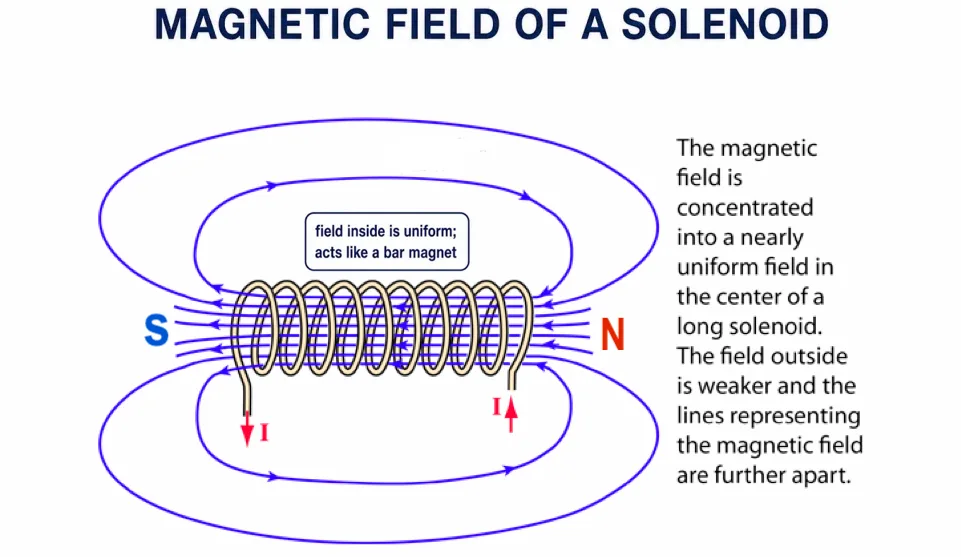
The magnetic field of a current-carrying solenoid looks just like that of a bar magnet:
- One end behaves as a north pole and the other as a south pole.
- The field lines inside the solenoid are parallel straight lines - the field is uniform (same magnitude and direction) inside.
- Outside, the field spreads out like a bar magnet's.
Key Point: The field inside a long current-carrying solenoid is uniform.
Electromagnets
The strong, uniform field inside a solenoid can be used to magnetise a piece of magnetic material (like soft iron) placed inside the coil. The magnet so formed is called an electromagnet.
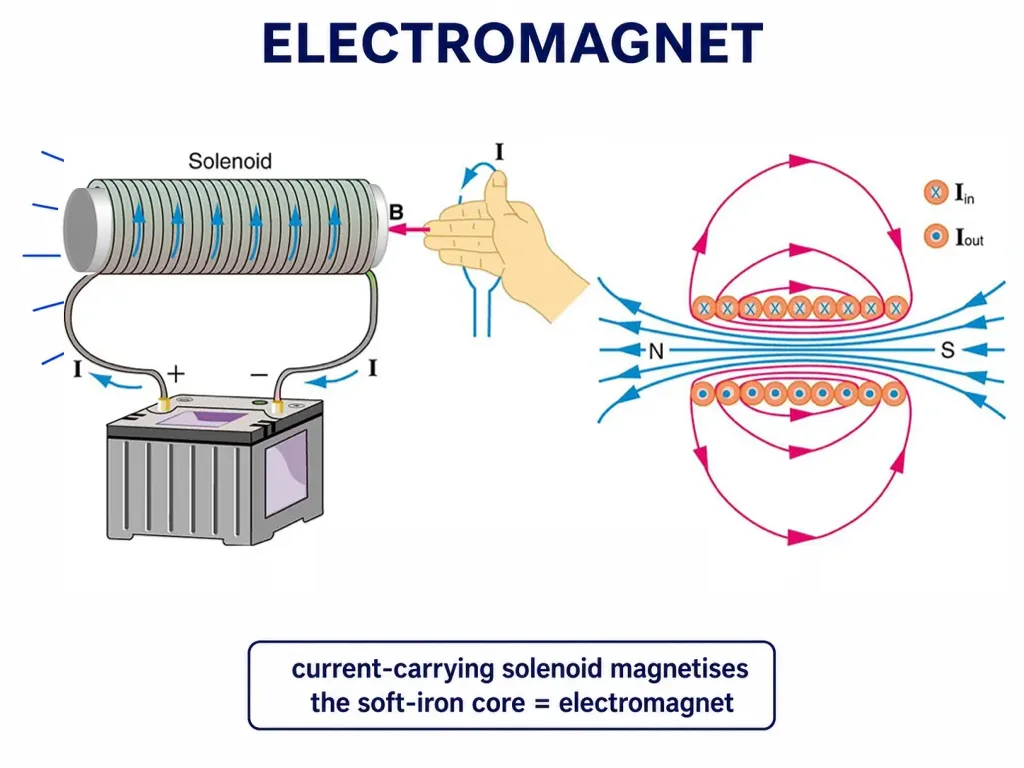
An electromagnet has a core of soft iron wrapped with a coil of insulated copper wire. When current flows, the core becomes strongly magnetised; when the current stops, it loses almost all its magnetism. This makes electromagnets very useful - they can be switched on and off, and their strength can be controlled by the current and the number of turns.
[Exam Tip] Solenoid field = bar-magnet-like, uniform inside. Soft iron is used for electromagnet cores because it magnetises and demagnetises easily.
Solved Examples
Example 1: Field inside a solenoid
What can you say about the magnetic field inside a long current-carrying solenoid?
Solution: The field inside a long current-carrying solenoid is uniform - the field lines are parallel straight lines of equal spacing, so the magnetic field has the same magnitude and direction at all points inside.
Example 2: Direction of field in a loop
A circular loop lies flat on a table and the current flows clockwise (seen from above). Which way does the field point at the centre?
Solution: By the right-hand thumb rule applied to the loop, for a clockwise current (viewed from above) the magnetic field at the centre points downward (into the table). (For anticlockwise current it would point upward.)
Example 3: Increasing the field of a coil
Give two ways to increase the magnetic field at the centre of a current-carrying circular coil.
Solution: (i) Increase the current through the coil (field is proportional to current). (ii) Increase the number of turns n (the field is n times that of one turn, since each turn's field adds up). Placing a soft-iron core also strengthens it.
Example 4: Why soft iron for an electromagnet
Why is soft iron, not steel, used as the core of an electromagnet?
Solution: Soft iron magnetises strongly when current flows and loses its magnetism when the current stops, so the electromagnet can be switched on and off. Steel would retain magnetism (making a permanent magnet), which is not wanted in an electromagnet.