
The Electric Generator
An electric generator converts mechanical energy into electrical energy. It is the reverse of a motor and works on electromagnetic induction: when a coil is rotated in a magnetic field, the changing magnetic field through it induces a current.
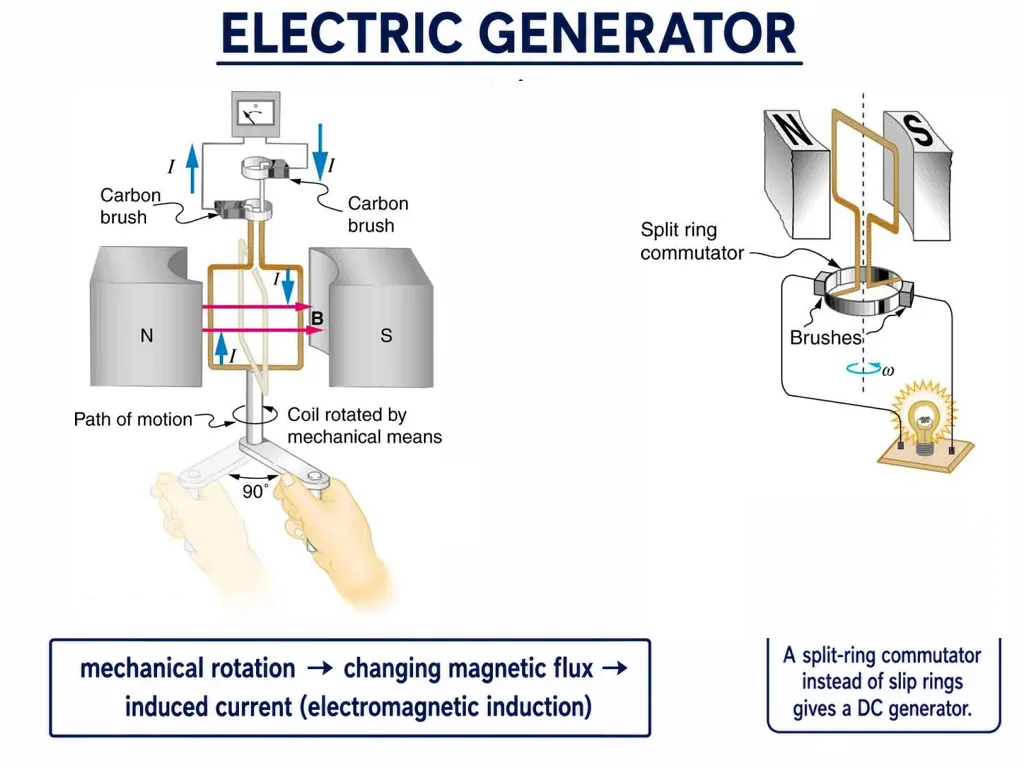
Main parts:
- A rectangular coil ABCD that is rotated in the magnetic field between the poles of a magnet.
- Two rings connected to the ends of the coil.
- Two brushes pressing on the rings, connecting the coil to the external circuit (with a galvanometer).
AC and DC Generators
As the coil rotates, each arm moves up on one side and down on the other, cutting field lines and inducing a current (direction given by Fleming's right-hand rule).
- AC generator: the coil ends are connected to two full slip rings. After every half rotation the current in the external circuit reverses direction - this gives alternating current (AC). In India, mains AC reverses 50 times per second (50 Hz).
- DC generator: if instead a split-ring commutator is used (as in a motor), the brushes always touch the arm moving in a fixed sense, so the output current stays in one direction - direct current (DC).
Key Point: Slip rings → AC generator; split-ring commutator → DC generator.
AC vs DC; Key Comparison
- Alternating current (AC) periodically reverses its direction; direct current (DC) flows in one direction only.
- A major advantage of AC is that it can be transmitted over long distances without much loss of energy (using transformers), which is why homes are supplied with AC.
| Motor | Generator | |
|---|---|---|
| Converts | electrical → mechanical | mechanical → electrical |
| Rule | Fleming's left hand | Fleming's right hand |
| Rings | split-ring commutator | slip rings (AC) / split-ring (DC) |
[Exam Tip] Generator = mechanical → electrical, right-hand rule. Slip rings = AC, split-ring commutator = DC. Household supply is AC, 220 V, 50 Hz.
Solved Examples
Example 1: Energy conversion in a generator
What energy conversion takes place in an electric generator?
Solution: An electric generator converts mechanical energy (rotation of the coil) into electrical energy by electromagnetic induction.
Example 2: AC vs DC generator
What single change turns an AC generator into a DC generator?
Solution: Replacing the two slip rings with a split-ring commutator turns an AC generator into a DC generator. The commutator makes the brushes always contact the coil arm moving in a fixed sense, so the output current stays in one direction.
Example 3: Meaning of AC and DC
What is the difference between alternating current and direct current?
Solution: Alternating current (AC) periodically reverses its direction (in India, 50 times per second, 50 Hz). Direct current (DC) flows in only one direction. AC can be transmitted over long distances with little energy loss, so it is used for the mains supply.
Example 4: Rule for induced current in a generator
Which rule gives the direction of the current generated in a coil rotating in a magnetic field?
Solution: Fleming's right-hand rule gives the direction of the induced (generated) current - forefinger = field, thumb = motion of the conductor, middle finger = induced current.