
Magnets, Poles and the Magnetic Field
You have seen that a compass needle gets deflected when brought near a bar magnet. A compass needle is itself a tiny bar magnet. Its ends point roughly north and south: the end pointing north is the north (north-seeking) pole, and the end pointing south is the south (south-seeking) pole.
A basic law of magnets: like poles repel, unlike poles attract.
If you sprinkle iron filings around a bar magnet and tap the board gently, the filings arrange themselves in a definite pattern. This happens because the magnet exerts a force in the region around it. The region around a magnet where its force can be detected is called the magnetic field. The lines along which the iron filings line up represent the magnetic field lines.
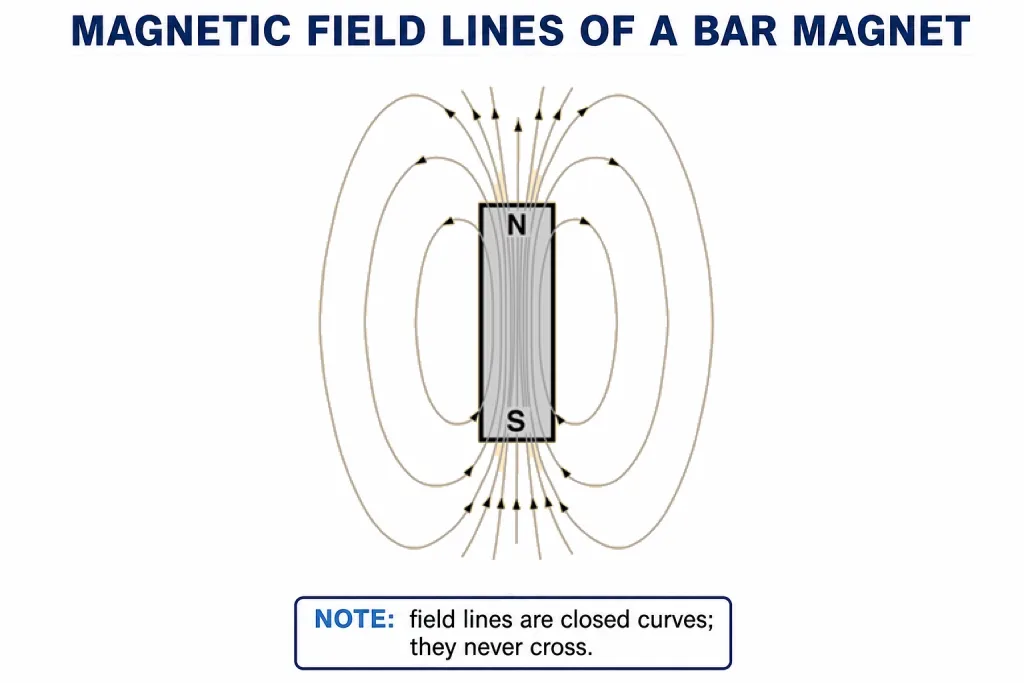
Magnetic Field Lines and their Direction
A magnetic field has both magnitude and direction. The direction of the magnetic field at a point is the direction in which the north pole of a compass needle points there.
By convention:
- Outside the magnet, field lines emerge from the north pole and merge into the south pole.
- Inside the magnet, the field lines run from the south pole to the north pole.
- Thus magnetic field lines are closed curves.
You can trace them yourself with a small compass, marking the needle's positions step by step from the north pole to the south pole and joining the points into a smooth curve.
Properties of Magnetic Field Lines
Remember these key properties (a favourite exam question):
- Field lines emerge from the north pole and merge at the south pole outside the magnet, forming closed loops.
- The direction of the field at any point is the direction a compass north pole points there (tangent to the line).
- Field lines are closer together where the field is stronger (near the poles) and farther apart where it is weaker.
- No two field lines ever cross. If they did, a compass at the crossing point would have to point in two directions at once, which is impossible.
Key Point: The crowding of field lines shows the relative strength of the field.
[Exam Tip] "Why do two field lines never intersect?" → Because at the point of intersection the compass would point in two different directions, which is impossible.
Solved Examples
Example 1: Why the compass deflects
Why does a compass needle get deflected when brought near a bar magnet?
Solution: A compass needle is a small magnet. When brought near a bar magnet, it lies in the bar magnet's magnetic field and experiences a force on its poles (like poles repel, unlike attract). This torque turns the needle so it aligns along the field, i.e. it gets deflected.
Example 2: Direction of the field
How is the direction of the magnetic field at a point defined?
Solution: The direction of the magnetic field at a point is the direction in which the north pole of a compass needle placed at that point points. Field lines are drawn from the north pole to the south pole outside the magnet.
Example 3: Reading field strength from lines
Two regions of a field diagram show field lines crowded in one place and spread out in another. Where is the field stronger?
Solution: The field is stronger where the field lines are crowded (closer together) and weaker where they are farther apart. Near the poles of a bar magnet the lines are most crowded, so the field is strongest there.