
The Electric Motor
An electric motor is a device that converts electrical energy into mechanical (rotational) energy. It works on the motor effect: a current-carrying coil placed in a magnetic field experiences a force and rotates.
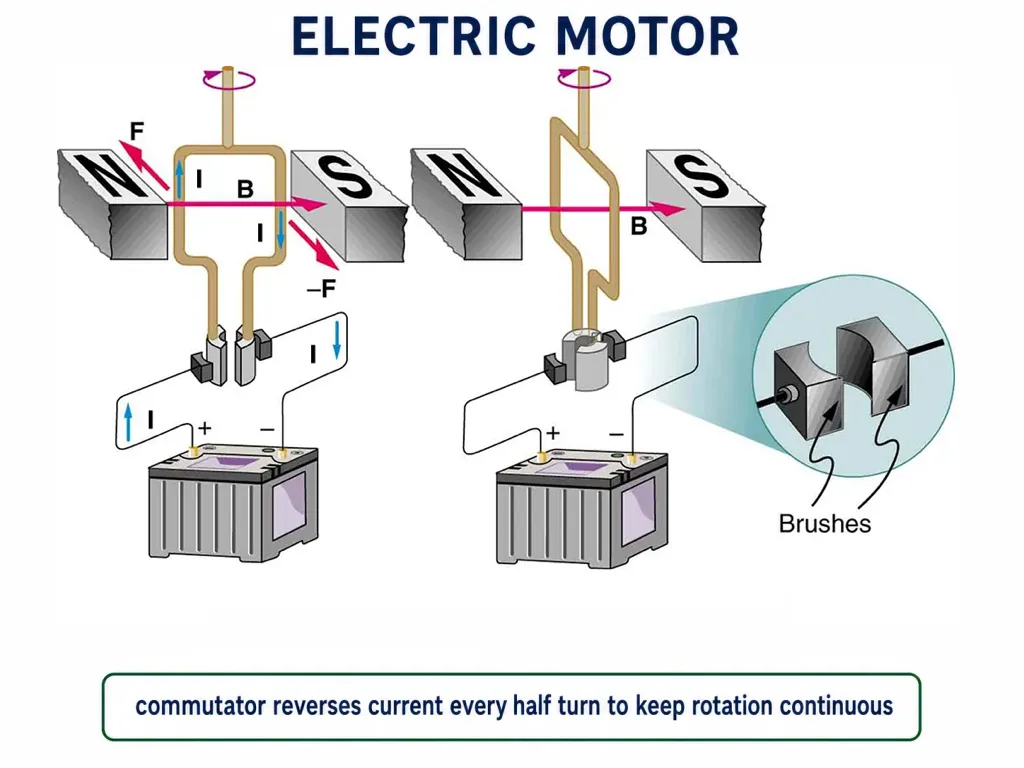
Main parts:
- A rectangular coil ABCD of insulated wire placed between the poles of a magnet.
- A split-ring commutator (two half-rings) connected to the ends of the coil.
- Two carbon brushes that press against the commutator and connect it to the battery.
How the Motor Works
When current flows through the coil, the two arms of the coil (AB and CD) carry current in opposite directions. By Fleming's left-hand rule, the forces on the two arms act in opposite directions, forming a couple that makes the coil rotate.
After the coil turns half a rotation, arm AB and arm CD swap sides. If the current kept flowing the same way, the forces would now oppose further rotation. This is where the split-ring commutator comes in: it reverses the direction of current through the coil every half rotation, so the force on each side always pushes the coil in the same direction. The coil therefore keeps rotating continuously.
Key Point: The commutator reverses the current every half turn, keeping the rotation continuous and in one direction.
Uses and Key Idea
Commercial motors use an electromagnet (instead of a permanent magnet), a large number of turns of the coil wound on a soft-iron core, all of which increase the force and hence the power of the motor. The soft-iron core plus coil is called the armature.
Electric motors are used in electric fans, refrigerators, mixers, washing machines, computers, MP3 players and many other appliances.
[Exam Tip] Motor = electrical → mechanical energy. Remember: coil + magnet + split-ring commutator + brushes; the commutator is what makes rotation continuous. Contrast with a generator (mechanical → electrical, uses slip rings for AC).
Solved Examples
Example 1: Energy conversion in a motor
What energy conversion takes place in an electric motor?
Solution: An electric motor converts electrical energy into mechanical (rotational) energy.
Example 2: Role of the commutator
What is the function of the split-ring commutator in an electric motor?
Solution: The split-ring commutator reverses the direction of current through the coil after every half rotation. This keeps the force (torque) acting in the same rotational sense, so the coil continues to rotate in one direction continuously.
Example 3: Why the coil rotates
Explain why the coil of a motor experiences a turning effect.
Solution: The two arms of the coil carry current in opposite directions. In the magnetic field, by Fleming's left-hand rule the forces on the two arms are equal, opposite and parallel (a couple), which produces a turning effect (torque) that rotates the coil.
Example 4: Increasing motor power
How can the turning force of a motor be increased?
Solution: By (i) increasing the current, (ii) increasing the number of turns in the coil, (iii) using a stronger magnetic field (electromagnet), and (iv) winding the coil on a soft-iron core (armature).