
Force on a Current-Carrying Conductor
A current produces a magnetic field, and that field exerts a force on a nearby magnet. By Newton's third law, the magnet must exert an equal and opposite force on the current-carrying conductor (as Ampere suggested).
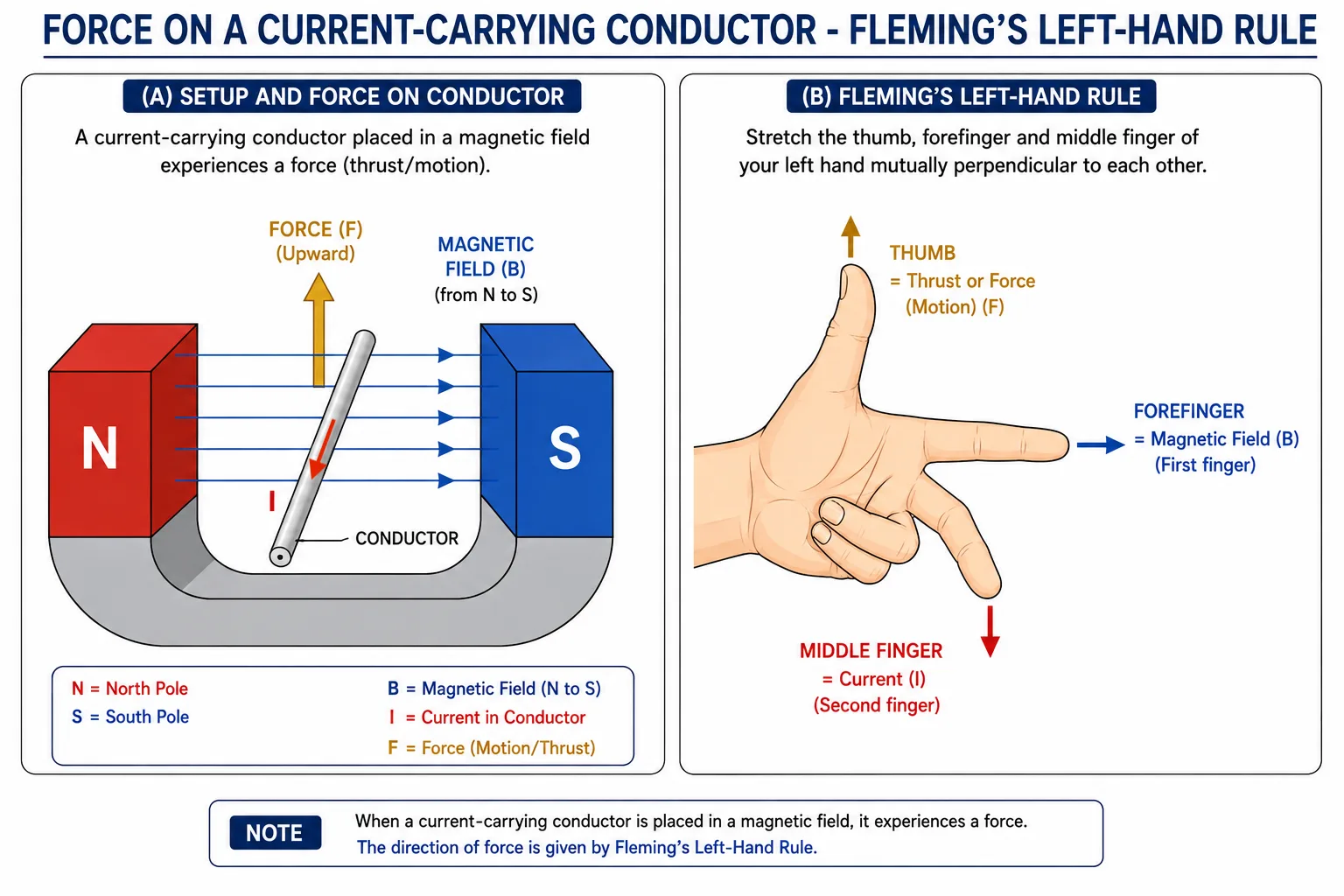
If a current-carrying rod is placed in a magnetic field, it experiences a force and gets displaced. Experiments show:
- Reversing the current reverses the direction of the force.
- Reversing the magnetic field also reverses the force.
- The force is greatest when the current is at right angles (perpendicular) to the magnetic field.
Fleming's Left-Hand Rule
When the current and the magnetic field are perpendicular, the force is perpendicular to both. The directions are given by Fleming's left-hand rule:
Stretch the thumb, forefinger and middle finger of your left hand mutually perpendicular. If the forefinger points along the magnetic field and the middle finger points along the current, then the thumb points in the direction of the force (motion) on the conductor.
A handy way to remember: ForeFinger = Field, ceNtre (middle) finger = curreNt, thuMb = Motion/force.
Key Point: Force is largest when current ⟂ field, and is perpendicular to both.
[Exam Tip] Motor effect: a current-carrying conductor in a magnetic field feels a force → this is the basis of the electric motor, loudspeakers, and measuring instruments.
Solved Examples
Example 1: Direction of force on an electron (NCERT 12.2)
An electron enters a magnetic field at right angles to it. Using Fleming's left-hand rule, what is the direction of the force on it (field into the diagram, electron moving to the right)?
Solution: The conventional current is opposite to the electron's motion. Applying Fleming's left-hand rule with the forefinger along the field and the middle finger along the conventional current, the thumb (force) points into the page. (In the NCERT figure the answer is "into the page".)
Example 2: Factors affecting the force
In the rod-in-field experiment, how is the displacement of the rod affected by (i) increasing the current, (ii) using a stronger magnet, (iii) increasing the length of the rod?
Solution: The force (and hence displacement) increases in all three cases: (i) a larger current, (ii) a stronger magnetic field, and (iii) a longer conductor in the field all increase the force on the conductor.
Example 3: Direction of the magnetic field
A positively charged alpha particle moving towards the west is deflected towards the north by a magnetic field. Find the direction of the field.
Solution: Current direction = motion of the positive charge = west. Force = north. By Fleming's left-hand rule (forefinger = field, middle = current, thumb = force), the field must point upward (out of the ground). So the magnetic field is directed upward.
Example 4: When is the force largest?
When is the force on a current-carrying conductor placed in a magnetic field the largest?
Solution: The force is largest when the direction of the current is at right angles (perpendicular) to the direction of the magnetic field.