
How Harmful Chemicals Enter the Food Chain
To protect crops from pests and diseases, farmers use pesticides and other chemicals. These chemicals are washed from the fields into the soil and into water bodies.
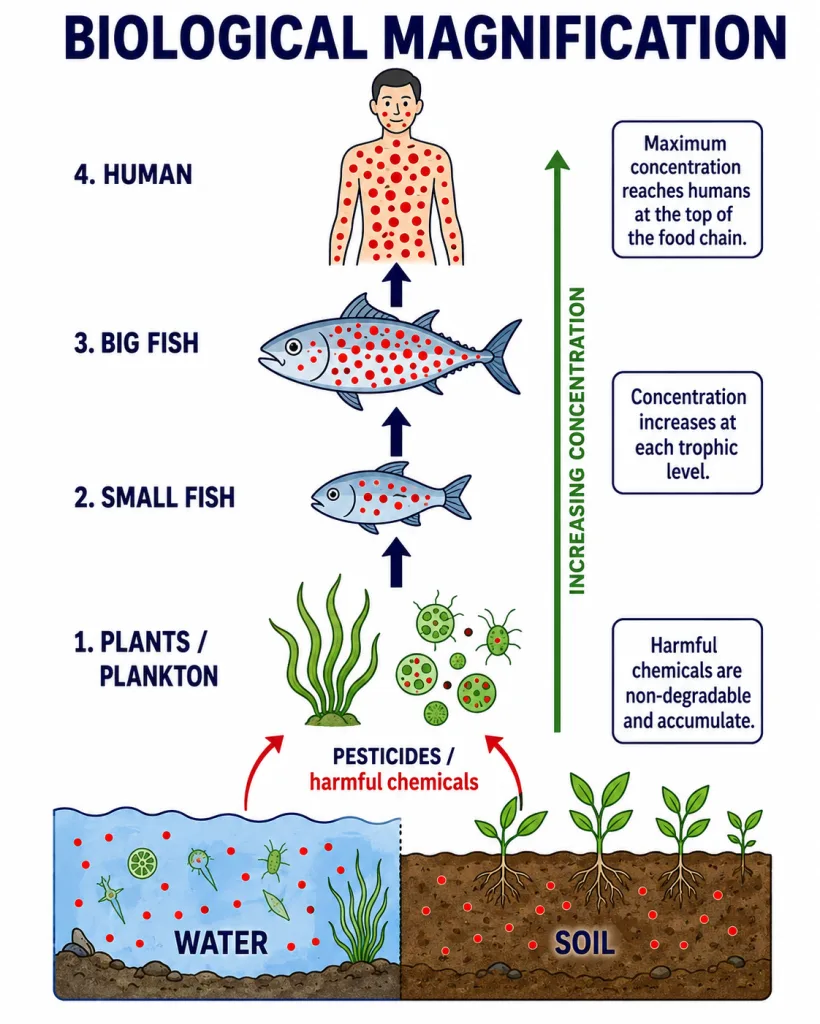
From the soil, plants absorb these chemicals along with water and minerals; from water bodies, aquatic plants and animals take them up. This is one of the main ways harmful chemicals enter the food chain.
Biological Magnification
These chemicals (such as pesticides) are not degradable - living organisms cannot break them down. So they are not excreted but instead accumulate progressively at each trophic level of the food chain.
Biological magnification (biomagnification) is the progressive increase in the concentration of harmful, non-degradable chemicals at each successive trophic level of a food chain.
- The concentration is lowest in producers and highest at the top of the food chain.
- Because human beings often occupy the top level of food chains, the maximum concentration of these chemicals accumulates in our bodies.
This is why food grains, vegetables, fruits and even meat contain varying amounts of pesticide residues, which cannot always be removed by washing.
Points to Remember about Biomagnification
- It occurs because the chemicals are non-biodegradable and fat-soluble, so they build up rather than break down.
- The level of magnification is different at different trophic levels - it is greater the higher up the chain you go.
- Organisms at higher trophic levels (including humans) are most at risk.
Key Point: Non-degradable chemicals get more concentrated at each higher trophic level → maximum in humans at the top.
[Exam Tip] Biomagnification increases upward along a food chain. In an aquatic chain (water → plankton → small fish → big fish → human), the human gets the highest dose.
Solved Examples
Example 1: Define biological magnification (NCERT)
What is biological magnification? Will its level be different at different levels of the ecosystem?
Solution: Biological magnification is the progressive increase in concentration of harmful, non-degradable chemicals at each successive trophic level of a food chain. Yes, the level is different at different trophic levels - it increases as we move up the chain, being highest at the top (e.g. in humans).
Example 2: Who gets the most pesticide?
In the chain water → phytoplankton → small fish → big fish → human, who accumulates the highest concentration of pesticide?
Solution: The human, being at the top of the food chain, accumulates the highest concentration of the non-degradable pesticide by biological magnification.
Example 3: How do pesticides enter the food chain?
How do pesticides enter our food chain?
Solution: Pesticides sprayed on crops are washed into the soil and water bodies. Plants absorb them from the soil with water and minerals, and aquatic organisms take them up from water. From these producers they pass up the food chain to consumers, including humans.
Example 4: Why washing does not fully help
Why can pesticide residues not always be removed from food by washing?
Solution: Because the pesticides are absorbed inside the plant and animal tissues (not just on the surface) and are non-degradable, so simply washing the surface cannot remove the residues stored within the food.