
From Food Chains to Food Webs
In nature, feeding relationships are rarely a simple straight line. Each organism is usually eaten by more than one kind of organism, and most organisms eat more than one kind of food. When many food chains are interconnected, they form a food web.
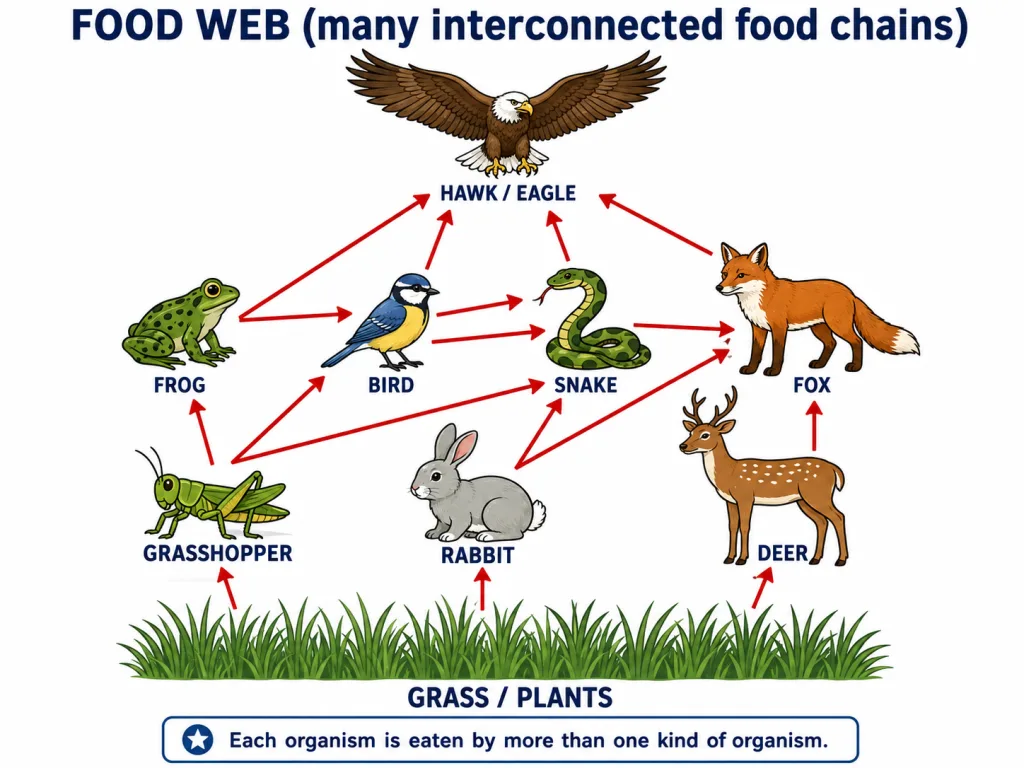
A food web is a network of many interconnected food chains in an ecosystem. Instead of a single straight line, the feeding relationships are shown as a series of branching lines.
Why Food Webs Matter
A food web is more realistic than a single food chain because:
- One organism (say grass) is eaten by several herbivores (grasshopper, rabbit, deer).
- One predator (say a hawk) eats several kinds of prey (snake, bird, mouse).
- A single species has alternative food sources, so if one prey becomes scarce it can eat another.
This gives the ecosystem stability: the loss of one species is less damaging because other feeding pathways remain. The greater the number of interconnections in a food web, the more stable the ecosystem.
Key Point: A food web = many interconnected food chains; it makes an ecosystem more stable than a single chain would.
[Exam Tip] Food chain = single straight line; food web = branching network of many chains. Remember that arrows in both always point in the direction of energy/food flow (prey → predator).
Solved Examples
Example 1: Food chain vs food web
What is the difference between a food chain and a food web?
Solution: A food chain is a single straight-line sequence of organisms, each eaten by the next. A food web is a network of many interconnected food chains, shown as branching lines, because each organism is eaten by, and eats, more than one kind of organism.
Example 2: Why food webs give stability
How does a food web make an ecosystem more stable?
Solution: In a food web each organism has several feeding options. If one food source or species is lost, organisms can use alternative pathways, so the ecosystem is less disturbed. More interconnections mean greater stability.
Example 3: Reading a food web
In a food web, grass is eaten by grasshoppers, rabbits and deer. What does this show?
Solution: It shows that a single producer (grass) supports several different herbivores through branching feeding relationships - one of the many food chains that together make up the food web.