
Ozone and its Role
Ozone (O₃) is a molecule made of three atoms of oxygen. Ordinary oxygen (O₂), which we breathe, is essential for all aerobic life. Ozone, at ground level, is actually a deadly poison - but high up in the atmosphere it does an essential job.
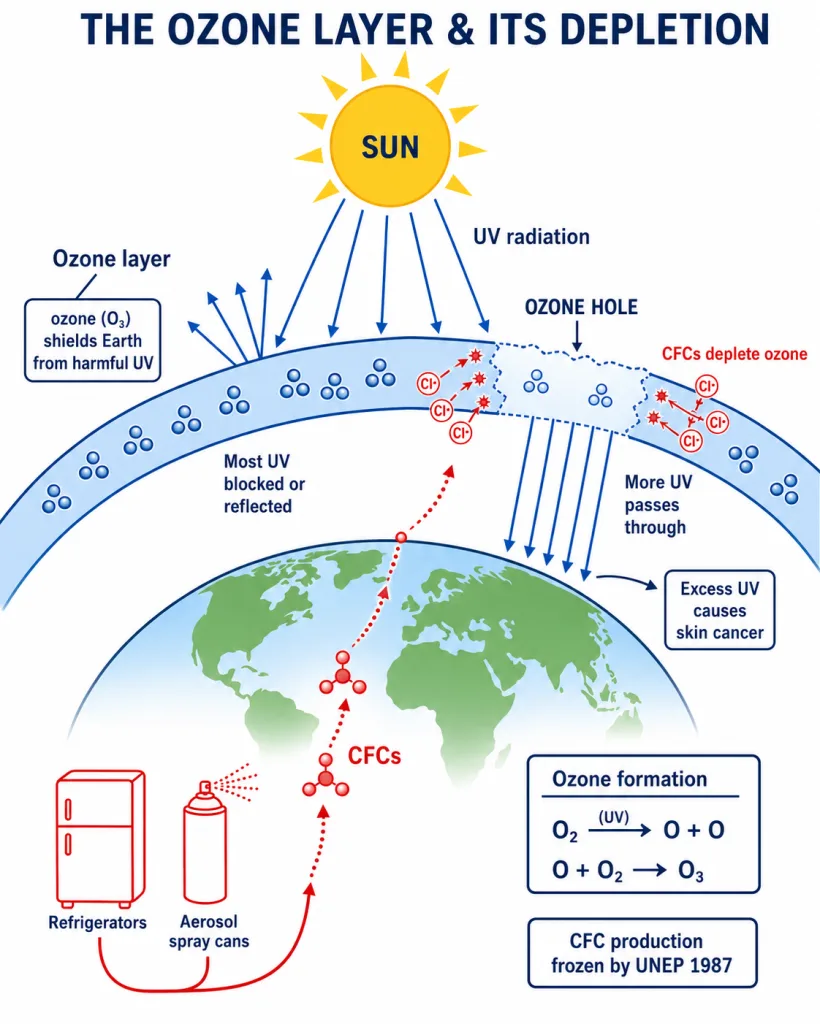
High in the atmosphere, the ozone layer shields the earth's surface from the Sun's ultraviolet (UV) radiation. UV radiation is highly damaging to living organisms - for example, it causes skin cancer in humans.
How Ozone is Formed
At the higher levels of the atmosphere, ozone is formed by the action of UV radiation on oxygen. High-energy UV rays split molecular oxygen (O₂) into free oxygen atoms (O); these atoms then combine with O₂ molecules to form ozone (O₃):
So UV both makes ozone and is absorbed by ozone - which is how the ozone layer protects us.
Depletion of the Ozone Layer
In the 1980s, the amount of ozone in the atmosphere began to drop sharply, creating an "ozone hole". This depletion was linked to synthetic chemicals called chlorofluorocarbons (CFCs), used as refrigerants (in refrigerators and air conditioners) and in fire extinguishers and aerosol sprays.
A thinner ozone layer lets more harmful UV radiation reach the earth, endangering living organisms.
Steps taken: In 1987, the United Nations Environment Programme (UNEP) forged an agreement to freeze CFC production at 1986 levels (the Montreal Protocol). It is now mandatory worldwide for companies to make CFC-free refrigerators.
Key Point: Ozone (O₃) shields Earth from UV; CFCs deplete it; UNEP (1987) acted to freeze CFC production.
[Exam Tip] Why is ozone depletion a concern? → Ozone absorbs harmful UV; without it, more UV reaches Earth causing skin cancer and other damage. The remedy is cutting CFCs.
Solved Examples
Example 1: What is ozone and how does it affect an ecosystem? (NCERT)
What is ozone and how does it affect any ecosystem?
Solution: Ozone (O₃) is a molecule of three oxygen atoms. High in the atmosphere it forms a layer that absorbs the Sun's harmful UV radiation, protecting all living organisms. Without this shield, increased UV would damage ecosystems - causing skin cancer, harming plants and aquatic life. (At ground level ozone is itself a harmful pollutant.)
Example 2: Why is ozone depletion a concern? (NCERT)
Why is damage to the ozone layer a cause for concern, and what steps are being taken?
Solution: Because the ozone layer absorbs harmful UV radiation, its depletion allows more UV to reach the earth, causing skin cancer, cataracts and damage to crops and aquatic organisms. Steps: the UNEP agreement of 1987 to freeze CFC production, and making CFC-free refrigerators and products worldwide.
Example 3: Chemicals responsible
Which chemicals are mainly responsible for ozone depletion, and where are they used?
Solution: Chlorofluorocarbons (CFCs) are mainly responsible. They are used as refrigerants (refrigerators, air conditioners), in fire extinguishers and aerosol sprays.
Example 4: Ground-level vs high-altitude ozone
Is ozone harmful or helpful?
Solution: It depends on where it is. High in the atmosphere, ozone is helpful - it shields us from UV radiation. At ground level, ozone is a harmful pollutant (a deadly poison). So ozone is 'good up high, bad nearby'.