
Flow of Energy in an Ecosystem
The interactions in an ecosystem involve a flow of energy from one component to another. Autotrophs capture the energy in sunlight and convert it into chemical energy (food). From the producers, energy flows to the herbivores, then to the carnivores, and to the decomposers.
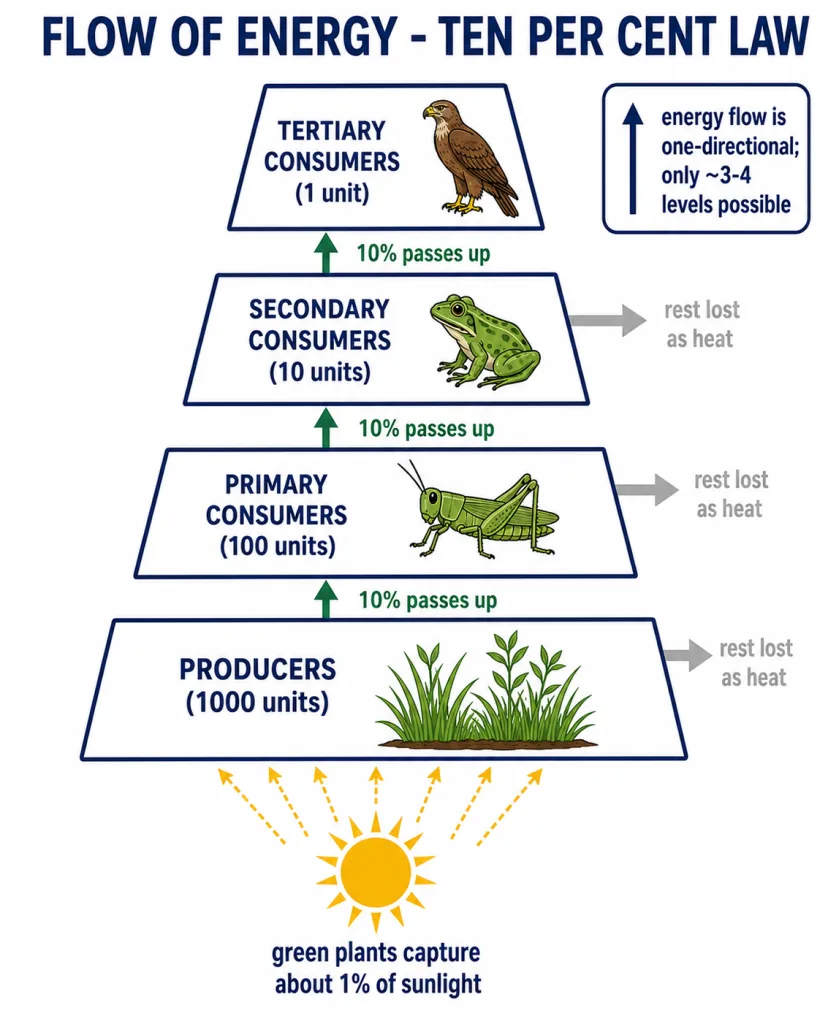
When energy is transferred from one trophic level to the next, a large part is lost to the environment as heat (and used in life processes), and cannot be reused.
Two important facts about energy flow:
- The flow of energy is unidirectional (one-way) - energy captured by autotrophs does not go back to the Sun, and energy passed to herbivores does not return to the plants.
- The energy available decreases progressively at each higher trophic level.
The Ten Per Cent Law
Careful studies of energy flow give these results:
- Green plants capture only about 1% of the sunlight falling on their leaves and convert it into food energy.
- When a trophic level is eaten by the next, on average only about 10% of the food energy is stored in the body of the consumer and passed on to the next level. The rest (about 90%) is lost as heat, used in digestion, movement and life processes.
This is the ten per cent law (given by Lindeman): only about 10% of the energy at one trophic level is passed on to the next trophic level.
Why Only Three or Four Trophic Levels
Because only ~10% of energy moves up at each step, the energy available becomes very small after a few levels. So a food chain generally has only three or four trophic levels - after four levels, too little usable energy remains to support another level.
Also:
- There are usually a greater number of individuals at the lower trophic levels; the greatest number is of producers.
- The energy diagram forms a pyramid (an energy pyramid) that narrows towards the top.
Key Point: Energy flow is one-way and decreases up the chain; only ~10% passes to each next level, so food chains have only 3-4 steps.
[Exam Tip] 1% of sunlight captured by plants; 10% law between trophic levels; energy flow is unidirectional - these three facts are frequently asked.
Solved Examples
Example 1: State the ten per cent law
State the ten per cent law of energy flow.
Solution: The ten per cent law states that when energy passes from one trophic level to the next, only about 10% of the energy is stored and passed on; the remaining ~90% is lost mainly as heat during transfer and life processes.
Example 2: Energy calculation
If producers have 20000 J of energy, roughly how much reaches the secondary consumers?
Solution: Primary consumers get ~10% of 20000 J = 2000 J. Secondary consumers get ~10% of 2000 J = 200 J. So about 200 J reaches the secondary consumers.
Example 3: Why only 3-4 trophic levels
Why do food chains usually have only three or four trophic levels?
Solution: Because only about 10% of energy is passed to each next trophic level, the energy available becomes very small after a few steps. After the fourth level too little usable energy remains, so food chains are limited to three or four trophic levels.
Example 4: Unidirectional flow
What is meant by saying that the flow of energy in an ecosystem is unidirectional?
Solution: It means energy flows in one direction only - from the Sun to producers to consumers to decomposers - and does not flow back. The energy captured by autotrophs never returns to the Sun, and the energy passed to a higher trophic level does not return to the lower one.