
Food Chains
A food chain is a series of organisms feeding on one another, in which each organism is eaten by the next. It shows how food (and the energy in it) passes from one organism to another.
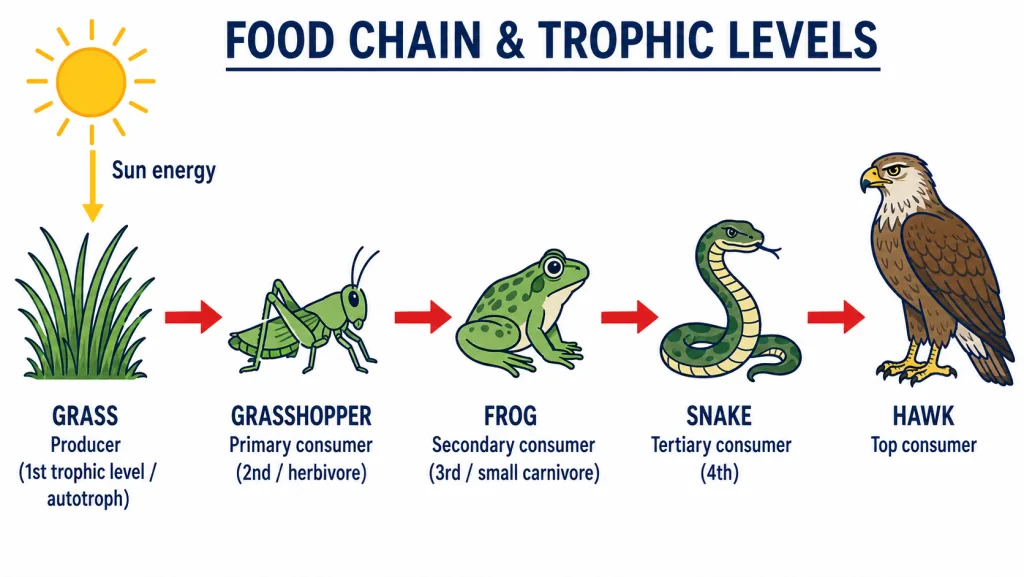
Example food chains:
- Grassland: grass → grasshopper → frog → snake → hawk
- Forest: plants → deer → tiger
- Pond: algae → small fish → big fish
Each food chain begins with a producer, which captures energy from sunlight.
Trophic Levels
Each step or level of a food chain is called a trophic level. Organisms are placed at trophic levels by their position in the food chain:
- First trophic level - producers (autotrophs), e.g. green plants. They fix solar energy.
- Second trophic level - primary consumers (herbivores), which eat producers.
- Third trophic level - secondary consumers (small carnivores), which eat herbivores.
- Fourth trophic level - tertiary consumers (larger carnivores), which eat the secondary consumers.
Autotrophs make solar energy available to the heterotrophs (consumers) and decomposers.
Key Point: Producer = 1st trophic level; primary consumer = 2nd; secondary = 3rd; tertiary = 4th.
[Exam Tip] In a food chain, always identify the producer first (green plant), then count trophic levels upward. Arrows point in the direction of energy flow (from the eaten to the eater).
Solved Examples
Example 1: Trophic levels of a food chain (NCERT)
What are trophic levels? Give an example of a food chain and state the different trophic levels in it.
Solution: A trophic level is each step (feeding level) of a food chain. Example: grass → grasshopper → frog → snake. Here grass = 1st trophic level (producer), grasshopper = 2nd (primary consumer), frog = 3rd (secondary consumer), snake = 4th (tertiary consumer).
Example 2: Identify the producer
In the food chain phytoplankton → small fish → big fish → human, which is the producer and at which trophic level is the human?
Solution: Phytoplankton is the producer (1st trophic level). The human is at the 4th trophic level (tertiary consumer / top consumer).
Example 3: Direction of arrows
In a food chain grass → deer → tiger, what do the arrows represent?
Solution: The arrows point from the organism that is eaten to the one that eats it, showing the direction of flow of food and energy - from grass (producer) to deer (herbivore) to tiger (carnivore).
Example 4: Autotroph and heterotroph
Which organisms in a food chain are autotrophs and which are heterotrophs?
Solution: The producers (green plants) are autotrophs - they make their own food. All the consumers (herbivores and carnivores) are heterotrophs - they get food by eating other organisms.