
What is an Ecosystem?
The environment is everything around us - living organisms and their physical surroundings. All organisms (plants, animals, microorganisms and humans) interact with each other and with their physical surroundings and maintain a balance in nature.
All the interacting organisms in an area, together with the non-living constituents of the environment, form an ecosystem.
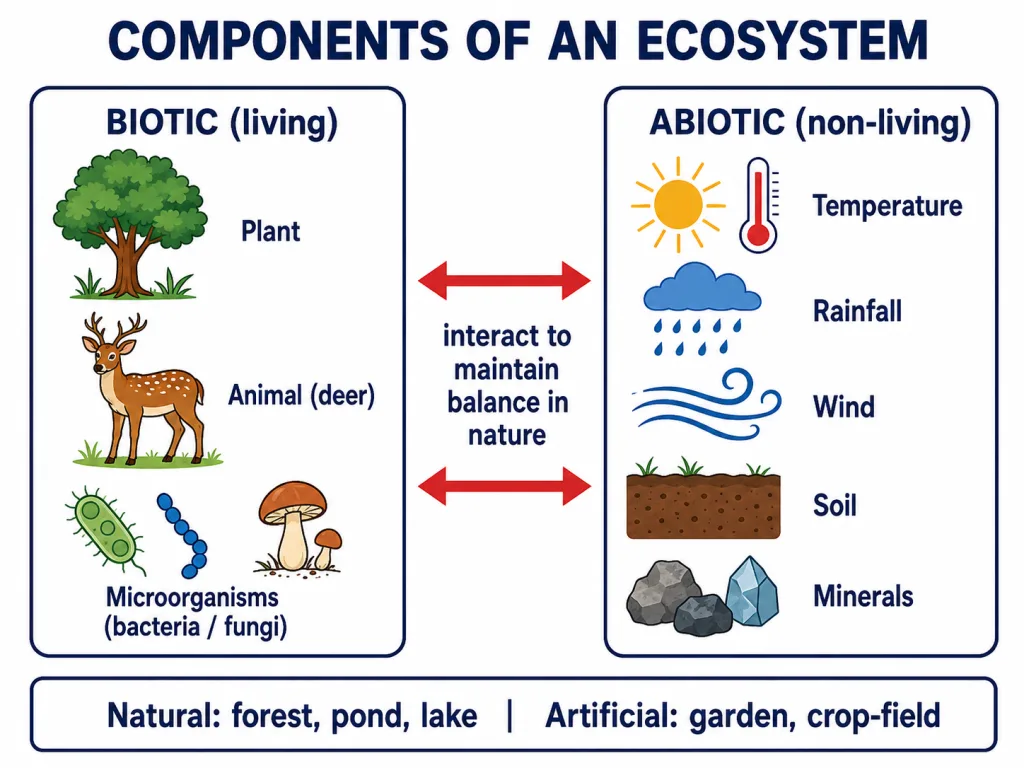
An ecosystem has two kinds of components:
- Biotic components - the living organisms (plants, animals, microorganisms).
- Abiotic components - the non-living physical factors: temperature, rainfall, wind, soil and minerals.
Natural and Artificial Ecosystems
The biotic and abiotic components constantly interact - the growth, reproduction and activities of the living organisms are affected by the abiotic factors, and in turn the organisms affect their surroundings.
Ecosystems are of two types:
- Natural ecosystems - formed by nature, e.g. forests, ponds and lakes.
- Artificial (human-made) ecosystems - created and maintained by humans, e.g. gardens, crop-fields and aquariums.
An aquarium is a good example of a small, human-made ecosystem: it needs water, oxygen, light, fish and aquatic plants, and it must be cleaned from time to time. A natural pond, however, cleans itself because it has decomposers and a balanced set of organisms.
Key Point: Ecosystem = biotic (living) + abiotic (non-living) components interacting together.
[Exam Tip] Garden, crop-field and aquarium = artificial; forest, pond and lake = natural ecosystems.
Solved Examples
Example 1: Define an ecosystem
What is an ecosystem? Name its two components.
Solution: An ecosystem is all the interacting organisms in an area together with the non-living components of the environment. Its two components are biotic (living organisms) and abiotic (non-living physical factors like temperature, soil, water).
Example 2: Natural vs artificial
Classify: forest, garden, lake, crop-field, aquarium.
Solution: Natural ecosystems: forest, lake. Artificial (human-made) ecosystems: garden, crop-field, aquarium.
Example 3: Abiotic examples
Give four abiotic components of an ecosystem.
Solution: Any four of: temperature, rainfall (water), wind, soil, minerals, light. These are the non-living physical factors of the ecosystem.