
Three Functional Groups
Based on how they obtain their food, the organisms of an ecosystem are grouped into three functional categories:
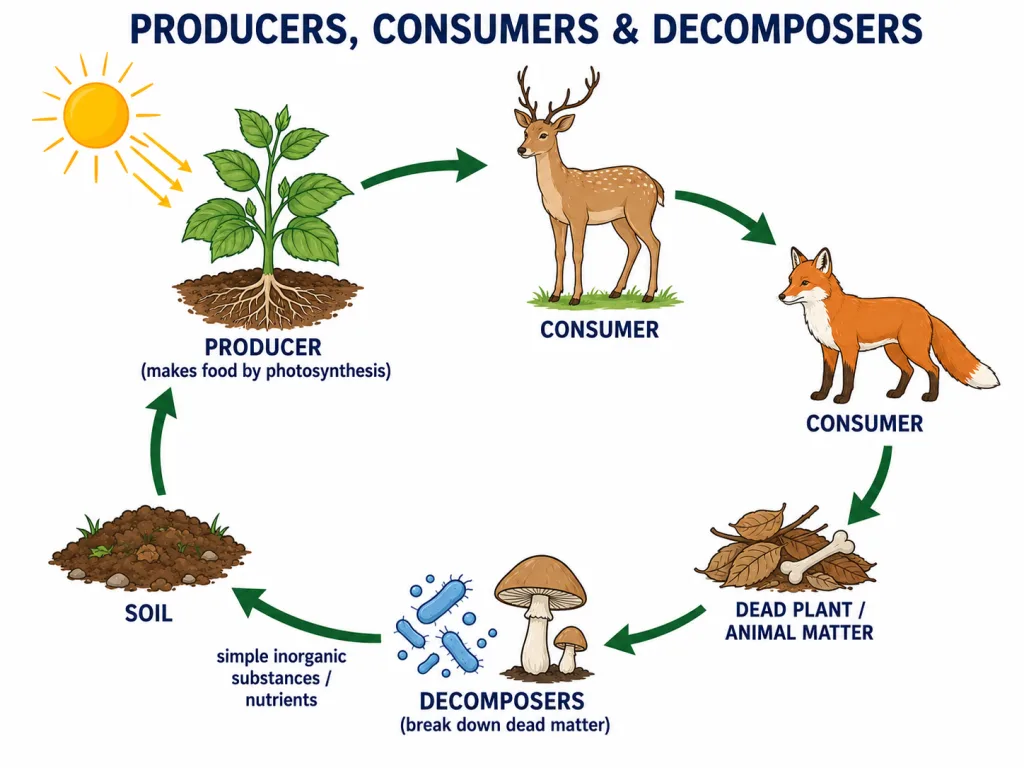
- Producers - green plants and certain bacteria that make their own food (organic compounds like sugar and starch) from inorganic substances using sunlight and chlorophyll by photosynthesis. They are also called autotrophs.
- Consumers - organisms that depend on producers, directly or indirectly, for food. They are also called heterotrophs.
- Decomposers - microorganisms (bacteria and fungi) that break down dead remains.
Types of Consumers
Consumers cannot make their own food, so they eat other organisms. They are classified as:
- Herbivores - eat only plants (e.g. cow, deer, grasshopper).
- Carnivores - eat other animals (e.g. lion, frog, snake).
- Omnivores - eat both plants and animals (e.g. humans, crow, bear).
- Parasites - live on or in another organism (the host) and take food from it (e.g. tapeworm, leech, Cuscuta).
Consumers that feed directly on producers are primary consumers; those that feed on primary consumers are secondary consumers, and so on.
Role of Decomposers
Decomposers are microorganisms - mainly bacteria and fungi - that break down the dead remains and waste products of organisms. They convert complex organic substances into simple inorganic substances that go back into the soil and are used again by plants.
Their role is vital:
- They clean up dead plants, animals and garbage.
- They recycle nutrients and replenish the soil, returning materials for producers to reuse.
Without decomposers, dead bodies and waste would pile up, and the natural replenishment of nutrients in the soil would stop.
Key Point: Producers = autotrophs (make food); Consumers = heterotrophs (eat others); Decomposers = recycle nutrients.
[Exam Tip] Decomposers keep nutrient cycles going - they turn dead organic matter back into simple substances for plants.
Solved Examples
Example 1: Role of decomposers
What is the role of decomposers in an ecosystem?
Solution: Decomposers (bacteria and fungi) break down the dead remains and waste of organisms into simple inorganic substances. These return to the soil and are reused by plants (producers). Thus decomposers recycle nutrients and keep the ecosystem's material cycles running.
Example 2: Producers
Which organisms are called producers and why?
Solution: Green plants and certain bacteria are producers because they make their own food (organic compounds) from inorganic substances using sunlight and chlorophyll by photosynthesis. They are autotrophs and form the base of every food chain.
Example 3: Classify the consumers
Classify: cow, lion, human, tapeworm.
Solution: Cow - herbivore; lion - carnivore; human - omnivore; tapeworm - parasite. All are consumers (heterotrophs).
Example 4: No decomposers
What would happen to dead plants and animals if there were no decomposers?
Solution: Without decomposers, dead bodies and waste would accumulate and would not be broken down. Nutrients locked in dead matter would not return to the soil, so the natural replenishment of the soil would stop and producers would run short of nutrients.