
Carboxylic Acids — Structure and Nomenclature
A carboxylic acid contains the carboxyl group, -COOH (a carbonyl C=O joined to a hydroxyl -OH). The two groups interact: the lone pair on the -OH oxygen is delocalised toward the C=O, which is why -COOH behaves very differently from a simple alcohol or ketone.
Common names: HCOOH = formic acid, CHCOOH = acetic acid, CHCOOH = benzoic acid, (COOH) = oxalic acid.
IUPAC names (alkanoic acid): replace the -e of the alkane with -oic acid; the carboxyl carbon is always C-1.
- HCOOH → methanoic acid
- CHCOOH → ethanoic acid
- CHCHCOOH → propanoic acid
- HOOC-COOH → ethanedioic acid (oxalic acid)
For -COOH on a ring, use -carboxylic acid (e.g. benzenecarboxylic acid = benzoic acid).
Key Point: -COOH = carboxyl. IUPAC = alkane → alkanoic acid (carboxyl is C-1). Ring-COOH = carboxylic acid suffix.
Preparation of Carboxylic Acids — From Oxidation
From primary alcohols and aldehydes (oxidation): 1° alcohols and aldehydes are oxidised by strong oxidants (KMnO, KCrO, conc. HNO) to carboxylic acids with the same number of carbons.
CHCHOH →(KMnO)→ CHCOOH
From alkylbenzenes (side-chain oxidation): an alkylbenzene is oxidised by hot KMnO to benzoic acid — the whole side chain is oxidised to a single -COOH regardless of its length (as long as there is a benzylic H). So toluene, ethylbenzene and propylbenzene all give benzoic acid.
Key Point: 1° alcohol or aldehyde + strong oxidant → carboxylic acid (same C count); any alkylbenzene with a benzylic H → benzoic acid (the side chain is cut to -COOH).
Preparation of Carboxylic Acids — From Nitriles, Grignard and Derivatives
From nitriles (hydrolysis): a nitrile is hydrolysed (acid or base) to a carboxylic acid (via the amide). R-C≡N → R-COOH. This adds one carbon (the nitrile is usually made from an alkyl halide + KCN), so it is a way to ascend the series.
From Grignard reagents (with CO): a Grignard reagent adds to carbon dioxide (dry ice) and the product is hydrolysed to a carboxylic acid with one more carbon than the Grignard:
R-MgX + CO → R-COO-MgX →(HO⁺)→ R-COOH
From acyl halides, anhydrides and esters (hydrolysis): all are hydrolysed to the parent carboxylic acid (esters need acid or base; base gives the salt — saponification).
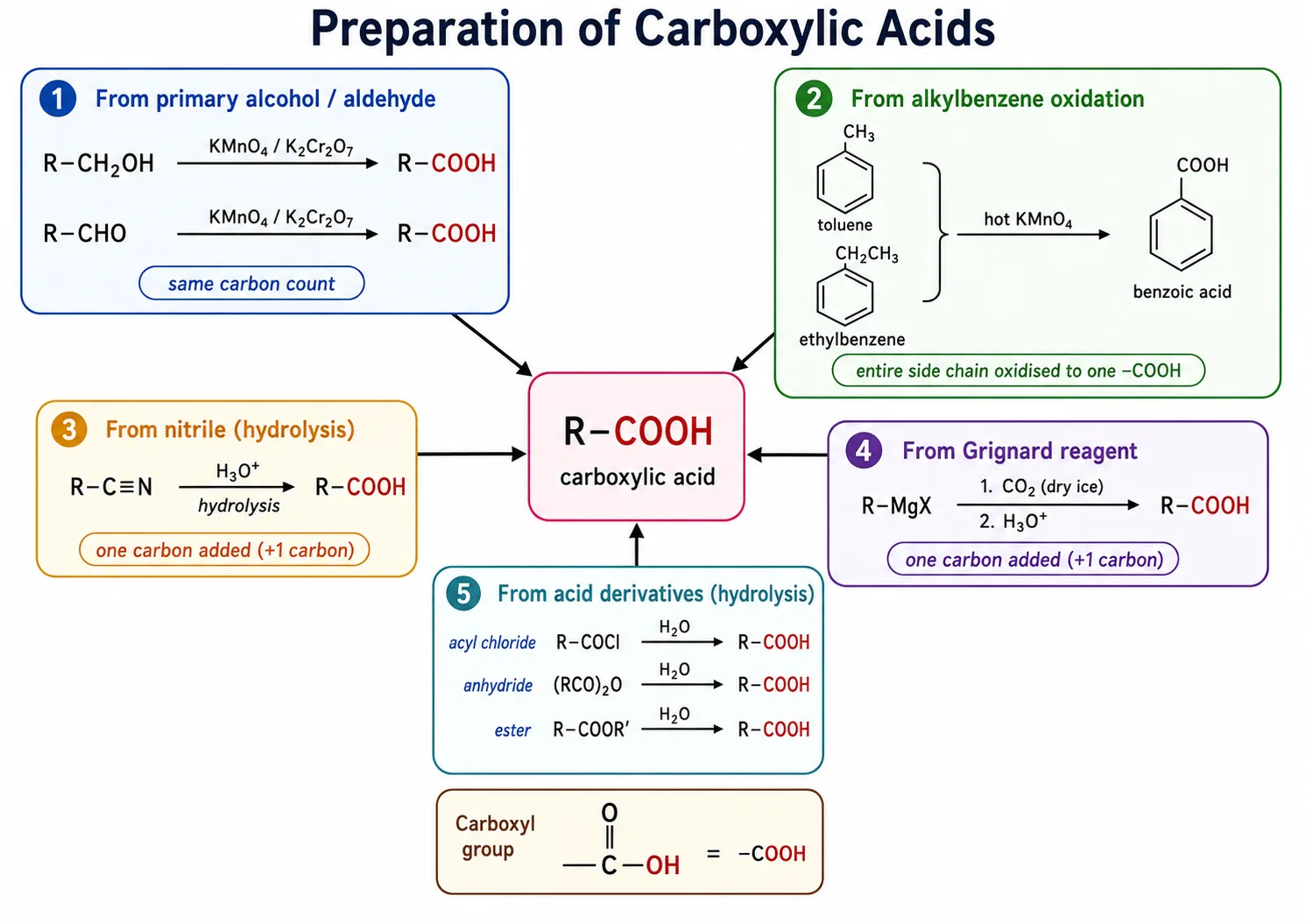
Key Point: nitrile hydrolysis and Grignard + CO both give an acid with one extra carbon; acyl halides, anhydrides and esters hydrolyse back to the acid.
Solved Examples
Example 1: IUPAC naming
Give the IUPAC name of (CH)CHCOOH.
Solution: A 3-carbon acid (-COOH is C-1) with a methyl branch on C-2: 2-methylpropanoic acid.
Example 2: Oxidation route
What acid forms when propan-1-ol is oxidised by acidified KMnO?
Solution: A 1° alcohol is oxidised to the acid with the same carbons: propanoic acid (CHCHCOOH).
Example 3: Side-chain oxidation
What is the product when ethylbenzene is heated with KMnO?
Solution: The whole side chain is oxidised to -COOH, giving benzoic acid (CHCOOH) (plus CO from the lost carbons).
Example 4: Grignard + CO
How would you make propanoic acid from ethylmagnesium bromide?
Solution: CHMgBr + CO (dry ice), then hydrolyse with dilute acid → propanoic acid (CHCHCOOH) (one carbon more than the ethyl group).
Example 5: Nitrile hydrolysis (ascending the series)
How is acetic acid prepared from methyl bromide?
Solution: CHBr + KCN → CHCN (acetonitrile), then hydrolyse (acid/base) → CHCOOH (acetic acid). The CN adds one carbon.
Example 6: From an ester
What acid (and other product) forms when ethyl ethanoate is hydrolysed with dilute acid?
Solution: Ethanoic acid (CHCOOH) + ethanol (CHOH) (acid-catalysed hydrolysis is the reverse of esterification).
Example 7: Choosing a method to add a carbon
You want to convert CHCHBr to CHCHCOOH. Give two ways.
Solution: (a) CHCHBr + KCN → CHCHCN → (hydrolysis) → CHCHCOOH. (b) CHCHMgBr + CO, then HO⁺ → CHCHCOOH. Both add one carbon.
Example 8: Oxalic acid name
Give the IUPAC name of HOOC-COOH.
Solution: Ethanedioic acid (common name oxalic acid) — a two-carbon diacid.
Example 9: All alkylbenzenes → one acid
Why do toluene and propylbenzene both give benzoic acid on oxidation?
Solution: KMnO oxidises the benzylic carbon and cleaves the rest of the side chain, leaving a single -COOH on the ring regardless of chain length — so both give benzoic acid.
Example 10: Hydrolysis of a nitrile
Write the product of hydrolysis of benzonitrile (CHCN).
Solution: Benzoic acid (CHCOOH) (via benzamide as the intermediate).