
Nucleophilic Addition — The Mechanism
Because the carbonyl carbon is electrophilic (δ+), it is attacked by nucleophiles. This is the signature reaction of aldehydes and ketones: nucleophilic addition across the C=O bond.
Mechanism (two steps):
- The nucleophile (Nu⁻) attacks the carbonyl carbon, and the π electrons shift onto oxygen. The carbon changes from sp (planar) to sp (tetrahedral), giving a tetrahedral alkoxide intermediate.
- The alkoxide oxygen is protonated (by water or acid) to give the neutral addition product.
Acids can speed the reaction by protonating the carbonyl oxygen first, making the carbon even more electrophilic.
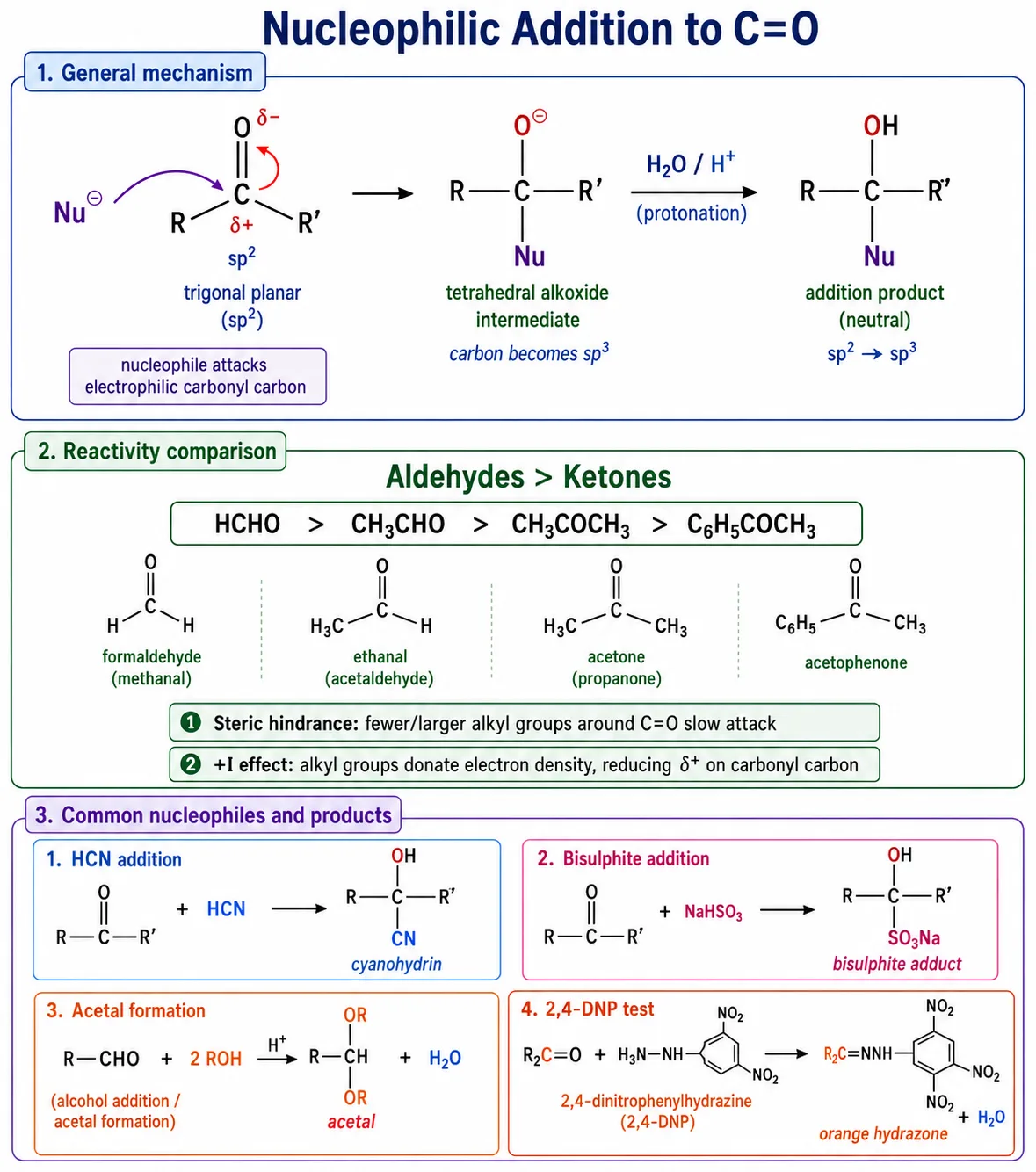
Key Point: Nu⁻ attacks the δ+ carbon → tetrahedral alkoxide → protonation → addition product. The carbon goes sp → sp.
Reactivity: Aldehydes vs Ketones
Aldehydes are MORE reactive than ketones toward nucleophilic addition. Two reasons:
- Steric: an aldehyde's carbonyl carbon carries an H (small), so the incoming nucleophile is less hindered than in a ketone (two bulky carbon groups).
- Electronic: the two alkyl groups of a ketone donate electron density (+I) toward the carbonyl carbon, reducing its δ+ and stabilising the reactant — so the carbon is less electrophilic. An aldehyde has only one such group.
General reactivity order: HCHO > CHCHO > CHCOCH > CHCOCH (and aryl ketones are least reactive, since the ring also donates electron density by resonance).
[JEE Tip] More/larger alkyl or aryl groups on the carbonyl → less reactive toward nucleophilic addition. So formaldehyde is the most reactive carbonyl of all.
Key Point: aldehydes > ketones in nucleophilic addition (less steric hindrance, less +I electron donation). HCHO is the most reactive.
The Important Addition Reactions
With HCN → cyanohydrin: addition of H-CN gives a cyanohydrin (R-CH(OH)-CN). Useful for making α-hydroxy acids.
With NaHSO → bisulphite adduct: gives a crystalline hydrogensulphite addition compound; used to purify/separate aldehydes and methyl ketones (the adduct can be hydrolysed back).
With alcohols → acetals/ketals: an aldehyde + 2 R'OH (dry HCl) gives a gem-dialkoxy compound (acetal), R-CH(OR'). Used to protect carbonyl groups.
With ammonia derivatives → C=N compounds: the carbonyl condenses with HN-Z, losing water, to give C=N-Z:
- NHOH (hydroxylamine) → oxime
- NH-NH (hydrazine) → hydrazone
- 2,4-dinitrophenylhydrazine (2,4-DNP) → 2,4-DNP derivative (orange-yellow crystals — a test for carbonyls)
- primary amine → imine (Schiff's base)
Key Point: HCN → cyanohydrin; NaHSO → bisulphite adduct (purification); alcohol → acetal (protection); HN-Z → oxime/hydrazone/2,4-DNP/Schiff's base (with loss of water).
Solved Examples
Example 1: Why aldehydes are more reactive
Explain why ethanal is more reactive than propanone toward HCN.
Solution: Ethanal's carbonyl carbon carries an H (less steric hindrance) and has only one electron-donating alkyl group, so it is more electrophilic. Propanone has two methyl groups that hinder the approach and reduce the δ+, making it less reactive.
Example 2: Cyanohydrin
Give the product of CHCHO + HCN.
Solution: Nucleophilic addition gives the cyanohydrin: CHCH(OH)CN (2-hydroxypropanenitrile).
Example 3: Oxime formation
What forms when propanone reacts with hydroxylamine (NHOH)?
Solution: Condensation with loss of water gives the oxime: (CH)C=N-OH (propanone oxime / acetoxime).
Example 4: 2,4-DNP test
What is observed when an aldehyde or ketone is treated with 2,4-dinitrophenylhydrazine?
Solution: An orange-yellow (or red) precipitate of the 2,4-DNP derivative (a hydrazone) forms. This is a general test confirming the presence of a carbonyl group (aldehyde or ketone).
Example 5: Bisulphite adduct use
Why is the NaHSO addition compound useful?
Solution: Aldehydes and methyl ketones form crystalline bisulphite adducts that can be separated and then hydrolysed with dilute acid/alkali to recover the pure carbonyl — so it is used for purification and separation.
Example 6: Acetal as a protecting group
Why is an aldehyde converted to an acetal during a synthesis?
Solution: The acetal (formed with an alcohol/dry HCl) is stable to base and nucleophiles, so it protects the carbonyl while another part of the molecule is reacted; it is later hydrolysed back to the carbonyl with aqueous acid.
Example 7: Reactivity order
Arrange in decreasing reactivity toward nucleophilic addition: HCHO, CHCHO, CHCOCH.
Solution: HCHO > CHCHO > CHCOCH. Fewer/smaller groups on the carbonyl carbon mean less steric hindrance and less +I donation, so formaldehyde is the most reactive.
Example 8: Schiff's base
What is formed when benzaldehyde reacts with a primary amine (e.g. aniline)?
Solution: A Schiff's base (imine): CHCH=N-CH, with loss of water.
Example 9: Aryl ketone reactivity
Why is acetophenone less reactive than acetone toward nucleophiles?
Solution: In acetophenone the benzene ring donates electron density into the carbonyl by resonance (and by +I/steric effects), reducing the δ+ on the carbonyl carbon, so it is less electrophilic than acetone.
Example 10: Identifying the intermediate
In nucleophilic addition, what is the geometry of the carbon in the intermediate formed after the nucleophile attacks?
Solution: The carbon becomes sp (tetrahedral) in the alkoxide intermediate, having changed from the sp planar carbonyl carbon.