
Oxidation of Aldehydes and Ketones
Aldehydes are easily oxidised to carboxylic acids — even by mild oxidising agents such as Tollens' reagent and Fehling's solution (and of course by strong oxidants like KMnO, KCrO).
Ketones resist oxidation. They are oxidised only by strong oxidants under vigorous conditions, which break C-C bonds on either side of the carbonyl to give a mixture of carboxylic acids with fewer carbons.
This big difference — aldehydes oxidise easily, ketones do not — is the basis of the tests that distinguish aldehydes from ketones (Tollens and Fehling).
Key Point: aldehydes oxidise easily (even mild reagents); ketones resist oxidation (need strong oxidants, C-C cleavage). This distinguishes them.
Reduction of Aldehydes and Ketones
To alcohols (reduce C=O to CH-OH): use NaBH or LiAlH (or H/Ni). Aldehydes → primary alcohols, ketones → secondary alcohols.
To hydrocarbons (reduce C=O all the way to CH): two named reactions remove the oxygen completely:
- Clemmensen reduction: Zn-Hg (zinc amalgam) + concentrated HCl → CH. Used when the molecule is acid-stable.
- Wolff-Kishner reduction: NH-NH (hydrazine), then KOH/heat (in ethylene glycol) → CH. Used when the molecule is base-stable.
Both convert >C=O into >CH (e.g. acetophenone → ethylbenzene).
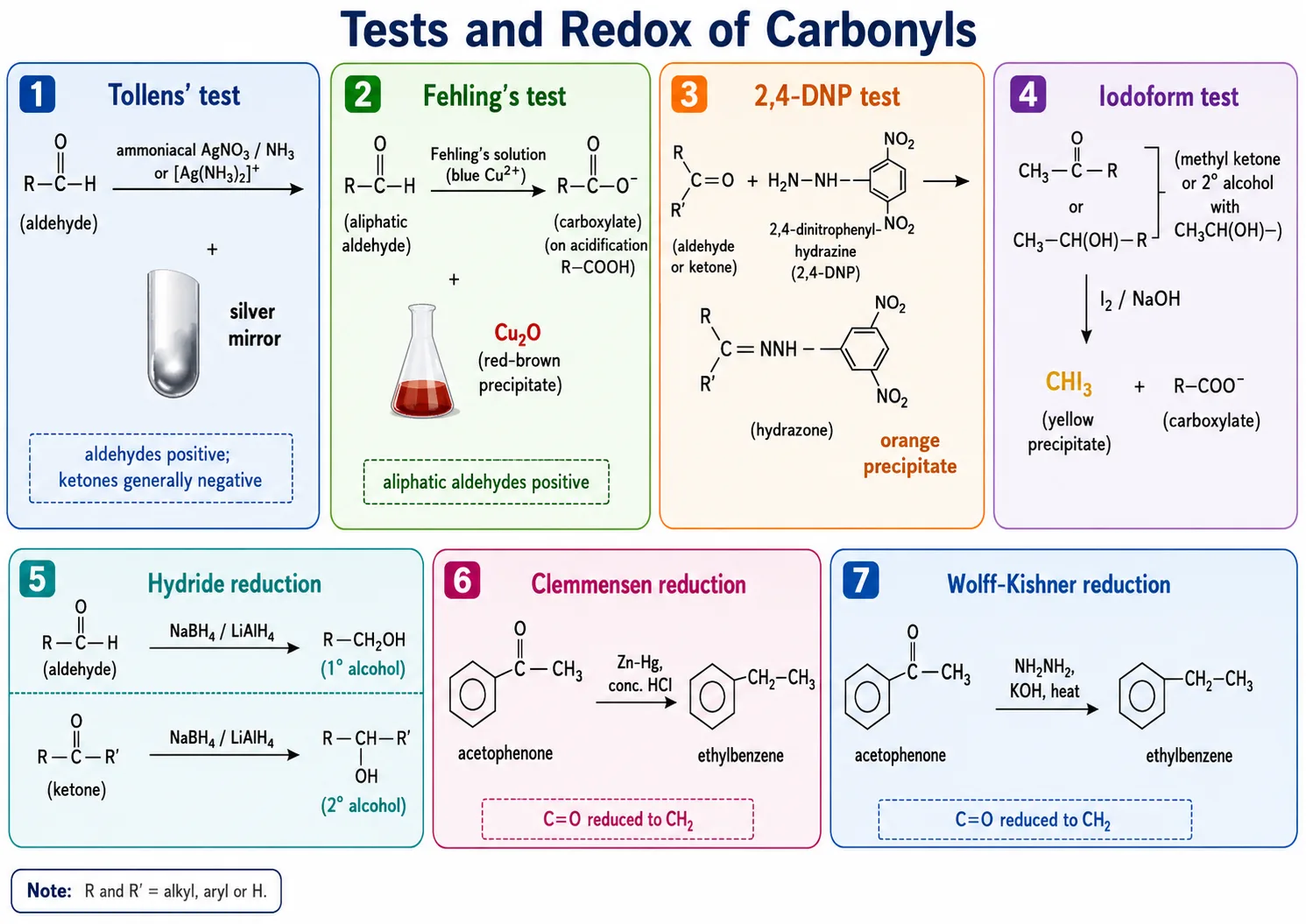
Key Point: NaBH/LiAlH reduce C=O to alcohol; Clemmensen (Zn-Hg/HCl) and Wolff-Kishner (NHNH/KOH) reduce C=O all the way to CH.
Distinguishing Tests
Tollens' test (silver mirror): an aldehyde reduces Tollens' reagent [ammoniacal AgNO, Ag(NH)⁺] to a shiny silver mirror (metallic Ag). Ketones give no reaction.
Fehling's test: an aliphatic aldehyde reduces Fehling's solution (blue Cu) to a red-brown precipitate of CuO. Ketones and aromatic aldehydes (like benzaldehyde) do not respond.
2,4-DNP (Brady's) test: both aldehydes and ketones give an orange-yellow precipitate — confirms a carbonyl group (but does not distinguish aldehyde from ketone).
Iodoform test: compounds with a CH-CO- group (methyl ketones, ethanal) or a CH-CH(OH)- group give a yellow precipitate of iodoform (CHI) with I / NaOH. Used to detect a methyl ketone or ethanol/acetaldehyde.
Key Point: Tollens (silver mirror) and Fehling (red CuO) → aldehydes only; 2,4-DNP → any carbonyl; iodoform → CHCO- or CHCH(OH)- groups.
Solved Examples
Example 1: Distinguish aldehyde from ketone
How would you distinguish propanal from propanone?
Solution: Use Tollens' reagent: propanal gives a silver mirror; propanone gives no reaction. (Fehling's solution also works — propanal gives red CuO, propanone does not.)
Example 2: Reduce to alcohol
What product forms when propanone is reduced with NaBH?
Solution: The C=O is reduced to CH-OH, giving the secondary alcohol propan-2-ol.
Example 3: Clemmensen reduction
What is formed when acetophenone undergoes Clemmensen reduction?
Solution: The C=O is reduced to CH, giving ethylbenzene (CHCHCH) (reagents: Zn-Hg / conc. HCl).
Example 4: Wolff-Kishner
Give the product and reagents for the Wolff-Kishner reduction of cyclohexanone.
Solution: Cyclohexanone → cyclohexane using hydrazine (NHNH) then KOH/heat (the C=O becomes CH).
Example 5: Iodoform-positive?
Which of ethanal, propanal and propanone give a positive iodoform test?
Solution: Ethanal (CHCHO) and propanone (CHCOCH) have the CHCO- group → positive (yellow CHI). Propanal (CHCHCHO) has no CHCO- → negative.
Example 6: Fehling vs benzaldehyde
Does benzaldehyde respond to Fehling's test?
Solution: No. Fehling's solution oxidises only aliphatic aldehydes; aromatic aldehydes such as benzaldehyde do not give the red CuO precipitate (though benzaldehyde does give a Tollens' silver mirror).
Example 7: 2,4-DNP scope
Two unknown liquids both give an orange precipitate with 2,4-DNP. What does this tell you?
Solution: Both contain a carbonyl group (aldehyde or ketone). The 2,4-DNP test confirms a carbonyl but cannot distinguish an aldehyde from a ketone — a further test (Tollens/Fehling) is needed.
Example 8: Choosing the reduction
You must convert a ketone to an alkane but the molecule contains an acid-sensitive group. Which reduction?
Solution: Use the Wolff-Kishner reduction (NHNH, then KOH/heat) — it works in basic conditions, avoiding the strong acid of Clemmensen.
Example 9: Identify by tests
An unknown gives a silver mirror with Tollens and a yellow precipitate with iodoform. What is it likely to be?
Solution: Silver mirror ⇒ an aldehyde; positive iodoform ⇒ a CHCO-/CHCH(OH)- unit. The aldehyde with a CH-CO/CH-OH pattern that fits both is ethanal (CHCHO) (it is an aldehyde and has the CHCO- arrangement).
Example 10: Oxidation of a ketone
Why do ketones require strong oxidising agents, and what kind of products form?
Solution: Ketones have no H on the carbonyl carbon, so oxidation must break a C-C bond. Only strong oxidants under vigorous conditions do this, giving a mixture of smaller carboxylic acids.