
Master Memory Capsule — Aldehydes, Ketones & Carboxylic Acids
A one-glance revision sheet for the morning of your Board, JEE or NEET paper.
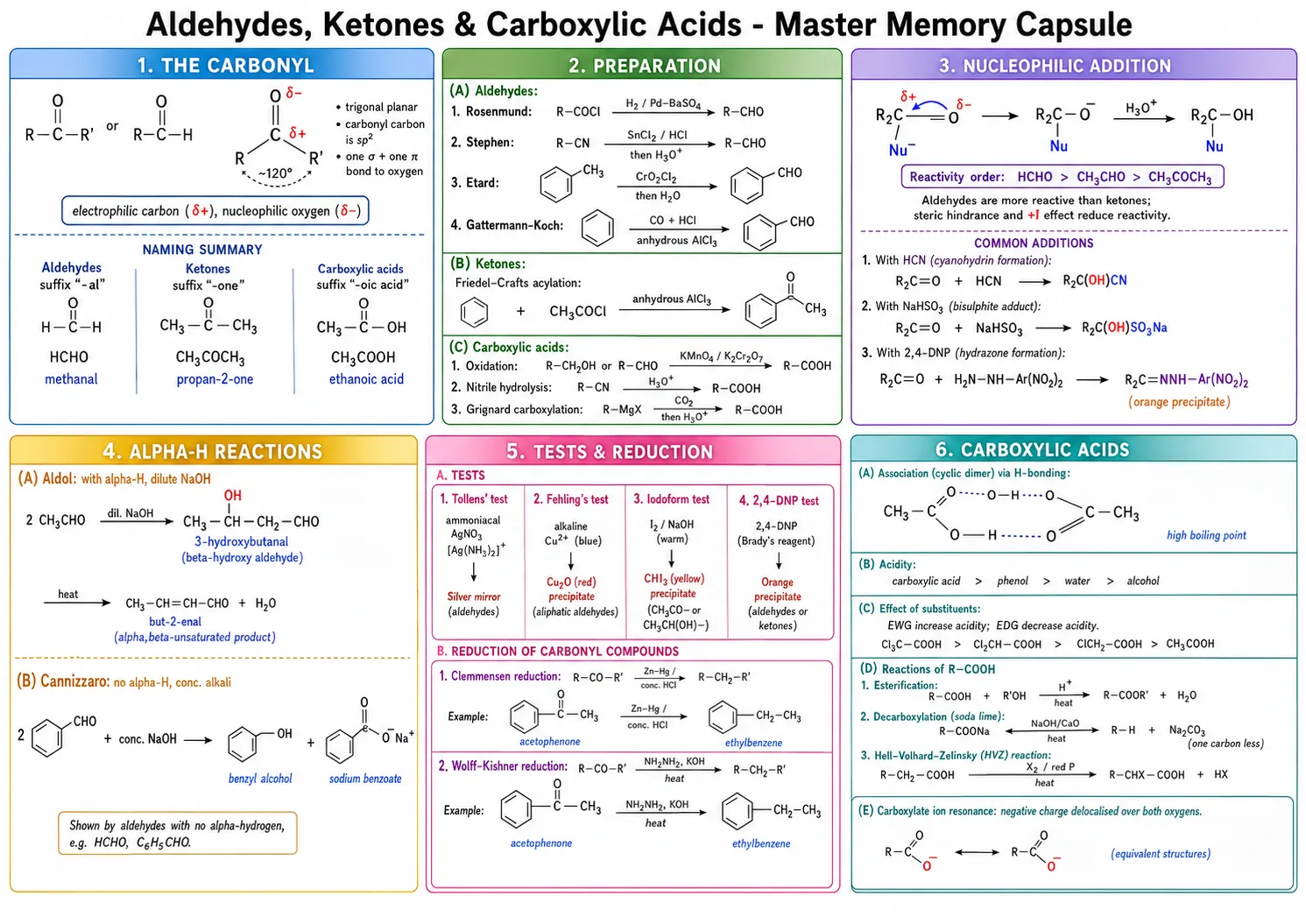
The carbonyl group: sp, planar, δ+ carbon / δ− oxygen — electrophilic carbon attacked by nucleophiles. Naming: aldehyde = -al (C-1), ketone = -one (lowest locant), acid = -oic acid (C-1).
Preparation — The Routes to Remember
Aldehydes: 1° alcohol + PCC; acyl chloride + H/Pd-BaSO (Rosenmund); nitrile + SnCl/HCl (Stephen); toluene + CrOCl (Etard); benzene + CO/HCl/AlCl (Gattermann-Koch).
Ketones: 2° alcohol oxidation; Friedel-Crafts acylation (arene + R-COCl/AlCl); nitrile + Grignard.
Carboxylic acids: oxidation of 1° alcohols/aldehydes (KMnO); side-chain oxidation of any alkylbenzene → benzoic acid; nitrile hydrolysis and Grignard + CO (both add one carbon); hydrolysis of acyl halides/anhydrides/esters.
Key Reactions & Named Reactions
Nucleophilic addition (aldehyde > ketone; HCHO most reactive): HCN → cyanohydrin; NaHSO → bisulphite adduct; alcohol → acetal; HN-Z → oxime/hydrazone/2,4-DNP/Schiff's base.
alpha-Hydrogen reactions: aldol (with alpha-H, dilute NaOH → beta-hydroxy carbonyl → alpha,beta-unsaturated on heating); Cannizzaro (no alpha-H, conc. alkali → alcohol + carboxylate).
Redox: aldehydes oxidise easily (Tollens, Fehling), ketones resist; reduce C=O to alcohol (NaBH/LiAlH) or to CH (Clemmensen Zn-Hg/HCl; Wolff-Kishner NHNH/KOH).
Carboxylic acids: salt + CO (NaHCO), esterification, acyl chloride (SOCl)/anhydride/amide, LiAlH → 1° alcohol, decarboxylation (soda lime), HVZ alpha-halogenation, meta-directing on the ring.
Tests, Acidity & Last-Minute Triggers
Distinguishing tests: 2,4-DNP = any carbonyl; Tollens (silver mirror) / Fehling (red CuO) = aldehydes (Fehling only aliphatic); iodoform (yellow CHI) = CHCO-/CHCH(OH)-; NaHCO effervescence = carboxylic acid; neutral FeCl violet = phenol.
Acidity: carboxylic acid > phenol > water > alcohol. EWG (Cl, NO) raise acidity (CClCOOH strongest); EDG (alkyl) lower it (HCOOH > CHCOOH).
Important compounds: formalin (preservative), acetone (solvent, cumene process), acetic acid (vinegar), sodium benzoate (food preservative), fatty-acid salts (soaps).
One-line recall: δ+ carbonyl carbon → nucleophilic addition (aldehyde > ketone); alpha-H → aldol, no alpha-H → Cannizzaro; Tollens/Fehling spot aldehydes, iodoform spots methyl ketones; acid > phenol > water > alcohol with EWG up / EDG down; remember Rosenmund, Stephen, Etard, Gattermann-Koch, Clemmensen, Wolff-Kishner, HVZ, decarboxylation.