
Boiling Points of Aldehydes and Ketones
Aldehydes and ketones are polar (because of the C=O dipole), so their molecules attract each other by dipole-dipole forces. This makes their boiling points higher than those of non-polar compounds (alkanes) or weakly polar ethers of comparable molecular mass.
However, aldehydes and ketones cannot form hydrogen bonds with each other — they have no O-H or N-H. So their boiling points are lower than those of the corresponding alcohols and carboxylic acids, which are H-bonded.
So the boiling-point order for similar molecular masses is: carboxylic acid > alcohol > aldehyde/ketone > ether > alkane.
For example (similar masses): butan-1-ol (118 °C) > butanal (76 °C) > diethyl ether (35 °C).
Key Point: aldehydes/ketones boil higher than alkanes and ethers (dipole-dipole) but lower than alcohols/acids (no inter-molecular H-bonding).
Solubility and Other Physical Properties
Solubility in water: the lower aldehydes and ketones (up to about 4 carbons — methanal, ethanal, propanone) are miscible with water. This is because the carbonyl oxygen can accept hydrogen bonds from water molecules. As the hydrocarbon chain grows, the non-polar part dominates and solubility falls (higher members are nearly insoluble).
Smell: the lower members have sharp, pungent smells; many higher aldehydes and ketones have pleasant, flowery smells and are used in perfumes.
State: methanal is a gas, ethanal is a volatile liquid, and the rest of the common aldehydes and ketones are liquids or solids.
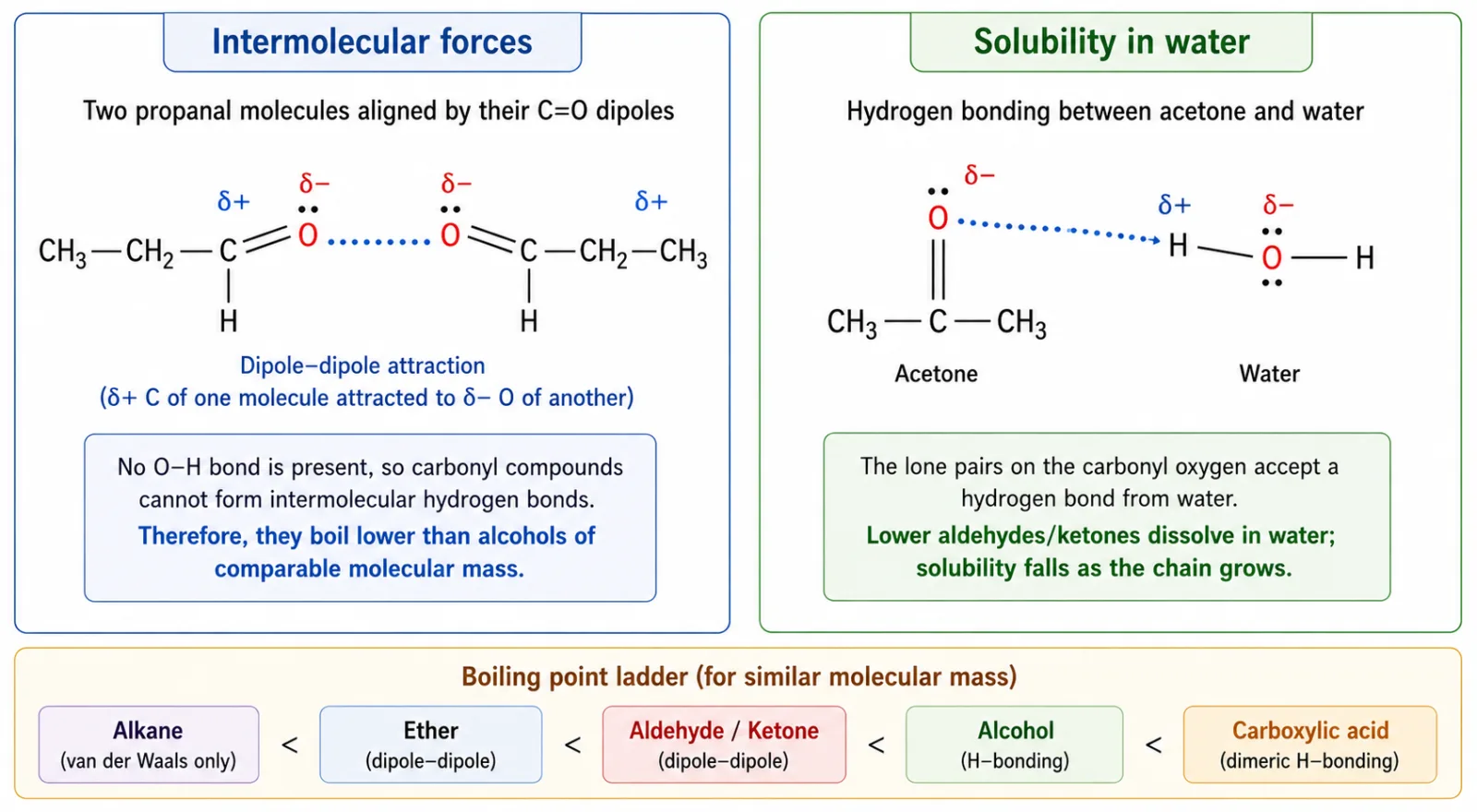
Key Point: lower aldehydes/ketones dissolve in water (carbonyl O accepts H-bonds from water); solubility decreases as the carbon chain lengthens.
Comparing the Trends — Why It Matters in Exams
Two comparisons are exam favourites:
1. Boiling point of a ketone vs its isomeric alcohol/acid. Butanal and butan-1-ol have similar masses, but butan-1-ol boils much higher because alcohols hydrogen-bond to each other while aldehydes only have dipole-dipole forces.
2. Within aldehydes/ketones, boiling point rises with molecular mass (more surface area, stronger van der Waals forces).
[NEET Important] A common question gives four compounds of similar mass (an alkane, an ether, an aldehyde, an alcohol) and asks you to order their boiling points. The answer always follows: alcohol > aldehyde/ketone > ether > alkane, because of the strength of the intermolecular forces (H-bond > dipole-dipole > weak dipole > dispersion only).
Key Point: order intermolecular forces — H-bonding > dipole-dipole > London dispersion — to rank boiling points of carbonyls against alcohols, ethers and alkanes.
Solved Examples
Example 1: Boiling point comparison
Why does butan-1-ol (b.p. 118 °C) boil much higher than butanal (b.p. 76 °C) though they have the same molecular mass?
Solution: Butan-1-ol molecules form intermolecular hydrogen bonds (O-H···O), which need extra energy to break. Butanal has no O-H, so its molecules attract only by dipole-dipole forces, which are weaker — so it boils lower.
Example 2: Carbonyl vs ether
Which has the higher boiling point: propanone or diethyl ether (similar masses)? Why?
Solution: Propanone boils higher. The C=O group is more polar, giving stronger dipole-dipole attractions than the weakly polar ether.
Example 3: Water solubility
Why is acetone miscible with water but hexan-2-one is not?
Solution: Acetone's carbonyl oxygen hydrogen-bonds with water and its small size keeps the molecule overall polar. In hexan-2-one the long hydrocarbon chain dominates and disrupts H-bonding with water, so it is nearly insoluble.
Example 4: Ordering boiling points
Arrange in increasing boiling point: butane, butan-1-ol, butanal, diethyl ether (similar masses).
Solution: butane < diethyl ether < butanal < butan-1-ol (dispersion < weak dipole < dipole-dipole < hydrogen bonding).
Example 5: Why carbonyls are soluble
Explain in one line why lower ketones dissolve in water despite having no O-H.
Solution: The lone pairs on the carbonyl oxygen accept hydrogen bonds from water's O-H, so small ketones mix with water.
Example 6: Trend with chain length
How does the water solubility of aldehydes change from methanal to decanal?
Solution: Solubility decreases as the chain lengthens. Methanal is very soluble; decanal (a long chain) is essentially insoluble, because the non-polar part dominates.
Example 7: Comparing two ketones
Which boils higher, propanone or pentan-2-one? Why?
Solution: Pentan-2-one, because it has the larger molecular mass and surface area, giving stronger van der Waals (dispersion) forces in addition to the dipole-dipole attraction.
Example 8: Aldehyde vs alkane
Why does propanal boil higher than butane though butane is heavier?
Solution: Propanal is polar (dipole-dipole forces from C=O); butane is non-polar (only weak dispersion forces). The stronger dipole-dipole attraction in propanal outweighs butane's slightly higher mass.
Example 9: Identifying strongest IMF
Among ethanol, ethanal and ethane, which has the strongest intermolecular forces?
Solution: Ethanol — it forms hydrogen bonds. Ethanal has dipole-dipole forces; ethane has only dispersion forces.
Example 10: Predicting state
At room temperature, methanal is a gas while benzaldehyde is a liquid. Explain.
Solution: Methanal is the smallest carbonyl with weak total intermolecular forces → gas. Benzaldehyde is much larger with stronger dispersion (and dipole) forces → liquid.