
Preparation of Aldehydes & Ketones — From Alcohols and Hydrocarbons
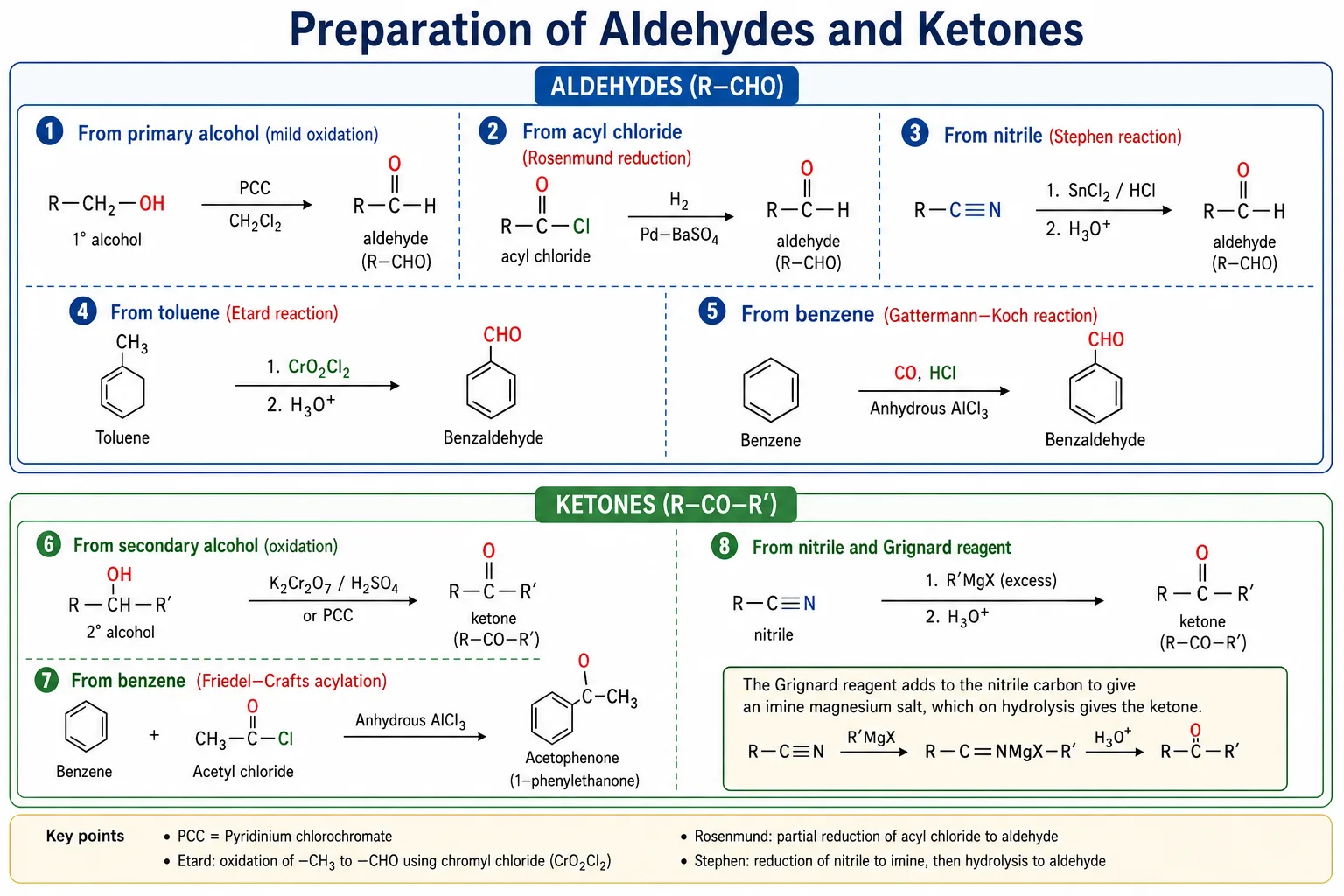
From alcohols (oxidation/dehydrogenation): a 1° alcohol gives an aldehyde (use a mild oxidant like PCC to stop at the aldehyde; strong oxidants over-oxidise to the acid). A 2° alcohol gives a ketone. Passing alcohol vapour over hot copper at 573 K dehydrogenates 1° → aldehyde and 2° → ketone.
From alkenes (ozonolysis): an alkene treated with O then Zn/HO is cleaved at the double bond into carbonyl compounds (aldehydes and/or ketones), depending on the substitution at each end.
From alkynes (hydration): adding water across a triple bond (dil. HSO / HgSO) gives a carbonyl. Ethyne → ethanal; any other alkyne → a ketone (Markovnikov addition of water, then tautomerism of the enol).
Key Point: 1° alcohol → aldehyde (PCC), 2° alcohol → ketone; ozonolysis cleaves C=C into carbonyls; alkyne hydration gives ethanal (from ethyne) or a ketone (from others).
Preparation of Aldehydes — From Acyl Chlorides and Nitriles
Rosenmund reduction (acyl chloride → aldehyde): an acyl chloride is hydrogenated over palladium on barium sulphate (Pd-BaSO, a poisoned catalyst) to give an aldehyde. The poison stops the reduction at the aldehyde stage (otherwise it would go to the alcohol):
R-COCl + H →(Pd-BaSO)→ R-CHO + HCl
Stephen reaction (nitrile → aldehyde): a nitrile is reduced with SnCl/HCl to an imine, which on hydrolysis gives an aldehyde: R-C≡N → R-CHO. (Alternatively, partial reduction with DIBAL-H gives the aldehyde.)
From nitriles with Grignard (→ ketone): a nitrile reacts with a Grignard reagent and the imine salt is hydrolysed to a ketone: R-C≡N + R'MgX → R-CO-R'.
Key Point: Rosenmund (R-COCl + H/Pd-BaSO) and Stephen (R-CN + SnCl/HCl) both give aldehydes; a nitrile + Grignard gives a ketone.
Preparation of Aromatic Carbonyls — From Arenes
Etard reaction (toluene → benzaldehyde): toluene is oxidised by chromyl chloride (CrOCl); the chromium complex formed is hydrolysed to benzaldehyde. The mild conditions stop oxidation at the aldehyde.
Gattermann-Koch reaction: benzene (or a derivative) is treated with CO + HCl in the presence of anhydrous AlCl (or CuCl) to give benzaldehyde directly — a formylation.
Friedel-Crafts acylation (→ aryl ketone): an arene reacts with an acyl chloride/anhydride and anhydrous AlCl to give an aromatic ketone (e.g. benzene + CHCOCl → acetophenone).
Key Point: Etard (toluene + CrOCl) and Gattermann-Koch (CO/HCl/AlCl) give benzaldehyde; Friedel-Crafts acylation gives an aryl ketone.
Solved Examples
Example 1: 1° vs 2° alcohol oxidation
What carbonyl forms when (a) propan-1-ol and (b) propan-2-ol are oxidised by PCC?
Solution: (a) Propan-1-ol (1°) → propanal (PCC stops at the aldehyde). (b) Propan-2-ol (2°) → propanone (acetone).
Example 2: Rosenmund reduction
Give the product and explain the role of the catalyst when CHCOCl is treated with H/Pd-BaSO.
Solution: Product is ethanal (CHCHO). The BaSO poisons the Pd so the reduction stops at the aldehyde and does not continue to ethanol.
Example 3: Ozonolysis
What are the products of ozonolysis (O, then Zn/HO) of 2-methylbut-2-ene?
Solution: The double bond cleaves between the two carbons. (CH)C=CHCH gives propanone (acetone) from the (CH)C= end and ethanal from the =CHCH end.
Example 4: Alkyne hydration
What is formed when (a) ethyne and (b) propyne are hydrated (dil. HSO/HgSO)?
Solution: (a) Ethyne → ethanal (acetaldehyde) — the only alkyne giving an aldehyde. (b) Propyne → propanone (acetone) by Markovnikov addition.
Example 5: Stephen reaction
How is CHCHCN converted to propanal?
Solution: Stephen reaction: reduce the nitrile with SnCl/HCl to the imine (R-CH=NH), then hydrolyse to give propanal (CHCHCHO).
Example 6: Nitrile + Grignard → ketone
What ketone forms from CHCN + CHMgBr followed by hydrolysis?
Solution: The Grignard adds to the nitrile carbon; hydrolysis of the imine salt gives butan-2-one (CHCOCHCH).
Example 7: Etard reaction
How is benzaldehyde prepared from toluene by the Etard reaction?
Solution: Toluene is treated with chromyl chloride (CrOCl) in CS; the brown chromium complex is hydrolysed to give benzaldehyde. The mild oxidation stops at -CHO.
Example 8: Gattermann-Koch
Give the reagents for converting benzene to benzaldehyde by the Gattermann-Koch reaction.
Solution: Treat benzene with carbon monoxide and hydrogen chloride in the presence of anhydrous AlCl (or CuCl) → benzaldehyde.
Example 9: Friedel-Crafts acylation
Predict the product of benzene + CHCOCl with anhydrous AlCl.
Solution: Friedel-Crafts acylation introduces the acetyl group onto the ring → acetophenone (CHCOCH).
Example 10: Choosing the route to an aldehyde
You need benzaldehyde from benzoyl chloride without forming the alcohol. Which reaction?
Solution: Use Rosenmund reduction: CHCOCl + H over Pd-BaSO gives benzaldehyde, the poisoned catalyst preventing over-reduction to benzyl alcohol.