
Physical Properties — The Hydrogen-Bonded Dimer
Carboxylic acids form strong intermolecular hydrogen bonds. In fact two acid molecules pair up into a cyclic dimer, held by two O-H···O hydrogen bonds. Because of this strong association, carboxylic acids have very high boiling points compared with compounds of similar molar mass, and they are generally higher than alcohols of similar mass.
Solubility: the lower acids (formic to butanoic) are miscible with water because -COOH forms hydrogen bonds with water. Solubility decreases as the carbon chain grows. The first four are completely miscible; higher acids are nearly insoluble in water but dissolve in organic solvents.
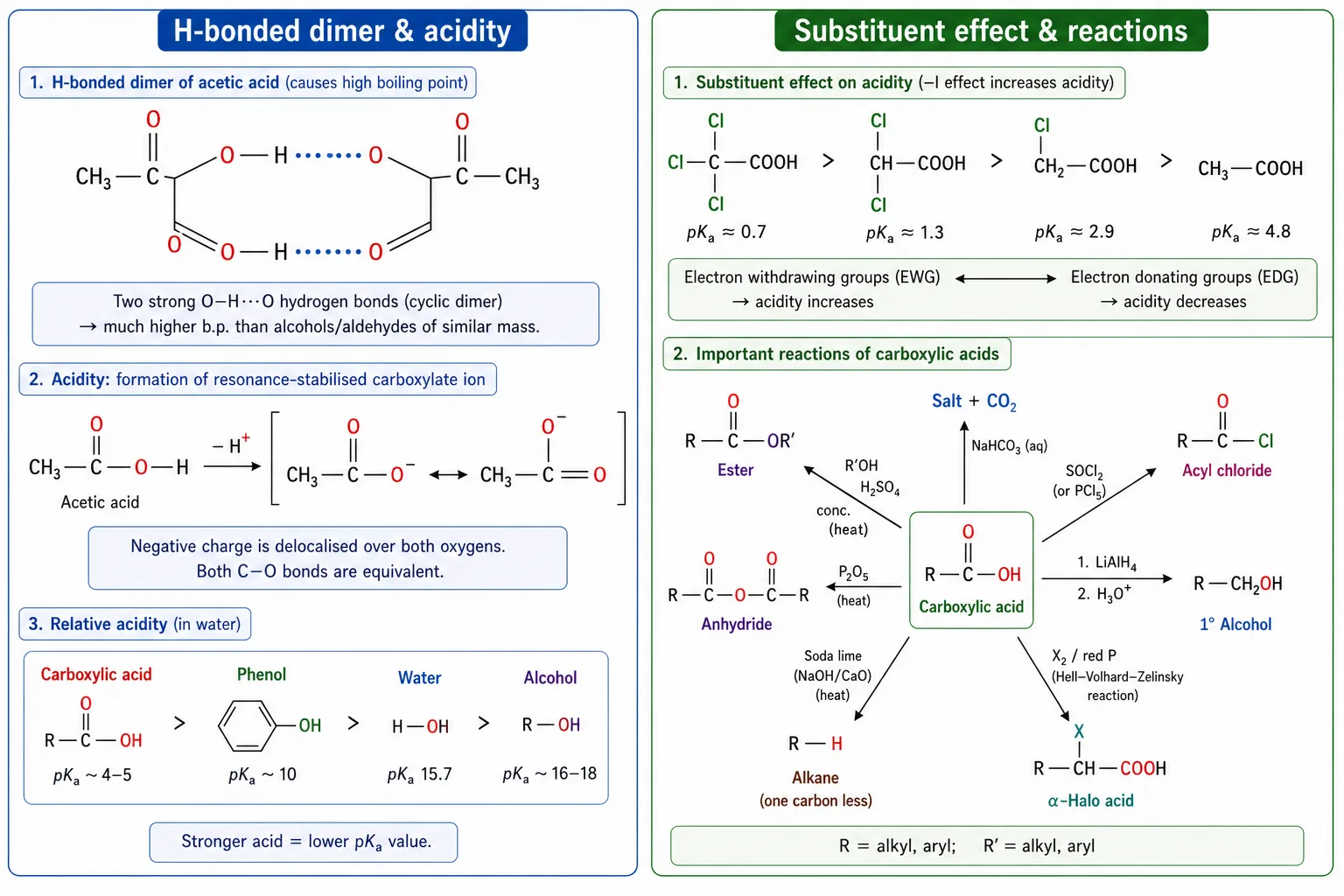
Key Point: carboxylic acids exist as H-bonded dimers → very high boiling points; lower acids are water-soluble (H-bond with water), solubility falls with chain length.
Acidity of Carboxylic Acids
Carboxylic acids are among the stronger common organic acids: carboxylic acid > phenol > water > alcohol. They turn blue litmus red and react with bases.
Why so acidic? When -COOH loses its proton, the carboxylate ion (R-COO⁻) is strongly stabilised by resonance — the negative charge is equally shared over both oxygen atoms (the two C-O bonds become identical). This is far more effective than the phenoxide ion's delocalisation into a ring, so a carboxylic acid is much stronger than a phenol.
Effect of substituents:
- Electron-withdrawing groups (EWG) like -Cl, -NO increase acidity (they stabilise the carboxylate). More EWG, and closer to -COOH, means stronger acid. So CClCOOH > CHClCOOH > CHClCOOH > CHCOOH.
- Electron-donating groups (EDG) like -CH decrease acidity. So acetic acid is weaker than formic acid (HCOOH > CHCOOH).
Key Point: acidity order = carboxylic acid > phenol > water > alcohol. EWG (Cl, NO) raise acidity; EDG (alkyl) lower it. Carboxylate is resonance-stabilised over two equal oxygens.
Chemical Reactions of Carboxylic Acids
Salt formation: react with NaOH, NaHCO or NaCO to give the carboxylate salt + CO (the brisk effervescence with NaHCO is a test for -COOH, distinguishing it from phenol).
Esterification: with an alcohol + conc. HSO (catalyst) gives an ester + water (reversible). The mechanism goes via protonation, nucleophilic addition of the alcohol, and loss of water.
Formation of derivatives: -COOH is converted to:
- acyl chloride with PCl, PCl or SOCl;
- anhydride by heating with PO (or with a second acid molecule);
- amide by heating its ammonium salt (loss of water).
Reduction: LiAlH (or BH) reduces -COOH to a primary alcohol (note: NaBH does not reduce -COOH).
Decarboxylation: heating the sodium salt with soda lime (NaOH/CaO) removes -COOH as CO, giving an alkane with one carbon fewer.
Hell-Volhard-Zelinsky (HVZ) reaction: an acid with an alpha-H reacts with Cl/Br in the presence of red phosphorus to give an alpha-halo acid.
Ring substitution (aromatic acids): -COOH is deactivating and meta-directing, so benzoic acid undergoes EAS (nitration, halogenation) mainly at the meta position.
Key Point: key acid reactions — salts (NaHCO test), esterification, acyl chloride/anhydride/amide, LiAlH reduction to 1° alcohol, decarboxylation (soda lime), HVZ alpha-halogenation, meta-directing on the ring.
Solved Examples
Example 1: Distinguish acid from phenol
How do you distinguish acetic acid from phenol?
Solution: Add NaHCO: acetic acid gives brisk effervescence (CO); phenol does not react. (Phenol gives a violet colour with neutral FeCl.)
Example 2: Acidity order of chloro acids
Arrange in increasing acidity: acetic acid, chloroacetic acid, trichloroacetic acid.
Solution: acetic acid < chloroacetic acid < trichloroacetic acid. More electron-withdrawing -Cl groups stabilise the carboxylate, increasing acidity.
Example 3: Esterification
Give the product of CHCOOH + CHOH with conc. HSO.
Solution: Ethyl ethanoate (CHCOOCH) + water. The acid is the catalyst; the reaction is reversible (Fischer esterification).
Example 4: HCOOH vs CHCOOH
Which is the stronger acid, formic or acetic acid? Why?
Solution: Formic acid (HCOOH) is stronger. Acetic acid's -CH group donates electron density (+I), destabilising the acetate ion, so it is the weaker acid.
Example 5: Decarboxylation
What forms when sodium acetate is heated with soda lime?
Solution: Decarboxylation removes CO: CHCOONa + NaOH (CaO) → CH (methane) + NaCO. The product has one carbon fewer.
Example 6: HVZ reaction
Give the product when acetic acid is treated with Cl/red phosphorus.
Solution: Hell-Volhard-Zelinsky alpha-chlorination gives chloroacetic acid (ClCHCOOH).
Example 7: Reduction of an acid
What product forms when propanoic acid is reduced with LiAlH?
Solution: -COOH is reduced to -CHOH, giving the primary alcohol propan-1-ol (CHCHCHOH). (NaBH would not reduce the acid.)
Example 8: Acyl chloride formation
How is ethanoyl chloride made from acetic acid?
Solution: Treat acetic acid with SOCl (or PCl/PCl): CHCOOH + SOCl → CHCOCl + SO + HCl (SOCl is preferred — the by-products are gases).
Example 9: Directing effect in benzoic acid
Where does nitration of benzoic acid occur, and why?
Solution: The -COOH group is deactivating and meta-directing, so nitration gives mainly m-nitrobenzoic acid (the electrophile enters the meta position).
Example 10: Why carboxylic acid is more acidic than phenol
Explain why ethanoic acid is more acidic than phenol.
Solution: The carboxylate ion spreads its negative charge equally over two oxygen atoms by resonance, which is far more stabilising than the phenoxide ion's delocalisation onto ring carbons. The more stable conjugate base makes the carboxylic acid the stronger acid.