
The Carbonyl Group — Structure
Aldehydes, ketones and carboxylic acids all contain the carbonyl group, C=O. In an aldehyde the carbonyl carbon carries at least one hydrogen (R-CHO); in a ketone it is bonded to two carbon groups (R-CO-R').
Geometry and bonding: the carbonyl carbon is sp hybridised and trigonal planar (bond angles ≈ 120°). The C=O bond is made of one σ bond and one π bond, like C=C, but it is strongly polar because oxygen is far more electronegative than carbon.
Polarity is everything: the bonding electrons are pulled toward oxygen, giving the carbon a partial positive charge (δ+) and the oxygen a partial negative charge (δ−). The carbon is therefore electrophilic (attacked by nucleophiles) and the oxygen is nucleophilic/basic (attacked by electrophiles or protons). This single fact controls the whole chapter.
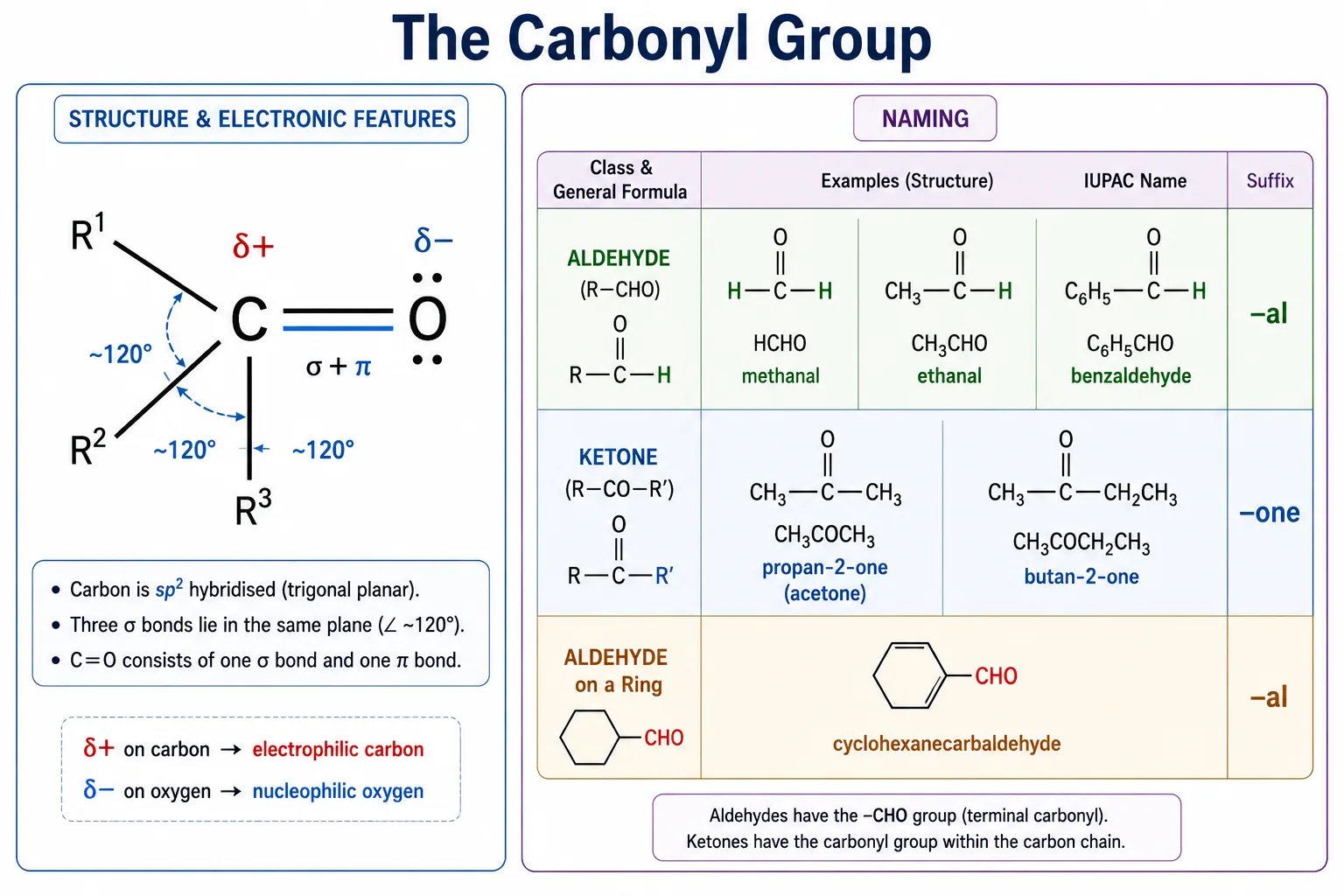
Key Point: the carbonyl carbon is sp, planar and δ+ (electrophilic); the oxygen is δ−. Aldehyde = at least one H on C=O; ketone = two carbons on C=O.
Nomenclature of Aldehydes
Common names of aldehydes come from the common names of the corresponding carboxylic acids (replace -ic acid with -aldehyde): HCHO = formaldehyde, CHCHO = acetaldehyde, CHCHO = benzaldehyde.
IUPAC names (alkanal): replace the -e of the parent alkane with -al. The -CHO carbon is always C-1.
- HCHO → methanal
- CHCHO → ethanal
- CHCHCHO → propanal
- (CH)CHCHO → 2-methylpropanal
For a -CHO attached to a ring, add -carbaldehyde (e.g. cyclohexanecarbaldehyde, benzenecarbaldehyde = benzaldehyde).
Key Point: aldehyde IUPAC = alkane → alkanal; -CHO is C-1. Ring-CHO = carbaldehyde.
Nomenclature of Ketones
Common names of ketones name the two alkyl/aryl groups attached to the C=O, followed by ketone: CHCOCH = dimethyl ketone (acetone), CHCOCH = ethyl methyl ketone, CHCOCH = methyl phenyl ketone (acetophenone).
IUPAC names (alkanone): replace the -e of the alkane with -one, and give the carbonyl carbon the lowest possible number.
- CHCOCH → propan-2-one
- CHCOCHCH → butan-2-one
- CHCHCOCHCH → pentan-3-one
[JEE Tip] Number the chain from the end nearer the C=O. For aldehydes the -CHO is automatically C-1 (no number needed for the suffix); for ketones the position of the C=O must be shown (e.g. pentan-2-one vs pentan-3-one).
Key Point: ketone IUPAC = alkane → alkanone, with the lowest locant for C=O. Acetone = propan-2-one; acetophenone = 1-phenylethan-1-one.
Solved Examples
Example 1: IUPAC of an aldehyde
Give the IUPAC name of (CH)CHCHCHO.
Solution: The longest chain including -CHO is 4 carbons (butanal); the methyl branch is on C-3. Name: 3-methylbutanal.
Example 2: IUPAC of a ketone
Name CHCHCOCHCHCH.
Solution: Six-carbon chain with C=O. Numbering from the nearer end puts the carbonyl at C-3: hexan-3-one.
Example 3: Common to IUPAC
Convert the common name "ethyl methyl ketone" to its IUPAC name.
Solution: CH-CO-CHCH has a 4-carbon chain with C=O at C-2: butan-2-one.
Example 4: Aromatic carbonyl
Give the common and IUPAC names of CHCOCH.
Solution: Common = acetophenone (methyl phenyl ketone). IUPAC = 1-phenylethan-1-one (or 1-phenylethanone).
Example 5: Why is C=O polar?
Explain why the carbonyl group is polar and what this means for its reactions.
Solution: Oxygen is more electronegative than carbon, so the C=O electrons (especially the π electron density) are pulled toward oxygen, giving C a δ+ and O a δ−. The δ+ carbon is electrophilic and is therefore attacked by nucleophiles — the basis of nucleophilic addition.
Example 6: Hybridisation and shape
What is the hybridisation and geometry of the carbonyl carbon in propanone?
Solution: The carbonyl carbon is sp hybridised and the three groups around it lie in a plane at about 120° — it is trigonal planar.
Example 7: Ring aldehyde
Name the compound formed by attaching -CHO directly to a cyclohexane ring.
Solution: It is cyclohexanecarbaldehyde (the -CHO suffix on a ring uses -carbaldehyde).
Example 8: Lowest locant
Why is CHCOCHCHCH named pentan-2-one and not pentan-4-one?
Solution: The carbonyl must get the lowest possible locant. Numbering from the end nearer C=O gives position 2, so it is pentan-2-one.
Example 9: Distinguish aldehyde vs ketone by formula
Classify CHCHCHO and CHCOCH.
Solution: CHCHCHO has a hydrogen on the carbonyl carbon → it is an aldehyde (propanal). CHCOCH has the carbonyl carbon between two carbons → it is a ketone (propanone).
Example 10: Naming a substituted aldehyde
Give the IUPAC name of OHC-CH-CH-CHO.
Solution: A four-carbon chain with -CHO at both ends is a dialdehyde: butanedial (the two -CHO carbons are C-1 and C-4).