
The alpha-Hydrogen and Its Acidity
A hydrogen on the carbon next to the carbonyl (the alpha-carbon) is called an alpha-hydrogen. These hydrogens are weakly acidic because the carbanion (enolate) left behind is stabilised by resonance with the carbonyl group (the negative charge is shared with the electronegative oxygen).
This acidity is the basis of the aldol condensation — a reaction that forms a new carbon-carbon bond, making it very important in synthesis.
Key Point: an alpha-H is acidic because its enolate is resonance-stabilised by the carbonyl. Only carbonyls with an alpha-H undergo the aldol reaction.
Aldol Condensation
Aldol condensation: aldehydes/ketones that have at least one alpha-hydrogen react in the presence of dilute base (NaOH) to add to one another. One molecule's enolate (the nucleophile) attacks the carbonyl carbon of a second molecule, giving a beta-hydroxy aldehyde or ketone — the aldol.
CHCHO + CHCHO →(dil. NaOH)→ CH-CH(OH)-CH-CHO (3-hydroxybutanal, an "aldol")
On heating, the aldol readily loses water to give an alpha,beta-unsaturated carbonyl compound:
CH-CH(OH)-CH-CHO →(Δ, −HO)→ CH-CH=CH-CHO (but-2-enal)
Cross (crossed) aldol condensation: if two different carbonyls each with alpha-H are used, a mixture of products usually results. It is only useful when one partner has no alpha-H (e.g. benzaldehyde or formaldehyde), so it can act only as the carbonyl electrophile.
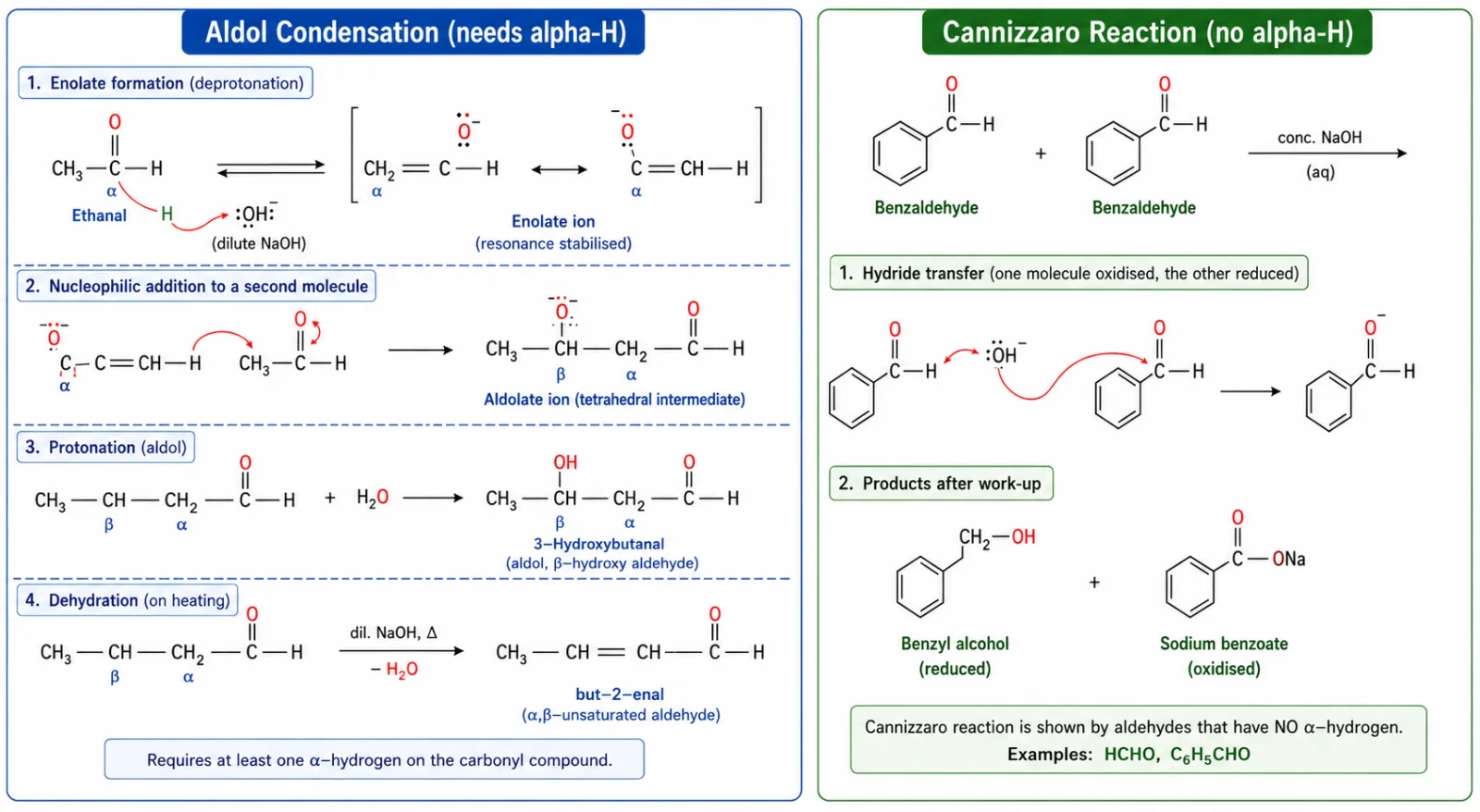
Key Point: aldol = base-catalysed self-addition of carbonyls with alpha-H → beta-hydroxy carbonyl → (heat) alpha,beta-unsaturated carbonyl. Cross-aldol is clean only when one partner lacks alpha-H.
Cannizzaro Reaction
The Cannizzaro reaction is the reaction of aldehydes that have NO alpha-hydrogen (e.g. HCHO, CHCHO, (CH)CCHO) with concentrated alkali. Since they cannot do aldol, they undergo disproportionation (self oxidation-reduction): one molecule is oxidised to the carboxylate salt and another is reduced to the alcohol.
2 CHCHO →(conc. NaOH)→ CHCHOH (benzyl alcohol) + CHCOO-Na+ (sodium benzoate)
For formaldehyde: 2 HCHO + NaOH → CHOH + HCOONa.
[NEET Important] The clue word is "no alpha-hydrogen + concentrated alkali" → Cannizzaro. If the aldehyde has an alpha-H, it does aldol instead.
Key Point: Cannizzaro = disproportionation of an aldehyde with no alpha-H in conc. alkali → an alcohol + a carboxylate salt.
Solved Examples
Example 1: Aldol product
Give the aldol product of two molecules of ethanal and the final dehydration product.
Solution: Aldol: 3-hydroxybutanal (CHCH(OH)CHCHO). On heating it loses water to give but-2-enal (CHCH=CHCHO).
Example 2: Which undergoes aldol?
Which can undergo aldol condensation: propanal or benzaldehyde?
Solution: Propanal has an alpha-H, so it undergoes aldol. Benzaldehyde has no alpha-H, so it cannot (it does Cannizzaro instead).
Example 3: Cannizzaro reaction
Give the products when benzaldehyde is warmed with concentrated NaOH.
Solution: Cannizzaro disproportionation: benzyl alcohol (CHCHOH) + sodium benzoate (CHCOONa).
Example 4: Acetone aldol
What is the aldol product of two molecules of propanone, and the dehydration product?
Solution: Aldol: 4-hydroxy-4-methylpentan-2-one ((CH)C(OH)CHCOCH). On dehydration: 4-methylpent-3-en-2-one (mesityl oxide).
Example 5: Cross-aldol choice
Why is the cross-aldol of benzaldehyde and ethanal useful, while ethanal + propanal is messy?
Solution: Benzaldehyde has no alpha-H, so it can only be the carbonyl electrophile; ethanal supplies the enolate → mainly one product (cinnamaldehyde, CHCH=CHCHO). Ethanal + propanal both have alpha-H and both can be nucleophile or electrophile → a mixture of products.
Example 6: Identify the reaction
(CH)CCHO is treated with conc. KOH. Name the reaction and the products.
Solution: It has no alpha-H, so it is the Cannizzaro reaction: products are (CH)CCHOH (neopentyl alcohol) + (CH)CCOO- K+.
Example 7: Why alpha-H is acidic
Explain why the alpha-hydrogen of an aldehyde is acidic.
Solution: Removing the alpha-H gives a carbanion (enolate) whose negative charge is delocalised onto the carbonyl oxygen by resonance. This stabilisation makes the alpha-H weakly acidic.
Example 8: Mechanism step of aldol
What acts as the nucleophile in the aldol reaction?
Solution: The enolate ion (the resonance-stabilised carbanion formed by removing an alpha-H) is the nucleophile; it attacks the carbonyl carbon of a second molecule.
Example 9: Predicting product type
What functional groups are present in the immediate aldol product?
Solution: A beta-hydroxy carbonyl — i.e. both a hydroxyl (-OH) group and a carbonyl (C=O) group (on the beta and the carbonyl carbons respectively).
Example 10: Distinguish via alpha-H
Which of methanal and ethanal undergoes Cannizzaro, and which undergoes aldol?
Solution: Methanal (HCHO) has no alpha-H → Cannizzaro. Ethanal (CHCHO) has an alpha-H → aldol. (A mixture of the two gives a crossed Cannizzaro where HCHO is preferentially oxidised, reducing ethanal to ethanol.)