
Why Amines Are Basic
Amines are bases because the lone pair on nitrogen accepts a proton to form a substituted ammonium ion:
The stronger the base, the more available the lone pair, and the more stable the cation () formed. We measure basic strength by (or ) — a larger / smaller means a stronger base.
Three factors control basic strength: the electron-donating/withdrawing effect of the groups (inductive/resonance), the stability of the cation in solution (solvation), and steric hindrance around the nitrogen.
Key Point: amines are basic because the N lone pair grabs a proton. Stronger base = more available lone pair + more stable, well-solvated cation. Larger = stronger base.
Basicity Order — Gas Phase vs Aqueous
Electron-donating alkyl groups (+I) push electron density onto nitrogen, making the lone pair more available — so on inductive grounds alone, basicity should rise 1° < 2° < 3°.
In the gas phase (no solvent), only the inductive effect matters, so the order is exactly: 3° > 2° > 1° > NH.
In water, two extra effects compete:
- Solvation: a cation with more N-H bonds is better stabilised by hydrogen bonding to water. So a 1° ammonium (, three N-H) is better solvated than a 3° ammonium (, one N-H), which favours the lower amines.
- Steric hindrance: bulky groups in 3° amines block solvation and proton approach.
The result is an irregular aqueous order. For methyl amines the observed order is: (CH)NH > CHNH > (CH)N > NH — the 2° amine is the strongest because it balances electron donation and solvation best.
Key Point: gas phase 3° > 2° > 1° > NH (pure +I). In water, solvation + sterics make the order irregular — for methylamines the 2° amine is most basic.
Aromatic Amines Are Weak Bases
Aniline (and other aromatic amines) are far WEAKER bases than aliphatic amines (and even weaker than ammonia). The reason: the nitrogen lone pair is delocalised into the benzene ring by resonance. Because the lone pair is partly tied up in the ring, it is much less available to accept a proton.
Also, after protonation the anilinium ion loses this resonance stabilisation, so protonation is unfavourable. Hence: aliphatic amine > ammonia > aniline in basic strength.
Effect of ring substituents on aniline:
- Electron-withdrawing groups (-NO) at o/p further decrease basicity (they pull the lone pair away even more). So p-nitroaniline is a weaker base than aniline.
- Electron-donating groups (-CH, -OCH) increase basicity relative to aniline. So p-toluidine (p-methylaniline) is a stronger base than aniline.
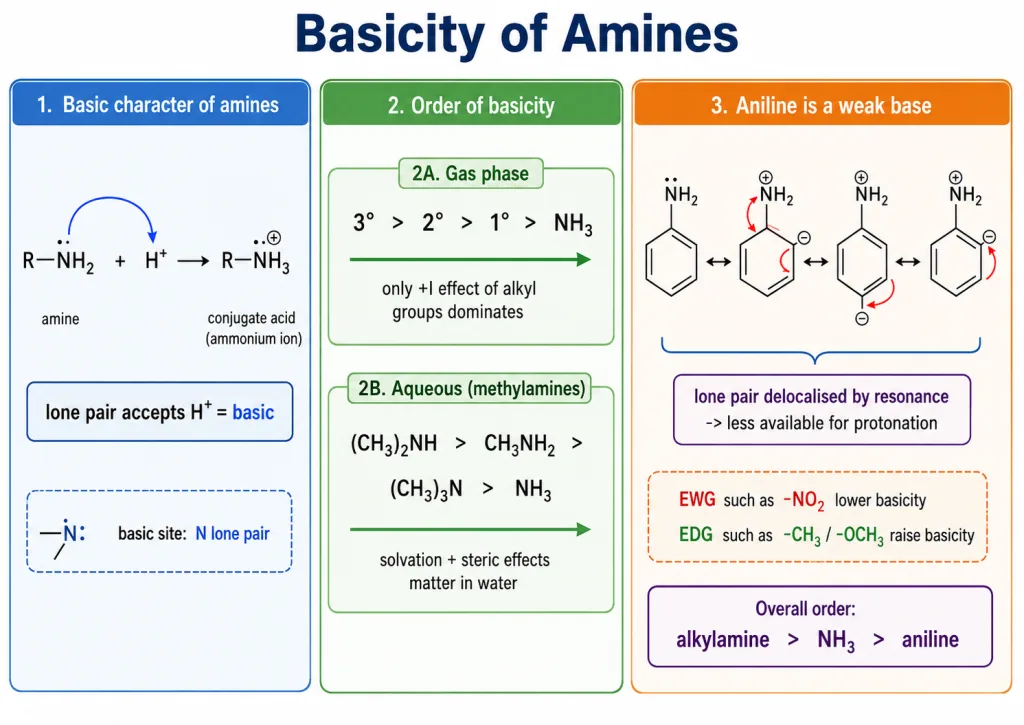
Key Point: aniline is a weak base — its lone pair is delocalised into the ring. EWG (-NO) lower its basicity, EDG (-CH, -OCH) raise it. Order: aliphatic amine > NH > aniline.
Solved Examples
Example 1: Aliphatic vs aromatic
Why is ethylamine a much stronger base than aniline?
Solution: In ethylamine the N lone pair is fully available (the ethyl group even donates electrons). In aniline the lone pair is delocalised into the benzene ring by resonance, so it is much less available to bind a proton — making aniline a far weaker base.
Example 2: Gas-phase order
Give the order of basic strength of methylamines in the gas phase.
Solution: In the gas phase only the +I effect operates, so: (CH)N > (CH)NH > CHNH > NH.
Example 3: Aqueous order
Give the observed order of basicity of methylamines in water and explain the position of trimethylamine.
Solution: (CH)NH > CHNH > (CH)N > NH. Trimethylamine (3°) drops because its cation has only one N-H (poorly solvated) and the three methyls cause steric hindrance, so despite the strongest +I it is not the strongest base in water.
Example 4: Substituted anilines
Arrange in increasing basicity: aniline, p-nitroaniline, p-toluidine.
Solution: p-nitroaniline < aniline < p-toluidine. The -NO (EWG) lowers basicity; the -CH (EDG) raises it.
Example 5: Why aniline loses on protonation
Use resonance to explain why aniline resists protonation.
Solution: In aniline the lone pair is delocalised into the ring (resonance), stabilising the molecule. Protonation removes this delocalisation (the lone pair is now bonded to H), so the protonated form is less stable — making aniline a poor base.
Example 6: NH vs aniline
Which is the stronger base, ammonia or aniline?
Solution: Ammonia. Its lone pair is fully available, whereas aniline's lone pair is partly delocalised into the ring — so ammonia is the stronger base.
Example 7: Effect of two nitro groups
Predict the relative basicity of aniline, p-nitroaniline and 2,4-dinitroaniline.
Solution: More electron-withdrawing nitro groups pull the lone pair away further, so basicity decreases: 2,4-dinitroaniline < p-nitroaniline < aniline.
Example 8: Methoxy effect
Is p-anisidine (p-methoxyaniline) a stronger or weaker base than aniline?
Solution: Stronger. The -OCH group is electron-donating (by resonance/+I at para), increasing electron density on nitrogen and so increasing basicity.
Example 9: Measuring basicity
If amine A has and amine B has , which is the stronger base?
Solution: Amine A. A smaller (larger ) means a stronger base.
Example 10: Overall order
Arrange in decreasing basic strength: CHNH, NH, CHNH.
Solution: CHNH > NH > CHNH. The alkylamine's lone pair is most available; ammonia is intermediate; aniline's lone pair is delocalised into the ring (weakest).