
Master Memory Capsule — Amines
A one-glance revision sheet for the morning of your Board, JEE or NEET paper.
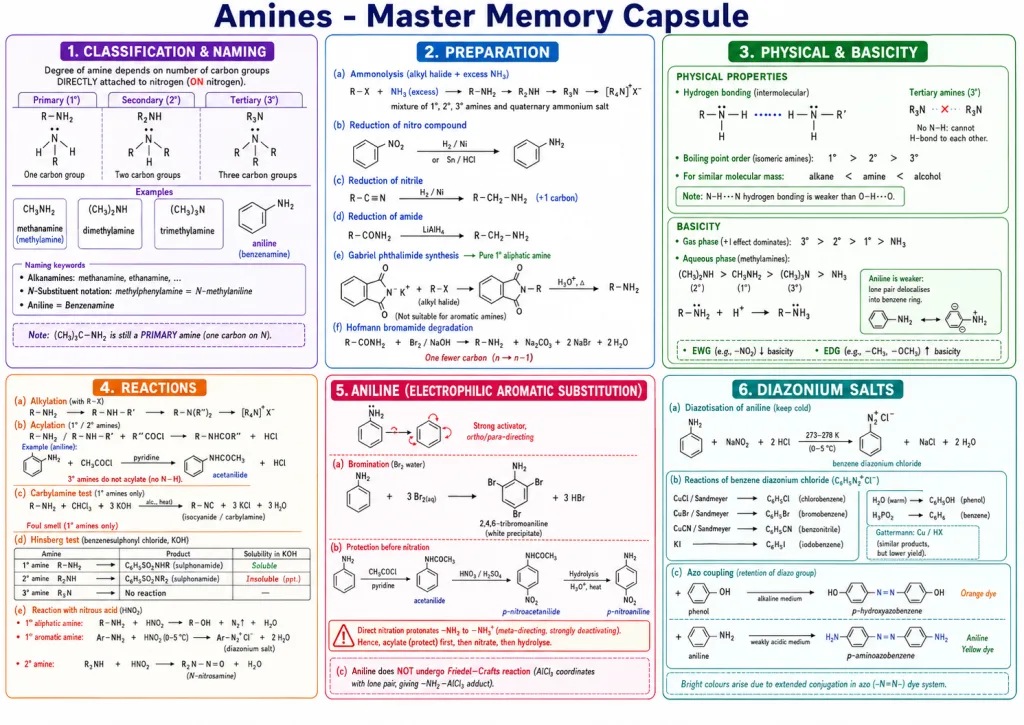
Classification & naming: 1°/2°/3° amines are classified by the number of carbon groups attached to nitrogen. Thus, (CH)CNH is a 1° amine because nitrogen is attached to only one carbon group. IUPAC names use alkanamine; use N- prefixes when a substituent is attached to nitrogen. Aniline is also called benzenamine. The pyramidal N lone pair drives basicity and nucleophilicity.
Preparation & Physical Properties
Preparation: Ammonolysis of R-X gives a mixture of amines; excess NH favours the primary amine. Reduction of nitro compounds gives amines (nitrobenzene → aniline), nitriles give 1° amines and add one carbon, and amides are reduced by LiAlH. Gabriel phthalimide synthesis gives pure 1° aliphatic amines, not aromatic amines. Hofmann bromamide degradation converts an amide into a 1° amine with one fewer carbon atom.
Physical properties: 1° and 2° amines show intermolecular hydrogen bonding (N-H···N), so they boil above alkanes but below alcohols because nitrogen is less electronegative than oxygen. 3° amines have no N-H bond, so they boil lowest among isomeric amines. Lower amines are water-soluble and often have a fishy smell.
Basicity & Key Reactions
Basicity: In the gas phase, basicity follows 3° > 2° > 1° > NH due to the +I effect of alkyl groups. In aqueous solution, methylamines follow (CH)NH > CHNH > (CH)N > NH because solvation and steric effects reduce the basicity of tertiary amines. Aniline is a weak base because the lone pair on nitrogen is delocalised into the benzene ring; electron-withdrawing groups such as -NO decrease basicity, while electron-donating groups such as -CH and -OCH increase it. Overall, alkylamines > NH > aniline.
Reactions: Amines undergo alkylation to give quaternary ammonium salts, and 1°/2° amines undergo acylation to give amides; 3° amines do not undergo acylation in the same way because they have no N-H hydrogen. The carbylamine test is given only by 1° amines and produces a foul smell. The Hinsberg test distinguishes amines: 1° amines form sulfonamides that are soluble in alkali, 2° amines form insoluble sulfonamides, and 3° amines do not react. With nitrous acid, 1° aliphatic amines give alcohols with evolution of N, 1° aromatic amines form diazonium salts, and 2° amines form nitrosamines.
Aniline and electrophilic substitution: The -NH group strongly activates the ring and directs substitution to ortho/para positions. Bromine water gives 2,4,6-tribromoaniline. Before nitration, aniline should be acetylated to protect the -NH group; otherwise, in acidic medium it becomes -NH+ and is meta-directing. Aniline does not undergo Friedel-Crafts reactions because AlCl coordinates strongly with the lone pair on nitrogen.
Diazonium Salts & Last-Minute Triggers
Diazotisation: Ar-NH + NaNO + dil. HCl at 273–278 K gives Ar-N+Cl−. The cold condition is essential because aromatic diazonium salts are resonance-stabilised, whereas aliphatic diazonium salts decompose almost immediately.
Replacement of N: Sandmeyer reaction uses CuCl, CuBr or CuCN to replace the diazonium group by Cl, Br or CN. Gattermann reaction uses Cu/HX to give aryl chlorides or bromides in lower yield. KI gives Ar-I, HO gives phenol, HPO gives Ar-H, and Balz-Schiemann reaction converts the salt to Ar-F using HBF.
Coupling (retain -N=N-): Coupling with phenol gives p-hydroxyazobenzene; coupling with aniline gives aniline yellow. These reactions are the basis of azo dyes.
Key Point recall: classify by groups on nitrogen; Gabriel gives pure 1° aliphatic amines; nitrile reduction adds one carbon; Hofmann bromamide removes one carbon; basicity alkylamine > NH > aniline with EWG lowering and EDG increasing; carbylamine identifies 1° amines; Hinsberg separates 1°/2°/3° amines; protect aniline before nitration; diazonium salts undergo Sandmeyer, Gattermann, KI, HO, HPO and azo coupling reactions.