
Alkylation and Acylation
The amine nitrogen's lone pair makes it a good nucleophile, so amines react with electrophiles.
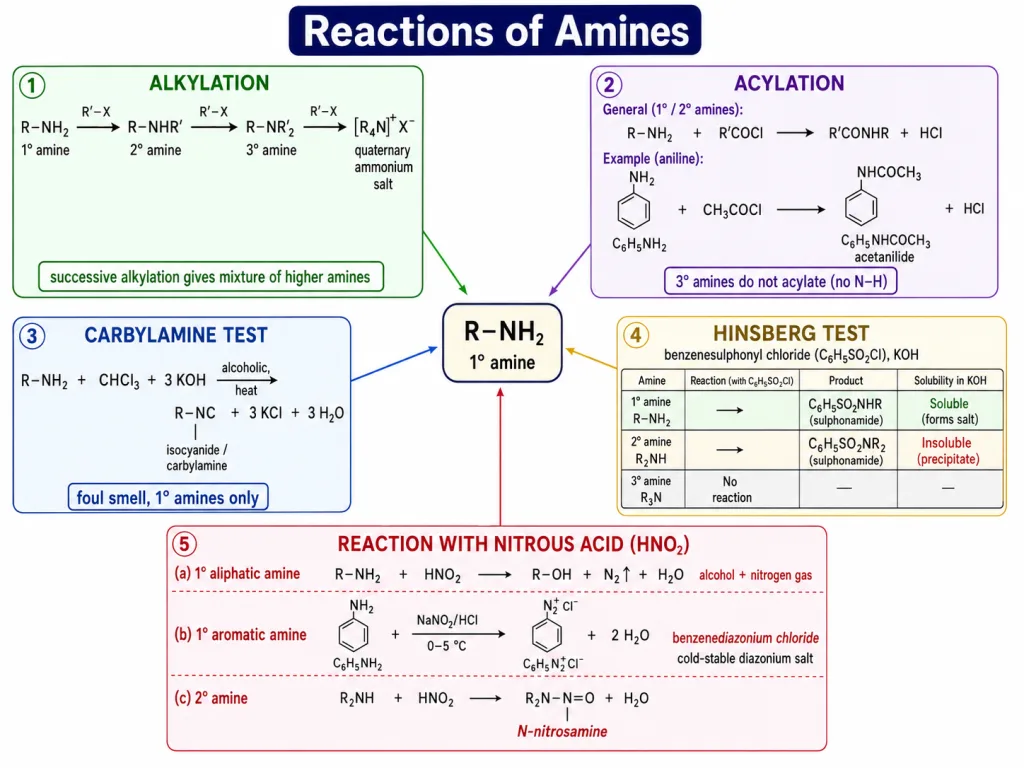
Alkylation: an amine reacts with an alkyl halide to give a higher amine, and with excess can go all the way to a quaternary ammonium salt (RNX). This is the same stepwise process as ammonolysis.
Acylation: 1° and 2° amines (which still have an N-H bond) react with acyl chlorides or anhydrides to give amides (the N-H is replaced by N-COR). The reaction is usually done in the presence of a base such as pyridine to remove the HCl formed.
CHNH + CHCOCl → CHNHCOCH (acetanilide) + HCl
3° amines do NOT acylate because they have no N-H bond.
Key Point: amines are nucleophiles — they alkylate (→ higher amines/quaternary salts) and acylate (1°/2° + acyl chloride → amide). 3° amines can't acylate because they have no N-H bond.
Carbylamine and Hinsberg Tests
Carbylamine (isocyanide) test — for 1° amines only: a primary amine (aliphatic or aromatic) heated with chloroform (CHCl) and alcoholic KOH gives an isocyanide (carbylamine) with a very foul, offensive smell. 2° and 3° amines do not respond, so this is a clean test for a primary amine.
R-NH + CHCl + 3 KOH → R-N≡C (carbylamine, foul smell) + 3 KCl + 3 HO
Hinsberg test — distinguishes 1°, 2°, 3°: the amine is shaken with Hinsberg's reagent (benzenesulphonyl chloride, CHSOCl) and then aqueous KOH:
- 1° amine → forms an N-substituted sulphonamide with an acidic N-H → soluble in KOH (clear solution).
- 2° amine → forms a sulphonamide with no N-H → insoluble (precipitate).
- 3° amine → has no N-H to react → no reaction (the amine stays as is).
Key Point: carbylamine (CHCl + KOH, foul smell) → only 1° amines. Hinsberg (CHSOCl): 1° → soluble, 2° → insoluble precipitate, 3° → no reaction.
Reaction with Nitrous Acid (HNO)
Nitrous acid (HNO, made in situ from NaNO + dilute HCl) reacts differently with each class — a key way to tell amines apart:
- 1° aliphatic amine → forms an unstable diazonium salt that decomposes immediately, giving an alcohol + N gas (brisk effervescence of nitrogen). R-NH + HNO → R-OH + N↑ + HO
- 1° aromatic amine → forms a stable at 0-5 °C diazonium salt at 273-278 K (the basis of all diazonium chemistry — next section). Ar-NH + HNO + HCl → Ar-NCl (at 0-5 °C)
- 2° amine (aliphatic or aromatic) → gives a yellow oily N-nitrosamine (RN-N=O).
- 3° amine → no useful reaction of this type (it has no N-H).
Key Point: with HNO — 1° aliphatic → alcohol + N; 1° aromatic → cold-stable diazonium salt; 2° → N-nitrosamine; 3° → no characteristic reaction.
Solved Examples
Example 1: Acylation of aniline
Give the product when aniline reacts with acetyl chloride.
Solution: Acylation of the N-H gives the amide acetanilide (CHNHCOCH) + HCl.
Example 2: Carbylamine test
How would you confirm that an unknown is a primary amine?
Solution: Heat it with CHCl and alcoholic KOH (carbylamine test). A foul, offensive smell of the isocyanide confirms a primary amine; 2° and 3° amines give no such smell.
Example 3: Hinsberg test results
In the Hinsberg test, what is observed for a 1°, a 2° and a 3° amine?
Solution: 1° → sulphonamide with an acidic N-H, soluble in KOH (clear solution); 2° → sulphonamide with no N-H, insoluble precipitate; 3° → no reaction (no N-H).
Example 4: 1° aliphatic amine + HNO
What happens when ethylamine is treated with nitrous acid?
Solution: It forms an unstable diazonium salt that decomposes to give ethanol + N gas (brisk effervescence): CHNH + HNO → CHOH + N + HO.
Example 5: 1° aromatic amine + HNO
What is formed when aniline is treated with NaNO/HCl at 273-278 K?
Solution: A cold-stable benzene diazonium chloride (CHNCl) — the key intermediate for diazonium reactions.
Example 6: 2° amine + HNO
Give the product of dimethylamine with nitrous acid.
Solution: An N-nitrosamine: (CH)N-N=O (N-nitrosodimethylamine), a yellow oily liquid.
Example 7: Why 3° amines don't acylate
Why does trimethylamine not form an amide with acetyl chloride?
Solution: Acylation replaces an N-H bond with N-COR. A 3° amine has no N-H bond, so there is nothing to replace and no amide forms.
Example 8: Quaternary salt
What forms when trimethylamine reacts with excess methyl iodide?
Solution: A quaternary ammonium salt, tetramethylammonium iodide (CH)NI (the lone pair is fully alkylated).
Example 9: Distinguish a 1° from a 3° amine
Which single test distinguishes a primary amine from a tertiary amine?
Solution: The carbylamine test — the primary amine gives a foul-smelling isocyanide with CHCl/KOH; the tertiary amine does not react. The Hinsberg test also distinguishes them.
Example 10: Identify by HNO behaviour
An aliphatic amine gives brisk effervescence of N with nitrous acid. What class is it?
Solution: A primary aliphatic amine — only it forms the unstable diazonium salt that decomposes to an alcohol and releases N gas.