
Aniline in Electrophilic Substitution — Why It's So Reactive
In aniline the -NH group is strongly activating and ortho/para-directing. The reason is that the nitrogen lone pair is delocalised into the ring, raising the electron density especially at the ortho and para positions, so electrophiles attack there and the ring reacts much faster than benzene.
So aniline undergoes nitration, halogenation and sulphonation readily — but the high reactivity sometimes needs to be controlled (see nitration below).
Key Point: -NH is a strong activator and o/p-director (lone pair feeds the ring). Aniline is far more reactive than benzene toward electrophiles.
Bromination and Nitration of Aniline
Bromination: aniline + bromine water gives an immediate white precipitate of 2,4,6-tribromoaniline — the ring is so activated that all three available o/p positions are substituted (you cannot easily stop at mono-bromo without protecting the -NH).
Nitration — and the need to protect the amino group: if aniline is nitrated directly with the strongly acidic HNO/HSO, the acid protonates -NH to -NH, which is a deactivating, meta-directing group — so you get a lot of the meta product. To get mainly the para product, the -NH is first protected by acetylation (→ acetanilide); the less basic -NHCOCH group still directs o/p but moderates the reactivity, giving mainly p-nitroacetanilide, which is then hydrolysed back to p-nitroaniline.
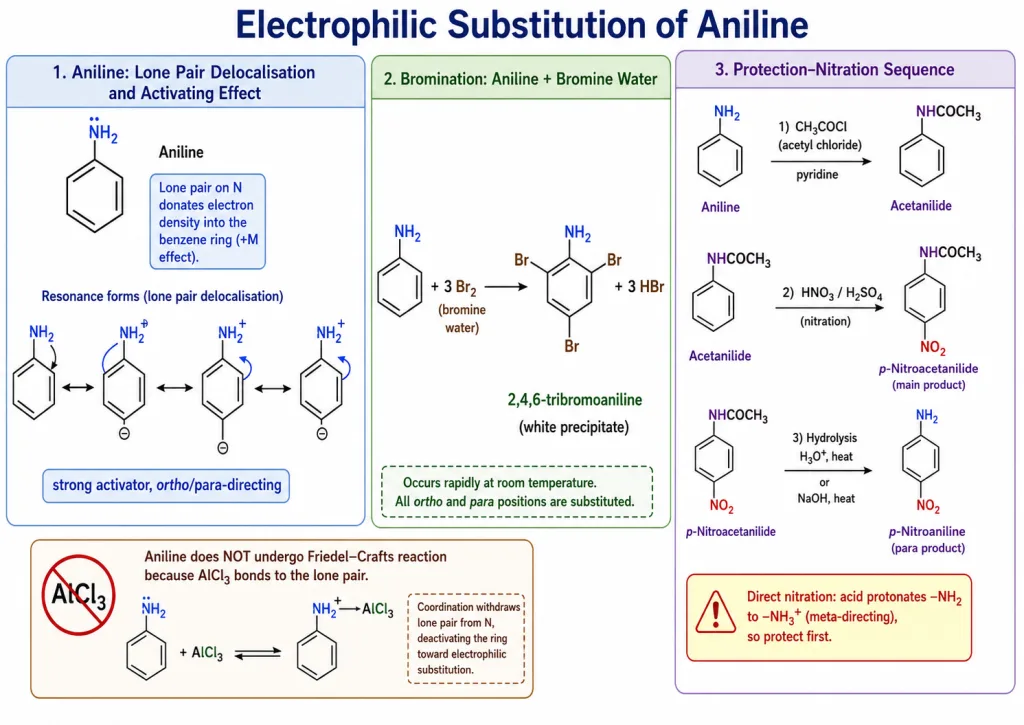
Key Point: aniline + bromine water → 2,4,6-tribromoaniline. For nitration, acetylate -NH first (else it becomes -NH+, meta-directing), then nitrate (→ mainly para) and hydrolyse back.
Sulphonation and the Friedel-Crafts Exception
Sulphonation: aniline with conc. HSO gives anilinium hydrogen sulphate, which on heating gives sulphanilic acid (p-aminobenzenesulphonic acid) — the basis of the sulpha drugs. Sulphanilic acid exists as an internal salt (a zwitterion).
Friedel-Crafts fails on aniline: aniline does not undergo the Friedel-Crafts reaction (alkylation/acylation). The Lewis-acid catalyst AlCl reacts with the basic nitrogen lone pair, forming a salt; the nitrogen now bears a positive charge, which makes it strongly deactivating (meta-directing) — so the Friedel-Crafts reaction does not work as intended.
Key Point: aniline + conc. HSO → sulphanilic acid (a zwitterion). Aniline does NOT do Friedel-Crafts — AlCl bonds to the lone pair, deactivating the ring.
Solved Examples
Example 1: Bromination of aniline
What product forms when aniline is treated with bromine water?
Solution: A white precipitate of 2,4,6-tribromoaniline — the strongly activated ring is trisubstituted at the two ortho and the para positions.
Example 2: Why protect before nitration
Why is aniline acetylated before nitration?
Solution: The strongly acidic nitrating mixture would protonate -NH to -NH (meta-directing, deactivating), giving a lot of meta product. Acetylation converts -NH to -NHCOCH, which is less basic (not protonated) and still o/p-directing, so nitration gives mainly the para product.
Example 3: Product of protected nitration
What is obtained when acetanilide is nitrated and then hydrolysed?
Solution: Nitration of acetanilide gives mainly p-nitroacetanilide; hydrolysis removes the acetyl group to give p-nitroaniline.
Example 4: Why -NH is o/p-directing
Explain why the -NH group directs electrophiles to the ortho and para positions.
Solution: The nitrogen lone pair is delocalised into the ring, increasing electron density specifically at the ortho and para carbons, so electrophiles attack there.
Example 5: Sulphonation product
What is the product of sulphonation of aniline, and why is it important?
Solution: Sulphanilic acid (p-aminobenzenesulphonic acid), which exists as a zwitterion. It is the parent of the sulpha drugs (e.g. sulphanilamide).
Example 6: Friedel-Crafts failure
Why does aniline not undergo Friedel-Crafts acylation?
Solution: The Lewis acid AlCl bonds to the basic nitrogen lone pair, giving the nitrogen a positive charge; this makes the group strongly deactivating (meta-directing), so the ring no longer reacts in the normal Friedel-Crafts manner.
Example 7: Comparing reactivity
Why does aniline brominate much faster than benzene?
Solution: The -NH group is a strong activator — its lone pair raises ring electron density (especially o/p), so aniline reacts with electrophiles much faster than unactivated benzene.
Example 8: Acetanilide vs aniline reactivity
Why is acetanilide less reactive than aniline in electrophilic substitution?
Solution: In acetanilide the nitrogen lone pair is partly delocalised onto the acetyl carbonyl, so less is available to the ring. The ring is still activated and o/p-directing, but less strongly than in aniline — which is exactly why acetylation moderates the reaction for clean para nitration.
Example 9: Predict the major nitration product (direct)
If aniline is nitrated directly without protection, why is a significant amount of meta product formed?
Solution: In the strongly acidic medium, much of the aniline is present as the anilinium ion (-NH), which is deactivating and meta-directing, so a substantial meta product forms alongside o/p.
Example 10: Tribromoaniline conditions
Why can't mono-bromination of aniline be achieved simply with bromine water?
Solution: The ring is so strongly activated that bromination does not stop at one substitution — all three o/p positions react, giving 2,4,6-tribromoaniline. (Protecting -NH by acetylation moderates the ring so mono-substitution becomes possible.)