
What Are Amines? Structure
Amines are organic derivatives of ammonia (NH), formed by replacing one, two or three of its hydrogens with alkyl or aryl groups. Like ammonia, the nitrogen of an amine is trivalent and carries an unshared (lone) pair of electrons.
Shape: the nitrogen is sp hybridised and pyramidal — three bonds and the lone pair point to the four corners of a (distorted) tetrahedron, just like ammonia. This lone pair is the key to all of amine chemistry: it makes amines basic (it grabs protons) and nucleophilic (it attacks electrophiles).
Key Point: an amine = NH with H replaced by C groups. The nitrogen is pyramidal (sp) with a lone pair — the source of its basicity and nucleophilicity.
Classification of Amines
Amines are classified in two independent ways.
By the number of carbon groups on nitrogen:
- Primary (1°): one carbon group — R-NH (e.g. CHNH, methylamine; CHNH, aniline)
- Secondary (2°): two carbon groups — RNH (e.g. (CH)NH, dimethylamine)
- Tertiary (3°): three carbon groups — RN (e.g. (CH)N, trimethylamine)
Careful! This is about the number of groups on nitrogen, not about the carbon bearing the N (unlike alcohols/halides). So tert-butylamine (CH)C-NH is a primary amine (only one C group on N), even though the carbon is tertiary.
By the type of carbon group: aliphatic amines (alkyl groups, e.g. ethylamine) vs aromatic amines (at least one aryl group on N, e.g. aniline).
Key Point: 1°/2°/3° = one/two/three carbon groups on nitrogen. (CH)CNH is 1° (one group on N). Aliphatic vs aromatic depends on whether an aryl group is bonded to N.
Nomenclature of Amines
Common names: name the alkyl group(s) on nitrogen and add -amine: CHNH = methylamine, (CH)NH = dimethylamine, (CH)N = trimethylamine, CHNH = ethylamine.
IUPAC names (alkanamine): the -e of the alkane is replaced by -amine: CHNH → methanamine, CHNH → ethanamine, CHCHCHNH → propan-1-amine.
For secondary and tertiary amines that are unsymmetrical, the largest group is the parent and the others are named as N-substituents: CH-NH-CH = N-methylethanamine; (CH)N-CH = N,N-dimethylethanamine.
Aromatic amine: CHNH is aniline (also an accepted IUPAC name) or benzenamine. A substituent on the N is shown with N- (e.g. N-methylaniline).
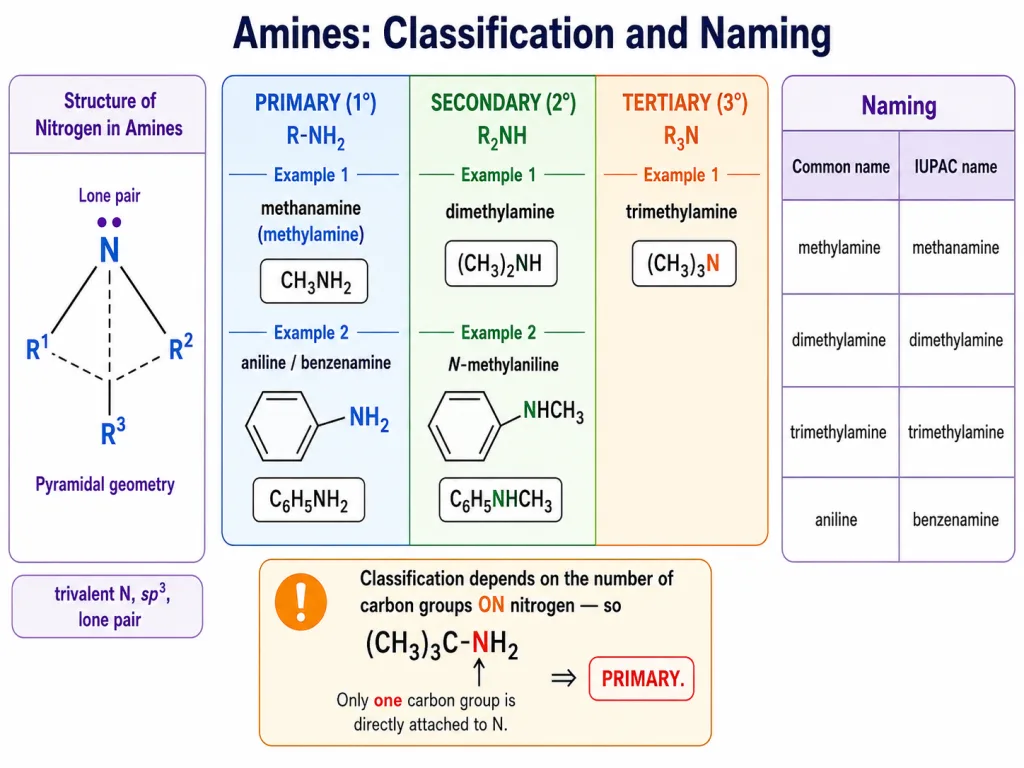
Key Point: IUPAC = alkane → alkanamine; other groups on N use the N- prefix. Aniline = benzenamine = the aromatic parent.
Solved Examples
Example 1: Classify the amine
Classify (CH)C-NH and (CH)NH.
Solution: (CH)C-NH has one carbon group on N → primary (1°) amine (the tert-butyl carbon is irrelevant to amine class). (CH)NH has two groups on N → secondary (2°) amine.
Example 2: IUPAC name
Give the IUPAC name of CHCHCHNH.
Solution: A three-carbon chain with -NH on C-1: propan-1-amine (common name n-propylamine).
Example 3: Unsymmetrical secondary amine
Name CH-NH-CH by IUPAC.
Solution: The larger group (ethyl) is the parent (ethanamine); the methyl is an N-substituent: N-methylethanamine.
Example 4: Tertiary amine naming
Give the IUPAC name of (CH)N-CHCH.
Solution: Parent = ethanamine; two methyls on N: N,N-dimethylethanamine.
Example 5: Aromatic amine
Give two acceptable names for CHNH.
Solution: Aniline (common, also accepted IUPAC) or benzenamine (IUPAC).
Example 6: Why the lone pair matters
Why are amines both basic and nucleophilic?
Solution: The nitrogen carries an unshared lone pair of electrons. This lone pair can accept a proton (basic behaviour) or attack an electron-poor carbon (nucleophilic behaviour).
Example 7: Identify class from structure
Classify CH-NH-CH.
Solution: Nitrogen carries two carbon groups (phenyl and methyl) → secondary (2°) amine (and it is aromatic, since an aryl group is on N). Name: N-methylaniline.
Example 8: Count carbon groups
Is (CH)N primary, secondary or tertiary?
Solution: Three ethyl groups on nitrogen → tertiary (3°) amine (triethylamine / N,N-diethylethanamine).
Example 9: Geometry of nitrogen
What is the hybridisation and shape around nitrogen in an amine?
Solution: The nitrogen is sp hybridised and pyramidal (three bonds plus a lone pair), like ammonia.
Example 10: Distinguish amine class by formula
Classify CHNH, (CH)NH and (CH)N.
Solution: CHNH = primary, (CH)NH = secondary, (CH)N = tertiary — one, two and three methyl groups on nitrogen respectively.