
Two Families of Diazonium Reactions
Diazonium reactions fall into two groups:
- Replacement of N — the -N group leaves as N gas and is replaced by another atom or group (-Cl, -Br, -I, -CN, -OH, -F, -H, -NO). These let you make halo-, cyano-, hydroxy- and other substituted benzenes.
- Retention of N (coupling) — the whole -N=N- unit is kept, joining the aryl group to another aromatic ring to make a brightly coloured azo compound (dye).
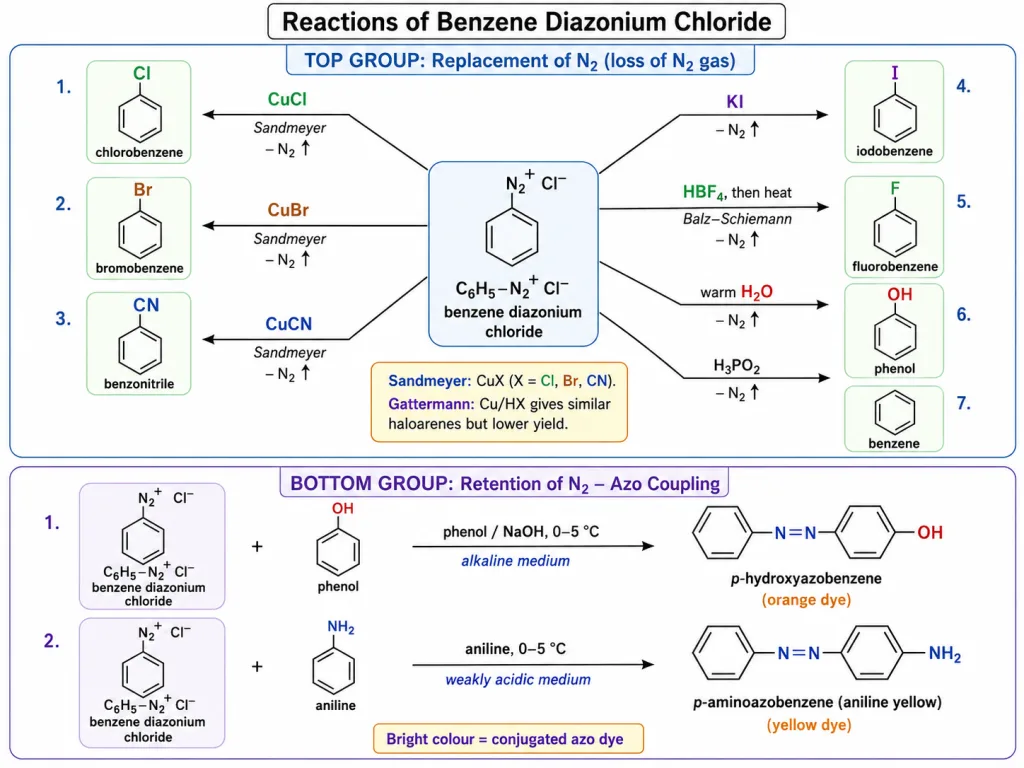
Key Point: diazonium reactions either replace -N (lose N) with a new group, or retain -N=N- to couple into an azo dye.
Replacement Reactions — Sandmeyer, Gattermann & Others
Sandmeyer reaction: the -N is replaced by -Cl, -Br or -CN using the cuprous halide/cyanide (CuCl, CuBr, CuCN):
- Ar-NCl + CuCl → Ar-Cl (chlorobenzene) + N
- with CuBr → Ar-Br; with CuCN → Ar-CN (benzonitrile)
Gattermann reaction: the same replacements by -Cl or -Br can be done with copper powder + HCl/HBr (Cu/HX). The Gattermann method uses copper powder instead of the cuprous salt; the yield is usually lower than Sandmeyer's.
Other replacements:
- -I: simply warming with KI gives iodobenzene (no catalyst needed).
- -F: via the fluoroborate (the Balz-Schiemann reaction, heating Ar-NBF) gives Ar-F.
- -OH: warming the salt with water (HO/H) gives a phenol.
- -H: treatment with hypophosphorous acid (HPO) or ethanol replaces -N by -H (removes the group entirely).
Key Point: Sandmeyer (CuCl/CuBr/CuCN) → Ar-Cl/Br/CN; Gattermann (Cu/HX) → Ar-Cl/Br (lower yield); KI → Ar-I; HO → phenol; HPO → Ar-H.
Coupling Reactions — Azo Dyes
In coupling reactions the -N group is retained: the diazonium ion acts as a weak electrophile and attacks a highly activated aromatic ring (a phenol or an aromatic amine), joining the two rings through an azo (-N=N-) bridge to give a brightly coloured azo compound.
- With phenol (in mildly alkaline solution) → p-hydroxyazobenzene (an orange dye).
- With aniline (in mildly acidic solution) → p-aminoazobenzene (aniline yellow).
Coupling occurs mainly at the para position (or ortho if para is blocked). The extended -N=N- conjugation between the two rings is what gives azo dyes their intense colours, which is why this reaction is the basis of a whole industry of dyes and pigments.
Key Point: azo coupling — diazonium ion + phenol/aromatic amine → -N=N- linked azo dye (para). The conjugated azo bridge gives the bright colour; basis of the dye industry.
Solved Examples
Example 1: Sandmeyer to chlorobenzene
How is chlorobenzene prepared from aniline?
Solution: Diazotise aniline (NaNO/HCl, 273–278 K) to CHNCl, then treat with CuCl (Sandmeyer reaction) → chlorobenzene + N.
Example 2: Benzonitrile
How would you convert benzene diazonium chloride to benzonitrile?
Solution: Treat it with cuprous cyanide (CuCN) (Sandmeyer): CHNCl + CuCN → CHCN (benzonitrile) + N.
Example 3: Iodobenzene
How is iodobenzene made from a diazonium salt?
Solution: Simply warm the diazonium salt with potassium iodide (KI) — no copper catalyst is needed: CHN + KI → CHI (iodobenzene) + N.
Example 4: Diazonium to phenol
Give the product of warming benzene diazonium chloride with water.
Solution: Phenol (the -N is replaced by -OH): CHNCl + HO → CHOH + N + HCl.
Example 5: Sandmeyer vs Gattermann
What is the difference between the Sandmeyer and Gattermann reactions for making chlorobenzene?
Solution: Both replace -N by -Cl. Sandmeyer uses cuprous chloride (CuCl); Gattermann uses copper powder + HCl (Cu/HCl). The Sandmeyer yield is generally better than the Gattermann.
Example 6: Removing the amino group
How can the -NH group of aniline be removed entirely (replaced by H)?
Solution: Diazotise to the diazonium salt, then treat with hypophosphorous acid (HPO) (or ethanol): the -N is replaced by -H, giving benzene.
Example 7: Azo coupling with phenol
What forms when benzene diazonium chloride couples with phenol?
Solution: p-Hydroxyazobenzene (an orange azo dye), formed by coupling at the para position of phenol through an -N=N- link.
Example 8: Aniline yellow
Name the azo dye formed when benzene diazonium chloride couples with aniline.
Solution: p-Aminoazobenzene (aniline yellow), formed by para coupling with aniline.
Example 9: Why azo compounds are coloured
Why are azo dyes intensely coloured?
Solution: The -N=N- azo bridge conjugates the two aromatic rings, giving an extended delocalised π system that absorbs visible light — producing the bright colour.
Example 10: Para preference in coupling
Why does coupling occur mainly at the para position of phenol/aniline?
Solution: The diazonium ion is a weak electrophile, so it attacks the most activated, least hindered position. The -OH/-NH groups are o/p-directing, and the para position is usually the least hindered, so coupling occurs there (ortho if para is blocked).