
Preparation — Ammonolysis & Reduction
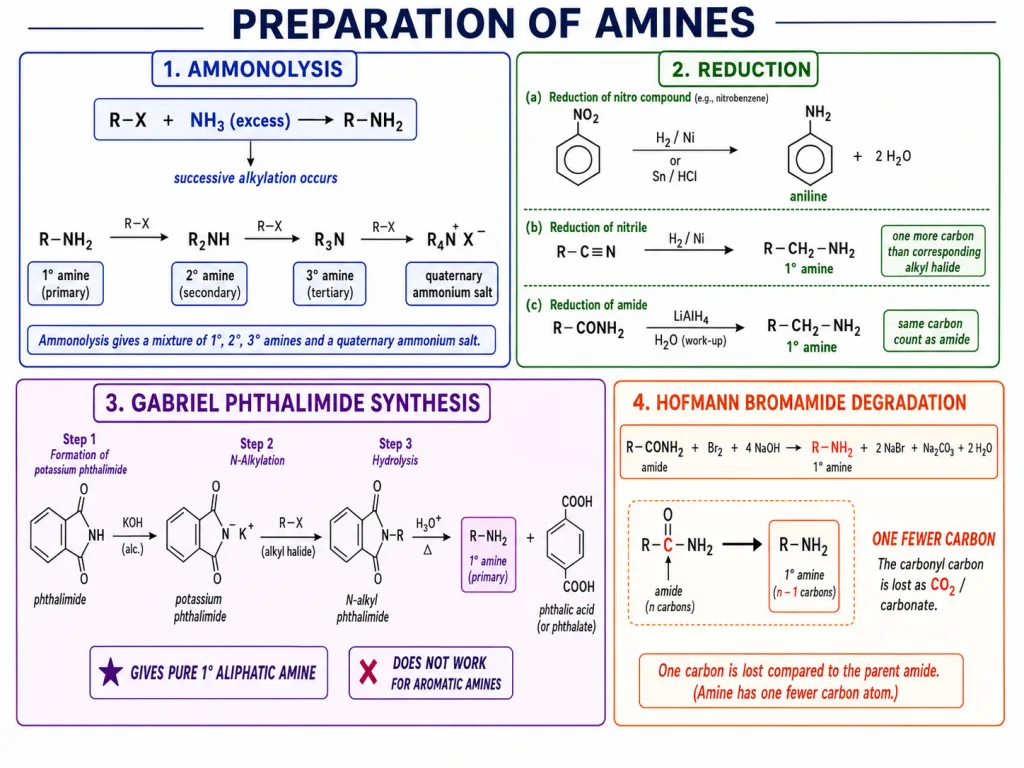
Ammonolysis of alkyl halides: an alkyl halide reacts with ammonia (the N lone pair displaces the halide, SN2). But the 1° amine formed is itself nucleophilic and reacts further, so a mixture of 1°, 2° and 3° amines and the quaternary ammonium salt results.
R-X + NH → R-NH → RNH → RN → RN⁺X⁻
Using a large excess of ammonia favours the primary amine. (This route gives a mixture — for a pure 1° amine, use Gabriel synthesis instead.)
Reduction of nitro compounds: nitrobenzene is reduced (H/Ni, or Sn/Fe + HCl) to aniline. This is the main industrial route to aromatic amines.
Reduction of nitriles and amides: nitriles (R-CN) are reduced (H/Ni or LiAlH) to primary amines (R-CH-NH) — this adds one carbon. Amides (R-CONH) are reduced by LiAlH to amines.
Key Point: ammonolysis gives a mixture (excess NH → mostly 1°); nitrobenzene → aniline; nitriles reduce to 1° amines (adding a carbon); amides reduce with LiAlH.
Gabriel Phthalimide Synthesis
The Gabriel phthalimide synthesis gives pure primary aliphatic amines (no 2°/3° contamination). The steps:
- Phthalimide is treated with KOH to form potassium phthalimide (the N-H is acidic).
- This is alkylated with an alkyl halide (R-X) (SN2) to give an N-alkylphthalimide.
- Hydrolysis (or treatment with hydrazine) releases the primary amine (R-NH).
Important limitation: Gabriel synthesis cannot be used to make aromatic primary amines (like aniline), because aryl halides do not undergo the SN2 alkylation of potassium phthalimide.
Key Point: Gabriel = phthalimide + KOH + R-X, then hydrolysis → pure 1° aliphatic amine. It does NOT work for aromatic amines (aryl halides won't react).
Hofmann Bromamide Degradation
The Hofmann bromamide degradation converts an amide into a primary amine with ONE FEWER carbon atom. An amide is treated with bromine and aqueous (or alcoholic) NaOH/KOH:
R-CO-NH + Br + 4 NaOH → R-NH + NaCO + 2 NaBr + 2 HO
The carbonyl carbon is lost as carbonate, so the amine has one carbon fewer than the amide (the alkyl group R migrates from carbon to nitrogen).
[JEE Tip] The carbon count is the giveaway: Hofmann bromamide degradation shortens the chain by one carbon (amide CnH(2n+1)CONH → amine CnH(2n+1)NH), whereas reduction of a nitrile adds a carbon. Use this to spot the right reagent in conversion questions.
Key Point: Hofmann bromamide (R-CONH + Br/NaOH) → R-NH with one fewer carbon. Nitrile reduction adds a carbon — opposite directions.
Solved Examples
Example 1: Why ammonolysis gives a mixture
Why does ammonolysis of an alkyl halide not give a pure primary amine?
Solution: The 1° amine formed is itself nucleophilic and reacts with more alkyl halide to give 2° and 3° amines and the quaternary salt. A large excess of ammonia is used to maximise the primary amine.
Example 2: Gabriel synthesis product
What amine is obtained when ethyl bromide is used in the Gabriel synthesis?
Solution: Ethanamine (ethylamine, CHNH) — a pure primary amine.
Example 3: Gabriel limitation
Can aniline be prepared by the Gabriel synthesis? Explain.
Solution: No. Aniline would need an aryl halide to alkylate potassium phthalimide, but aryl halides do not undergo this SN2 substitution, so the aromatic amine cannot be made this way.
Example 4: Hofmann bromamide
What amine forms when CHCHCONH (propanamide) undergoes Hofmann bromamide degradation?
Solution: One carbon is lost, giving ethanamine (CHNH) (a 2-carbon amine from the 3-carbon amide).
Example 5: Nitrile reduction
What amine is formed when CHCN is reduced with H/Ni?
Solution: The nitrile gains hydrogen during reduction, giving ethanamine (CHCHNH) — note that reduction of a nitrile adds one carbon relative to the alkyl group.
Example 6: Preparing aniline
How is aniline prepared industrially from benzene?
Solution: Nitrate benzene to nitrobenzene, then reduce (H/Ni or Sn/Fe + HCl) to aniline.
Example 7: Choosing add vs remove a carbon
You need to convert CHCHNH (2 C) to CHNH (1 C). Which method?
Solution: Use a route that removes a carbon — make the amide CHCONH and apply Hofmann bromamide degradation → CHNH (methanamine).
Example 8: Ascending the series
How would you convert CHBr to CHCHNH (adding a carbon)?
Solution: CHBr + KCN → CHCN, then reduce (H/Ni or LiAlH) → CHCHNH (ethanamine). The nitrile route adds one carbon.
Example 9: Pure primary amine
Which method gives a pure 1° amine free of 2° and 3° amines?
Solution: The Gabriel phthalimide synthesis — the phthalimide nitrogen carries only one R group, so on hydrolysis only the primary amine is released (for aliphatic amines).
Example 10: Reduction of an amide
What is the product when CHCONH (acetamide) is reduced with LiAlH?
Solution: LiAlH reduces the amide to the amine with the same number of carbons: ethanamine (CHCHNH). (Contrast Hofmann bromamide, which would remove a carbon to give methanamine.)