
Boiling Points of Amines
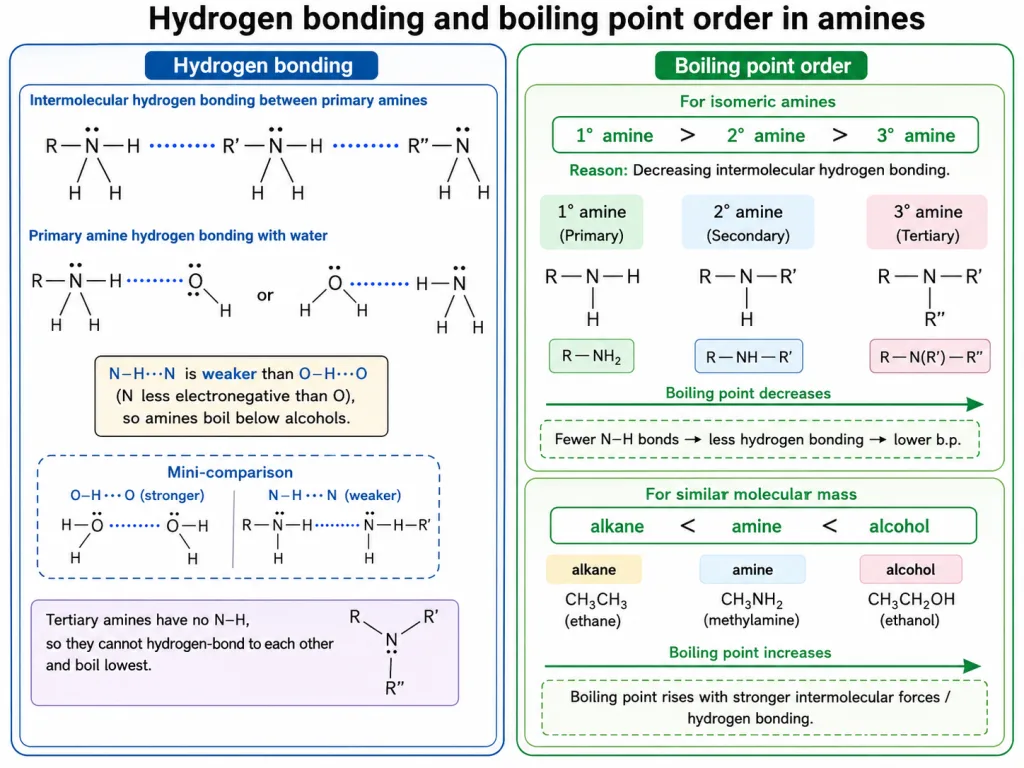
1° and 2° amines have an N-H bond, so their molecules form intermolecular hydrogen bonds (N-H···N). This makes them boil higher than alkanes of similar mass.
But nitrogen is less electronegative than oxygen, so the N-H···N hydrogen bond is weaker than the O-H···O bond of an alcohol. Therefore amines boil lower than alcohols and carboxylic acids of comparable mass.
Tertiary (3°) amines have NO N-H, so their molecules cannot hydrogen-bond to each other — they boil lowest among isomeric amines (only weak dipole/van der Waals forces operate).
Order for isomeric amines: 1° > 2° > 3° boiling point (more N-H bonds = more hydrogen bonding).
Key Point: 1°/2° amines H-bond (N-H···N) and boil above alkanes but below alcohols (N less electronegative than O); 3° amines have no N-H and boil lowest.
Solubility and Smell
Solubility in water: the lower amines (small ones) are soluble in water because they form hydrogen bonds with water (even 3° amines, since the N lone pair accepts an H-bond from water). Solubility decreases as the hydrocarbon part grows — higher amines are nearly insoluble.
Comparison with alcohols: amines are less soluble than alcohols of similar size, again because N-H···O / N···H-O hydrogen bonds are weaker than O-H···O.
Smell: the lower aliphatic amines have a characteristic "fishy" smell (trimethylamine smells of rotting fish); aromatic amines are usually colourless but darken on standing in air.
Key Point: lower amines dissolve in water (H-bond with water); solubility falls as the chain grows; amines are less soluble than comparable alcohols. Lower amines smell fishy.
The Comparisons Examiners Love
1. Amine vs alcohol (same mass): the alcohol boils higher (O-H···O stronger than N-H···N). E.g. ethanol > ethylamine.
2. Within isomeric amines: boiling point 1° > 2° > 3° (number of N-H bonds available for hydrogen bonding decreases).
3. Amine vs alkane (same mass): the amine boils higher (it has dipole and, for 1°/2°, hydrogen bonding).
[NEET Important] A frequent question: arrange ethane, ethanol and ethylamine (or compare 1°, 2°, 3° isomeric amines) by boiling point. The answer follows the strength and number of hydrogen bonds: ethanol > ethylamine > ethane; and for isomers, 1° amine > 2° amine > 3° amine.
Key Point: rank by hydrogen-bond strength and count — alcohol > amine > alkane, and among isomeric amines 1° > 2° > 3°.
Solved Examples
Example 1: Amine vs alcohol
Why does ethanol boil higher than ethylamine, though they have similar masses?
Solution: Both can hydrogen-bond, but O is more electronegative than N, so the O-H···O bonds in ethanol are stronger than the N-H···N bonds in ethylamine. Hence ethanol boils higher.
Example 2: Isomeric amines
Arrange in decreasing boiling point: propan-1-amine (1°), N-methylethanamine (2°), N,N-dimethylmethanamine/trimethylamine (3°).
Solution: 1° > 2° > 3°: propan-1-amine > N-methylethanamine > trimethylamine. Fewer N-H bonds means weaker/less hydrogen bonding.
Example 3: Why 3° amines boil lowest
Why does trimethylamine boil lower than its isomer propan-1-amine?
Solution: Trimethylamine (3°) has no N-H bond, so its molecules cannot form intermolecular hydrogen bonds; propan-1-amine (1°) has two N-H bonds and does. So the 1° amine boils higher.
Example 4: Solubility trend
Why is methylamine very soluble in water but hexan-1-amine only slightly soluble?
Solution: Methylamine is small and hydrogen-bonds strongly with water. In hexan-1-amine the long hydrocarbon chain dominates, disrupting H-bonding with water, so it is much less soluble.
Example 5: 3° amine still dissolves
Trimethylamine has no N-H, yet it dissolves in water. Explain.
Solution: The lone pair on its nitrogen accepts a hydrogen bond from water's O-H, so even a 3° amine is water-soluble (it just can't H-bond to other amine molecules).
Example 6: Amine vs alkane
Why does ethylamine boil higher than propane (similar mass)?
Solution: Ethylamine is polar and forms N-H···N hydrogen bonds, while propane has only weak dispersion forces — so the amine boils higher.
Example 7: Compare with alcohol solubility
Which is more soluble in water, ethylamine or ethanol?
Solution: Ethanol is somewhat more soluble; both H-bond with water, but O-H···O / O···H-O interactions are stronger than those involving nitrogen, so the alcohol associates with water a little more strongly. (Both small molecules are, in practice, miscible.)
Example 8: The fishy smell
What everyday observation is linked to lower amines?
Solution: Lower aliphatic amines have a "fishy" odour — trimethylamine is responsible for the smell of decaying fish.
Example 9: Ordering three compounds
Arrange in increasing boiling point: ethane, ethanol, ethylamine.
Solution: ethane < ethylamine < ethanol. Ethane has only dispersion forces; ethylamine has N-H hydrogen bonds; ethanol has stronger O-H hydrogen bonds.
Example 10: Which has no intermolecular H-bond?
Among propan-1-amine, N-methylethanamine and trimethylamine, which cannot form intermolecular hydrogen bonds?
Solution: Trimethylamine — it is a 3° amine with no N-H bond, so it cannot donate a hydrogen bond between its own molecules.