
What Is a Diazonium Salt?
An aromatic diazonium salt has the structure Ar-N X⁻ — an aryl group bonded to a -N≡N⁺ (diazonium) group, with a counter-ion such as Cl⁻ or HSO. The simplest is benzene diazonium chloride, CH-NCl⁻.
These salts are the single most useful intermediates in aromatic synthesis: the -N group is an excellent leaving group (it leaves as harmless N gas), so it can be replaced by a huge range of other groups — making it possible to put -Cl, -Br, -I, -CN, -OH, -F, -H and many more onto a benzene ring exactly where the original -NH was.
Key Point: a diazonium salt is Ar-NX⁻. The -N group leaves easily as N, so it is the gateway to making many substituted benzenes from anilines.
Preparation by Diazotisation
Diazonium salts are made by diazotisation: a primary aromatic amine is treated with nitrous acid (HNO), generated in situ from sodium nitrite (NaNO) and a mineral acid (dilute HCl), at a low temperature of 273-278 K (0-5 °C):
CHNH + NaNO + 2 HCl →(273-278 K)→ CHNCl⁻ + NaCl + 2 HO
Why keep it cold (273-278 K)? Aromatic diazonium salts are only stable at low temperature. If the solution is warmed, the diazonium salt decomposes (reacting with water to give a phenol + N). So the reaction and storage are kept at 0-5 °C, and the salt is usually used immediately (often not isolated).
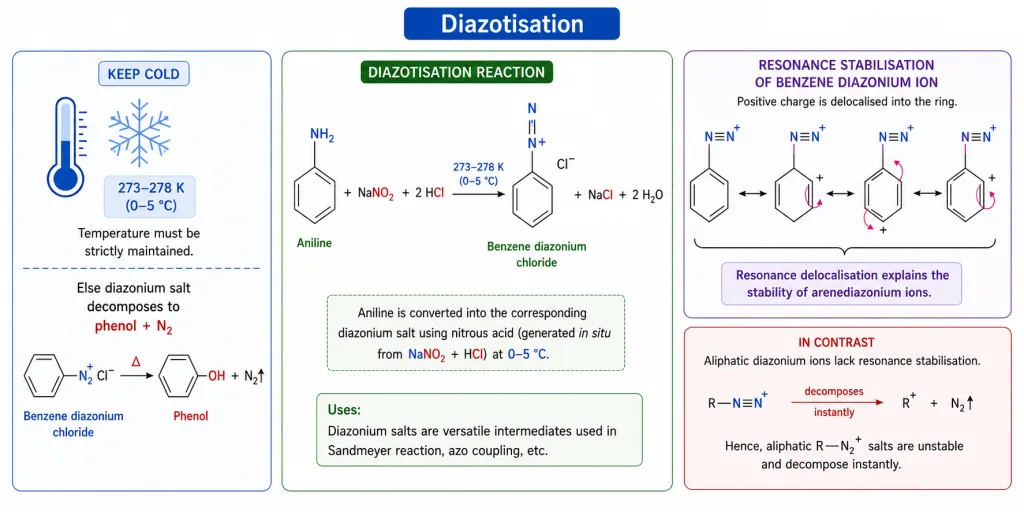
Key Point: diazotisation = Ar-NH + NaNO + dil. HCl at 273-278 K → Ar-NCl⁻. Keep cold or it decomposes to a phenol + N.
Why the Aromatic Diazonium Ion Is (Relatively) Stable
A key exam point: aromatic diazonium salts are far more stable than aliphatic ones.
- An aliphatic diazonium ion (R-N) is so unstable it decomposes instantly, even in the cold — which is why a 1° aliphatic amine + HNO gives an alcohol + N right away (Section 5).
- An aromatic diazonium ion (Ar-N) is stabilised by resonance — the positive charge and the N≡N group are delocalised into the benzene ring (the ring's π system conjugates with the -N group). This dispersal of charge makes it stable enough to exist in cold solution and to undergo controlled reactions.
Key Point: Ar-N is stabilised by resonance/conjugation with the ring, so it survives in the cold; R-N (aliphatic) has no such stabilisation and decomposes at once.
Solved Examples
Example 1: Diazotisation
Give the reagents and conditions to convert aniline to benzene diazonium chloride.
Solution: Treat aniline with NaNO and dilute HCl at 273-278 K (0-5 °C): CHNH → CHNCl⁻.
Example 2: Why low temperature
Why is diazotisation carried out at 0-5 °C?
Solution: Aromatic diazonium salts are unstable at higher temperatures — on warming they decompose (to a phenol + N). Keeping the mixture cold prevents this decomposition.
Example 3: Aliphatic vs aromatic diazonium stability
Why can benzene diazonium chloride be kept in cold solution while ethyl diazonium chloride cannot?
Solution: The aromatic diazonium ion is stabilised by resonance (delocalisation of charge into the ring), so it survives in the cold. The aliphatic diazonium ion has no such stabilisation and decomposes instantly to give an alcohol and N.
Example 4: Product on warming
What happens if benzene diazonium chloride solution is warmed with water?
Solution: It decomposes to phenol and nitrogen gas: CHNCl⁻ + HO → CHOH + N + HCl.
Example 5: Identify the intermediate
Which functional group must the starting compound have for diazotisation?
Solution: A primary aromatic amino group (Ar-NH) — only 1° aromatic amines give stable diazonium salts on treatment with HNO in the cold.
Example 6: Counter-ion
Write the formula of benzene diazonium chloride and name the cation.
Solution: CHNCl⁻; the cation is the benzene diazonium ion (CHN), with chloride as the counter-ion.
Example 7: Source of nitrous acid
How is the nitrous acid for diazotisation generated?
Solution: In situ from sodium nitrite (NaNO) + dilute mineral acid (HCl): NaNO + HCl → HNO + NaCl. (HNO is unstable, so it is made as needed.)
Example 8: Why used immediately
Why is a diazonium salt usually used at once and not stored?
Solution: Because it is unstable (decomposes on warming or standing), it is generally prepared and used immediately in the next reaction rather than isolated and stored.
Example 9: Resonance stabilisation
In one line, explain the resonance stabilisation of the benzene diazonium ion.
Solution: The positive charge of the -N group is delocalised into the benzene ring through conjugation, spreading the charge and stabilising the ion.
Example 10: Recognise the salt's importance
Why are diazonium salts called versatile synthetic intermediates?
Solution: Because the -N group can be replaced by many different groups (-Cl, -Br, -I, -CN, -OH, -F, -H, etc.) and can also couple to form dyes — so one diazonium salt can lead to a wide variety of substituted benzenes.