
Meet the Halogen Compounds
When one or more hydrogen atoms of a hydrocarbon are replaced by halogen atoms (F, Cl, Br, I), we get a halogen compound. These are everywhere — from the anaesthetic chloroform and the refrigerant freons to the insecticide DDT and the solvent in your dry cleaner.
Two big families:
- Haloalkanes (alkyl halides): the halogen is attached to an sp-hybridised carbon of an open-chain (aliphatic) framework. General formula C(n)H(2n+1)X, written R-X.
- Haloarenes (aryl halides): the halogen is attached directly to an sp-hybridised carbon of an aromatic ring (like chlorobenzene).
This single difference — whether the C-X carbon is sp or sp — controls almost all the chemistry in this chapter.
Classification by Number of Halogens and by C-X Carbon
By the number of halogen atoms:
- Monohalogen — one halogen (e.g. CHCl, chloromethane).
- Dihalogen — two halogens (e.g. CHCl, dichloromethane).
- Polyhalogen — three or more (e.g. CHCl chloroform, CCl carbon tetrachloride).
By the hybridisation of the carbon bearing the halogen:
- Compounds with sp C-X (haloalkanes and derivatives):
- Alkyl halides — X on an sp C of an alkyl group (R-X).
- Allylic halides — X on an sp C adjacent to a C=C double bond (e.g. CH=CH-CH-X).
- Benzylic halides — X on an sp C attached to a benzene ring (CH-CH-X).
- Compounds with sp C-X:
- Vinylic halides — X on an sp C of a C=C double bond (e.g. CH=CH-X).
- Aryl halides — X directly on an sp C of an aromatic ring (e.g. CH-X, chlorobenzene).
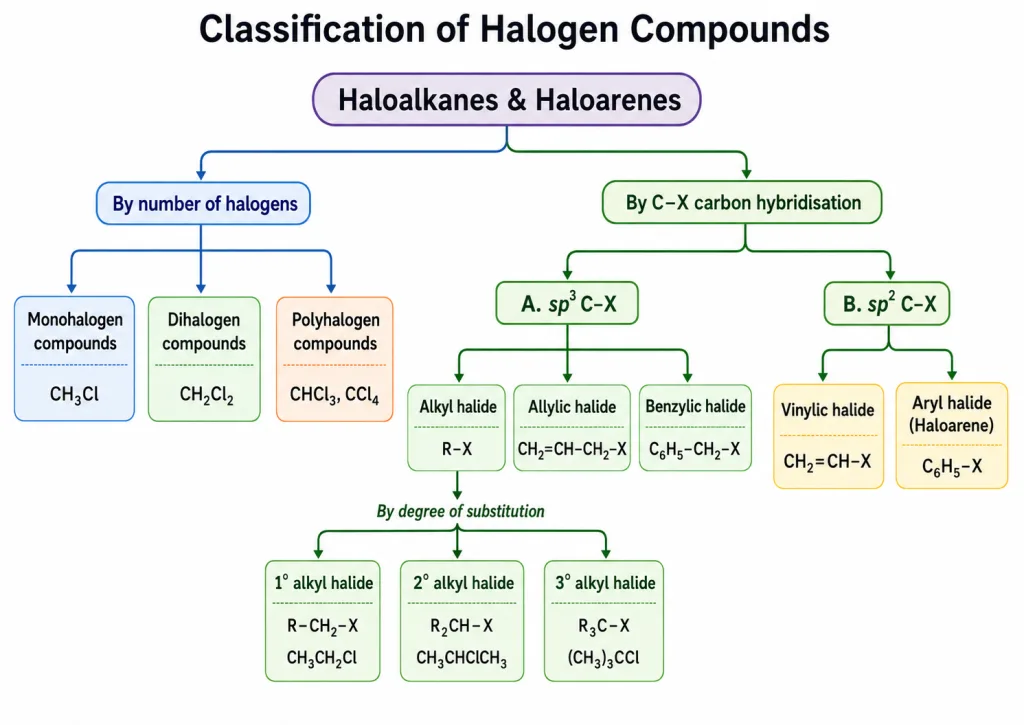
Primary, Secondary and Tertiary Alkyl Halides
Alkyl halides are further classified by how many carbon atoms are attached to the carbon bearing the halogen:
- Primary (1°): the C-X carbon is attached to one other carbon (e.g. CHCH-Br, bromoethane). Methyl halide (CHX) is also counted here.
- Secondary (2°): the C-X carbon is attached to two other carbons (e.g. (CH)CH-Br, 2-bromopropane).
- Tertiary (3°): the C-X carbon is attached to three other carbons (e.g. (CH)C-Br, 2-bromo-2-methylpropane).
This 1°/2°/3° classification is crucial — it decides whether an alkyl halide reacts by the SN1 or SN2 mechanism (Section 5) and how easily it undergoes elimination.
Key Point: Two classifications matter most: (a) sp (haloalkane) vs sp (haloarene/vinyl) C-X — controls overall reactivity; and (b) 1°/2°/3° for alkyl halides — controls the substitution mechanism. Master both.
Solved Examples
Example 1: Identify the type of halide
Classify CH=CH-CH-Cl and CH=CH-Cl by the type of C-X carbon.
Solution:
- CH=CH-CH-Cl: the C-Cl carbon is sp and adjacent to a C=C — an allylic halide.
- CH=CH-Cl: the C-Cl carbon is sp (part of the C=C) — a vinylic halide.
Example 2: Primary, secondary or tertiary?
Classify (CH)C-Br as 1°, 2° or 3°.
Solution: The carbon bearing Br is attached to three other carbons (three CH groups), so it is a tertiary (3°) alkyl halide.
Example 3: Benzylic vs aryl halide
Distinguish CH-CH-Cl from CH-Cl.
Solution:
- CH-CH-Cl (benzyl chloride): Cl on an sp carbon attached to the ring — a benzylic halide.
- CH-Cl (chlorobenzene): Cl directly on an sp ring carbon — an aryl halide (haloarene).
Example 4: Number of halogens
Classify CHCl and CHCl by the number of halogen atoms.
Solution: CHCl (chloroform) has three halogens → polyhalogen (trihalogen); CHCl has two halogens → dihalogen.
Example 5: Classify a secondary halide
Classify CH-CHBr-CH as 1°, 2° or 3°.
Solution: The carbon bearing Br is attached to two other carbons (two CH), so it is a secondary (2°) alkyl halide (2-bromopropane).
Example 6: sp vs sp C-X
In which of bromobenzene and bromoethane is the C-Br carbon sp hybridised?
Solution: In bromobenzene (CH-Br) the C-Br carbon is part of the aromatic ring, so it is sp. In bromoethane (CHCH-Br) it is sp.
Example 7: Allylic halide recognition
Why is 3-chloroprop-1-ene (CH=CH-CH-Cl) called an allylic halide?
Solution: Because the chlorine is on an sp carbon that is directly attached to a carbon-carbon double bond (the allylic position). The adjacent C=C stabilises the intermediate, making allylic halides quite reactive.
Example 8: Identify a tertiary halide among isomers
Among the isomeric bromides of formula CHBr, which is tertiary?
Solution: (CH)C-Br (2-bromo-2-methylpropane, tert-butyl bromide) — its C-Br carbon is bonded to three carbons, so it is the tertiary isomer.
Example 9: Mono/di/poly
Classify CHCHCl, ClCHCHCl and CCl by the number of halogens.
Solution: CHCHCl — monohalogen; ClCHCHCl — dihalogen; CCl — polyhalogen (tetrahalogen).
Example 10: Aryl vs alkyl reactivity preview
Which is expected to be far less reactive toward nucleophilic substitution: chlorobenzene or chloroethane?
Solution: Chlorobenzene (an aryl halide, sp C-Cl) is much less reactive — the C-Cl bond has partial double-bond character (resonance), making substitution very difficult, unlike the sp C-Cl of chloroethane.