
Preparation of Haloarenes
Aryl halides (halogen on a benzene ring) are made in two main ways.
(1) Electrophilic aromatic substitution — direct halogenation of benzene with X in the presence of a Lewis-acid catalyst (FeCl, FeBr or anhydrous AlCl): The Lewis acid generates the electrophile (Cl+ or Br+). This works well for Cl and Br; fluorination and iodination need special methods (iodination is reversible and needs an oxidant).
(2) From amines via diazonium salts - the most versatile route. An aromatic primary amine is diazotised to a diazonium salt, which is then converted to the aryl halide:
- Sandmeyer reaction: the diazonium salt is treated with CuCl/HCl or CuBr/HBr:
- Gattermann reaction: uses copper powder with HCl/HBr instead of the copper(I) salt.
- For iodides, the diazonium salt simply reacts with KI (no catalyst needed).
Physical Properties
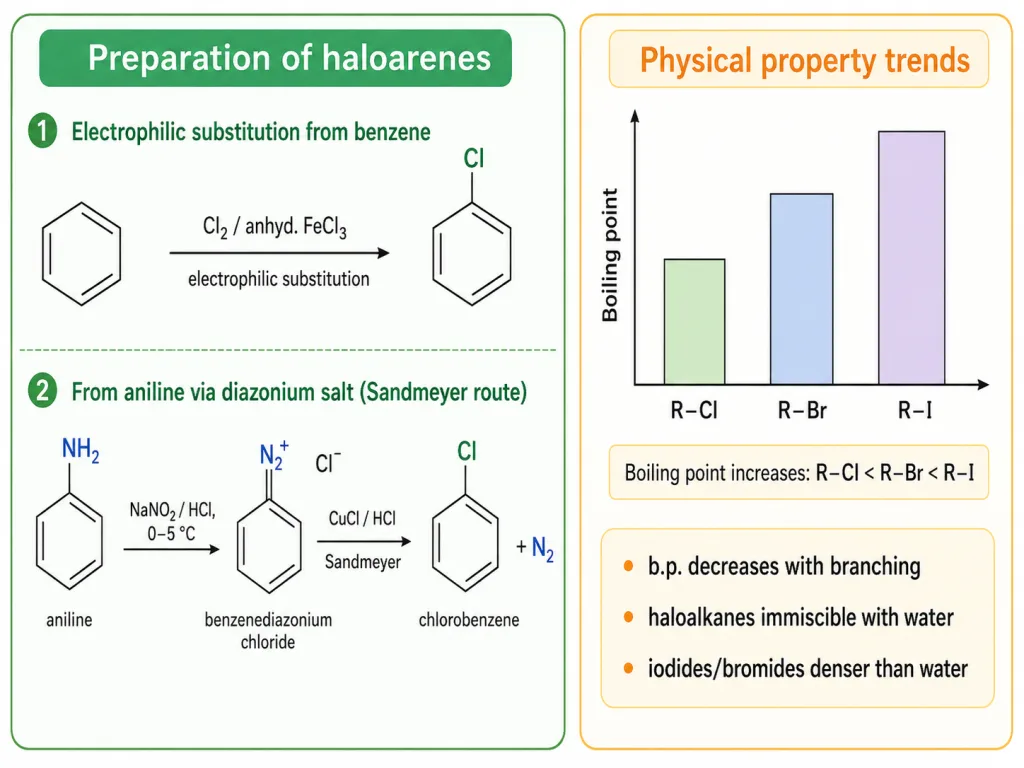
Boiling points: haloalkanes and haloarenes have higher boiling points than the parent hydrocarbons (greater molecular mass and stronger dipole-dipole and van der Waals forces). The trends:
- For the same alkyl group, b.p. increases with the halogen: R-I > R-Br > R-Cl > R-F (heavier, more polarisable).
- For the same halogen, b.p. increases with the size of the alkyl group (more electrons, larger surface).
- Branching lowers the boiling point (more spherical shape → smaller surface area → weaker van der Waals forces).
Solubility: haloalkanes are immiscible with water (they cannot form the strong H-bonds with water that would be needed to overcome water's own H-bonding), but they dissolve in organic solvents.
Density: bromides, iodides and polychloro compounds are denser than water (and sink). Density also increases with the number and atomic mass of halogen atoms.
Key Point: Among isomeric haloalkanes, the straight-chain isomer has the highest boiling point and the most branched has the lowest. Among different halides of the same alkyl group, the iodide boils highest.
Comparing and Predicting Boiling Points
To rank boiling points, weigh three factors in order:
- Molecular mass / number of electrons (bigger = higher b.p.).
- Halogen identity (I > Br > Cl > F for the same R).
- Branching (more branching = lower b.p. for isomers).
Worked rankings:
- CHCl < CHBr < CHI (same R, heavier halogen raises b.p.).
- CHCHCHCHBr (n-butyl) > (CH)CHCHBr (isobutyl) > (CH)CBr (tert-butyl) — increasing branching lowers b.p.
[JEE Tip] When asked to "arrange in increasing boiling point," first compare molecular masses; if they are similar (isomers), the least branched boils highest. For different halogens on the same skeleton, the heavier halogen boils higher.
NCERT fact to remember: haloalkanes, though polar, are insoluble in water because the energy released on forming weak halide-water attractions is less than the energy needed to break the strong hydrogen bonds in water.
Solved Examples
Example 1: Sandmeyer reaction
How is chlorobenzene prepared from aniline?
Solution: Diazotise aniline (NaNO/HCl, 0-5 °C) to benzenediazonium chloride, then carry out the Sandmeyer reaction with CuCl/HCl: CHNH → CHN+Cl- → (CuCl/HCl) → CHCl + N.
Example 2: Boiling point order by halogen
Arrange CHCl, CHBr, CHI in increasing boiling point.
Solution: Heavier, more polarisable halogen raises the b.p.: CHCl < CHBr < CHI.
Example 3: Effect of branching on b.p.
Among n-butyl bromide, isobutyl bromide and tert-butyl bromide, which has the lowest boiling point?
Solution: tert-butyl bromide — it is the most branched (most spherical), so it has the smallest surface area and the weakest van der Waals forces, hence the lowest boiling point.
Example 4: Why insoluble in water
Why are haloalkanes insoluble in water?
Solution: To dissolve, a haloalkane would have to break the strong hydrogen bonds between water molecules, but it can only form weak attractions with water (no H-bonding of its own). Since the energy gained is less than that required, haloalkanes are immiscible with water.
Example 5: Gattermann reaction
How does the Gattermann reaction differ from the Sandmeyer reaction?
Solution: Both convert a diazonium salt to an aryl halide, but the Gattermann reaction uses copper powder with HCl/HBr, whereas the Sandmeyer reaction uses the copper(I) halide (CuCl/CuBr).
Example 6: Density of halides
Which is denser than water: chloroethane or iodoethane?
Solution: Iodoethane — iodides (and bromides, polychloro compounds) are denser than water because of the heavy halogen, so they sink. (Chloroethane is around or slightly less dense.)
Example 7: Aryl halide by EAS
Write the equation for the preparation of bromobenzene from benzene.
Solution: Electrophilic substitution with Br and a Lewis acid: CH + Br → (anhydrous FeBr) → CHBr + HBr.
Example 8: Highest boiling isomer
Among the isomeric CHCl chlorides, which has the highest boiling point?
Solution: The straight-chain (n-pentyl) isomer, 1-chloropentane — least branched, largest surface area, strongest van der Waals forces, hence the highest boiling point.
Example 9: Preparation of iodobenzene
How is iodobenzene prepared from a diazonium salt?
Solution: The benzenediazonium salt reacts with potassium iodide (KI) directly (no catalyst): CHN+Cl- + KI → CHI + N + KCl.
Example 10: Boiling point vs the parent hydrocarbon
Why do haloalkanes boil at higher temperatures than the corresponding alkanes?
Solution: The C-X bond is polar, so haloalkanes have dipole-dipole interactions in addition to van der Waals forces, and they have a greater molecular mass. Both raise the boiling point above that of the non-polar parent alkane.