
IUPAC Nomenclature
In the IUPAC system, haloalkanes are named as halo-substituted alkanes (the halogen is a substituent prefix: fluoro, chloro, bromo, iodo). The common system names them as alkyl halides (e.g. ethyl bromide).
Rules of thumb:
- Choose the longest carbon chain containing the carbon bearing the halogen as the parent.
- Number the chain to give the lowest locant to the substituents (halogen and any others).
- Cite substituents alphabetically.
Examples:
| Structure | IUPAC name | Common name |
|---|---|---|
| CHCl | chloromethane | methyl chloride |
| CHCHBr | bromoethane | ethyl bromide |
| (CH)CHCl | 2-chloropropane | isopropyl chloride |
| (CH)CBr | 2-bromo-2-methylpropane | tert-butyl bromide |
| CHCl | dichloromethane | methylene chloride |
| CHCl | trichloromethane | chloroform |
| CHBr | bromobenzene | phenyl bromide |
Nature of the C-X Bond
The carbon-halogen bond is polar, because the halogen is more electronegative than carbon. This pulls bonding electrons toward the halogen, giving:
So the carbon carries a partial positive charge and the halogen a partial negative charge. This is the key to all the chemistry: the electron-poor carbon is attacked by nucleophiles (substitution), and the C-X bond breaks heterolytically.
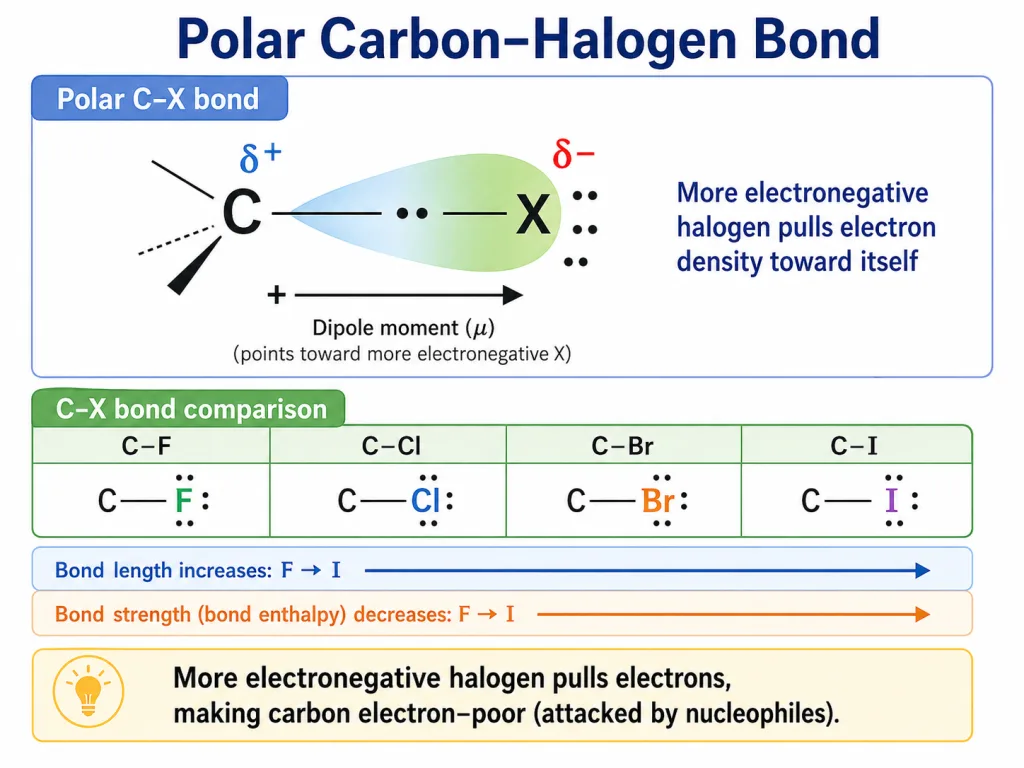
Trends down the group (C-F to C-I):
- Bond length increases (the halogen gets bigger: F < Cl < Br < I).
- Bond enthalpy (strength) decreases (C-F strongest, C-I weakest).
- Dipole moment depends on both electronegativity and bond length; for the molecule, CHCl has the highest dipole moment among CHF, CHCl, CHBr, CHI (a subtle balance of electronegativity and bond length).
Key Point: The C-X bond is polar (C is delta+, X is delta-). Because C-I is the weakest bond, iodides are the most reactive and fluorides the least reactive in substitution reactions.
Why the Trends Matter
The bond-strength order C-F > C-Cl > C-Br > C-I explains a recurring exam fact: in nucleophilic substitution, the rate follows
because the weakest bond (C-I) breaks most easily, making iodide the best leaving group.
[JEE Tip] Two trends are constantly tested:
- Bond strength decreases F → I, so reactivity (leaving-group ability) increases F → I.
- Among the methyl halides, CHCl has the largest dipole moment (not CHF, because although C-F is most polar per unit, the shorter bond and other factors make CHCl's overall dipole moment the highest in the commonly quoted NCERT data).
Be ready to explain: "Why is R-I more reactive than R-Cl in substitution?" — because the C-I bond is weaker and iodide is a better leaving group.
Solved Examples
Example 1: IUPAC name
Give the IUPAC name of (CH)CHCHBr.
Solution: The longest carbon chain passing through the C-Br carbon is three carbons long, so the parent is propane. Numbering from the end nearer the halogen places Br on C1 and a methyl branch on C2. Hence the name is 1-bromo-2-methylpropane (common name: isobutyl bromide).
Example 2: Polarity of C-X
In the C-Cl bond, which atom carries the partial negative charge, and why?
Solution: Chlorine carries the partial negative charge () because it is more electronegative than carbon and pulls the shared electrons toward itself, leaving carbon .
Example 3: Bond length order
Arrange the C-X bonds (C-F, C-Cl, C-Br, C-I) in order of increasing bond length.
Solution: Bond length increases with halogen size: C-F < C-Cl < C-Br < C-I.
Example 4: Bond strength and reactivity
Why is iodomethane (CHI) more reactive than chloromethane (CHCl) in nucleophilic substitution?
Solution: The C-I bond is weaker than the C-Cl bond (lower bond enthalpy), so it breaks more easily and iodide is a better leaving group, making CHI more reactive.
Example 5: Common name to IUPAC
Give the IUPAC name of "isopropyl chloride".
Solution: Isopropyl chloride is (CH)CHCl → 2-chloropropane.
Example 6: Highest dipole moment
Among CHF, CHCl, CHBr and CHI, which has the highest dipole moment?
Solution: CHCl has the highest dipole moment (in NCERT's data), reflecting the balance between the high electronegativity of the halogen and the C-X bond length.
Example 7: Naming a haloarene
Give the IUPAC name of the compound with Cl on a benzene ring (one substituent).
Solution: It is chlorobenzene (CHCl).
Example 8: Order of reactivity by halogen
Arrange CH-Cl, CH-Br, CH-I in increasing order of reactivity toward a nucleophile.
Solution: Reactivity follows the bond-weakness/leaving-group order: CH-Cl < CH-Br < CH-I (iodide is the best leaving group).
Example 9: Why C-X is reactive
Explain why the C-X bond makes haloalkanes reactive toward nucleophiles.
Solution: The C-X bond is polar: carbon is and halogen is . The electron-deficient carbon is readily attacked by electron-rich nucleophiles, which displace the halide (a good leaving group) — the basis of nucleophilic substitution.
Example 10: Name a dihalide
Give the IUPAC name of CHCl.
Solution: Dichloromethane (common name methylene chloride).