
Elimination Reactions (Dehydrohalogenation)
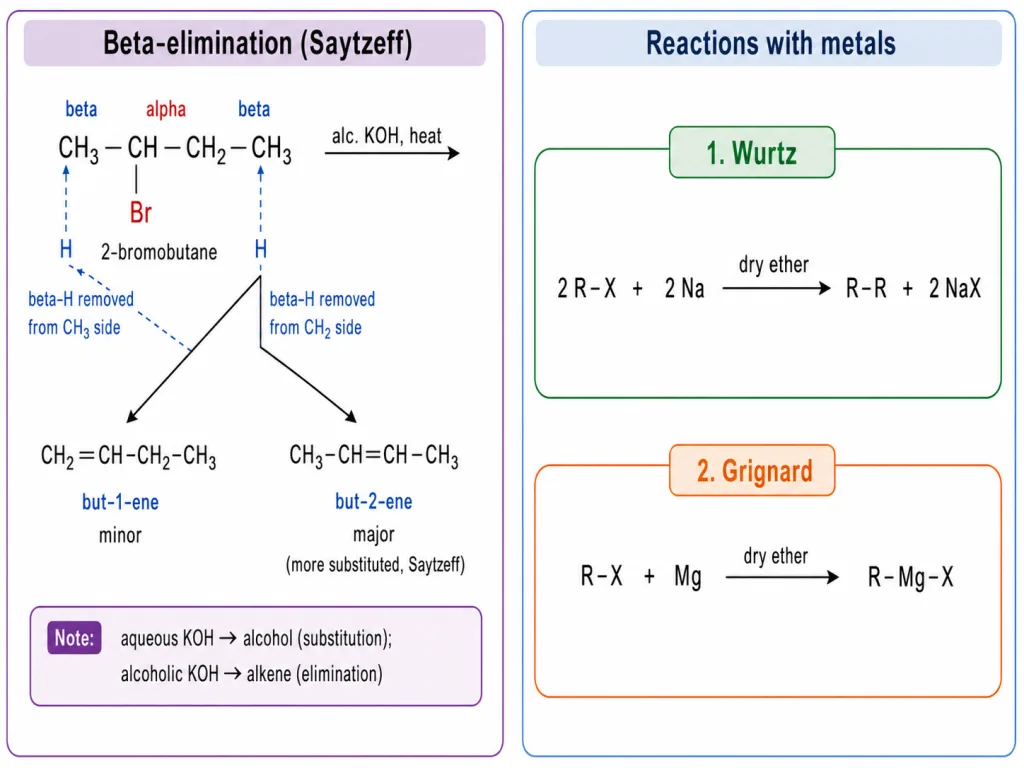
Besides substitution, haloalkanes can undergo elimination: a halide ion and a hydrogen atom are removed from adjacent carbon atoms to form a carbon-carbon double bond (alkene). Because the H comes from the carbon next to the carbon bearing the halogen, this is called beta-elimination or dehydrohalogenation.
The reagent is usually alcoholic KOH (potassium hydroxide in alcohol):
Substitution vs elimination — the reagent decides:
- Aqueous KOH → substitution (gives an alcohol).
- Alcoholic KOH → elimination (gives an alkene).
This is a favourite exam contrast: the same halide gives an alcohol or an alkene depending on whether the KOH is aqueous or alcoholic.
Saytzeff's Rule
When elimination can give more than one alkene (because there are different beta-hydrogens), which one predominates? Saytzeff's (Zaitsev's) rule answers:
In dehydrohalogenation, the preferred (major) product is the more substituted, more stable alkene — the one formed by removing the hydrogen from the beta-carbon with fewer hydrogen atoms.
Example: 2-bromobutane on elimination can give but-1-ene or but-2-ene. By Saytzeff's rule, the more substituted but-2-ene () is the major product, because it is more stable (more alkyl groups on the double bond).
[JEE Tip] To find the Saytzeff (major) product: remove H from the beta-carbon that has the fewest hydrogens, giving the most substituted double bond. The more alkyl groups attached to the C=C, the more stable (and hence major) the alkene.
Reactions with Metals
Haloalkanes react with several metals to form useful organometallic and coupling products.
(1) Wurtz reaction — with sodium in dry ether, two alkyl halide molecules couple to give a symmetrical alkane with double the carbon number: e.g. (butane).
(2) Grignard reagents - with magnesium in dry ether, alkyl/aryl halides form alkyl (or aryl) magnesium halides, RMgX: Grignard reagents are extremely useful in synthesis (they add to carbonyl compounds to make alcohols). They are very reactive — they react with any source of proton (even water), so the apparatus and solvents must be perfectly dry.
Key Point: alcoholic KOH → elimination (alkene, Saytzeff); aqueous KOH → substitution (alcohol). Na/dry ether → Wurtz (R-R alkane). Mg/dry ether → Grignard reagent (RMgX).
Solved Examples
Example 1: Substitution vs elimination
What is the product when 2-bromopropane reacts with (a) aqueous KOH and (b) alcoholic KOH?
Solution: (a) Aqueous KOH → substitution: propan-2-ol (). (b) Alcoholic KOH → elimination: propene ().
Example 2: Saytzeff product
What is the major alkene from the dehydrohalogenation of 2-bromobutane?
Solution: By Saytzeff's rule, the more substituted alkene but-2-ene () is the major product (minor: but-1-ene).
Example 3: Wurtz reaction
What is the product when bromoethane is treated with sodium in dry ether?
Solution: The Wurtz reaction couples two ethyl groups: (n-butane) .
Example 4: Grignard reagent formation
How is a Grignard reagent prepared from bromoethane?
Solution: React bromoethane with magnesium in dry ether: (ethylmagnesium bromide).
Example 5: Why dry conditions for Grignard
Why must Grignard reagents be prepared and used under perfectly dry (anhydrous) conditions?
Solution: Grignard reagents are very reactive toward protons — they react instantly with water (or any compound containing an acidic hydrogen such as -OH or -NH) to give an alkane, destroying the reagent: . So all traces of moisture must be excluded.
Example 6: Identify the elimination reagent
Which reagent converts an alkyl halide to an alkene?
Solution: Alcoholic KOH (potassium hydroxide dissolved in alcohol) brings about dehydrohalogenation (beta-elimination) to give the alkene.
Example 7: Predict elimination products
What alkenes form on dehydrohalogenation of 2-bromo-2-methylbutane, and which is major?
Solution: Two alkenes are possible: 2-methylbut-2-ene (more substituted) and 2-methylbut-1-ene (less substituted). By Saytzeff's rule, 2-methylbut-2-ene (more substituted, more stable) is the major product.
Example 8: Wurtz reaction limitation
Why is the Wurtz reaction not used to prepare alkanes with an odd number of carbons or unsymmetrical alkanes?
Solution: The Wurtz reaction couples two identical alkyl halides to give a symmetrical alkane. Using two different halides gives a mixture of three products (R-R, R'-R', R-R'), so it is unsuitable for unsymmetrical alkanes.
Example 9: Both products from one halide
Show how 2-bromopropane can give either an alcohol or an alkene.
Solution:
- With aqueous KOH (substitution): (propan-2-ol).
- With alcoholic KOH (elimination): (propene). The nature of the base/solvent decides the pathway.
Example 10: Grignard with water
What is formed when ethylmagnesium bromide reacts with water?
Solution: Ethane is formed: (ethane) . The Grignard reagent abstracts a proton from water.