
Nucleophilic Substitution — The Central Reaction
The polar C-X bond means haloalkanes are attacked by nucleophiles (electron-rich species: OH-, CN-, NH, OR-, etc.). The nucleophile replaces the halide (a good leaving group). This is nucleophilic substitution, and it happens by two distinct mechanisms: SN2 and SN1.
Which mechanism operates depends mainly on the structure of the alkyl halide (1°/2°/3°), the nucleophile, and the solvent. Understanding the difference is the most important skill in this chapter.
The SN2 Mechanism (Bimolecular)
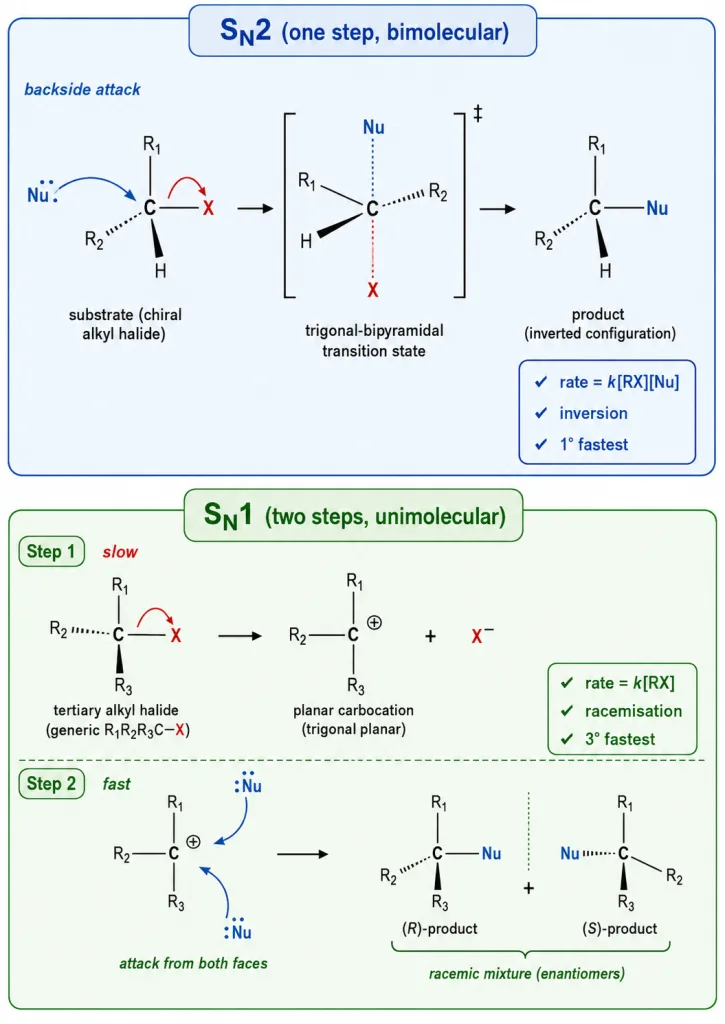
SN2 = Substitution Nucleophilic Bimolecular. It is a single-step reaction in which the nucleophile attacks the carbon from the side opposite to the leaving group (backside attack) as the C-X bond breaks.
Key features:
- One step, through a transition state in which both the nucleophile and the leaving group are partially bonded to carbon.
- Second-order kinetics: rate = k[R-X][Nu-] — both the halide and the nucleophile appear in the rate law (hence "bimolecular").
- Inversion of configuration at the carbon (like an umbrella turning inside out) — the Walden inversion.
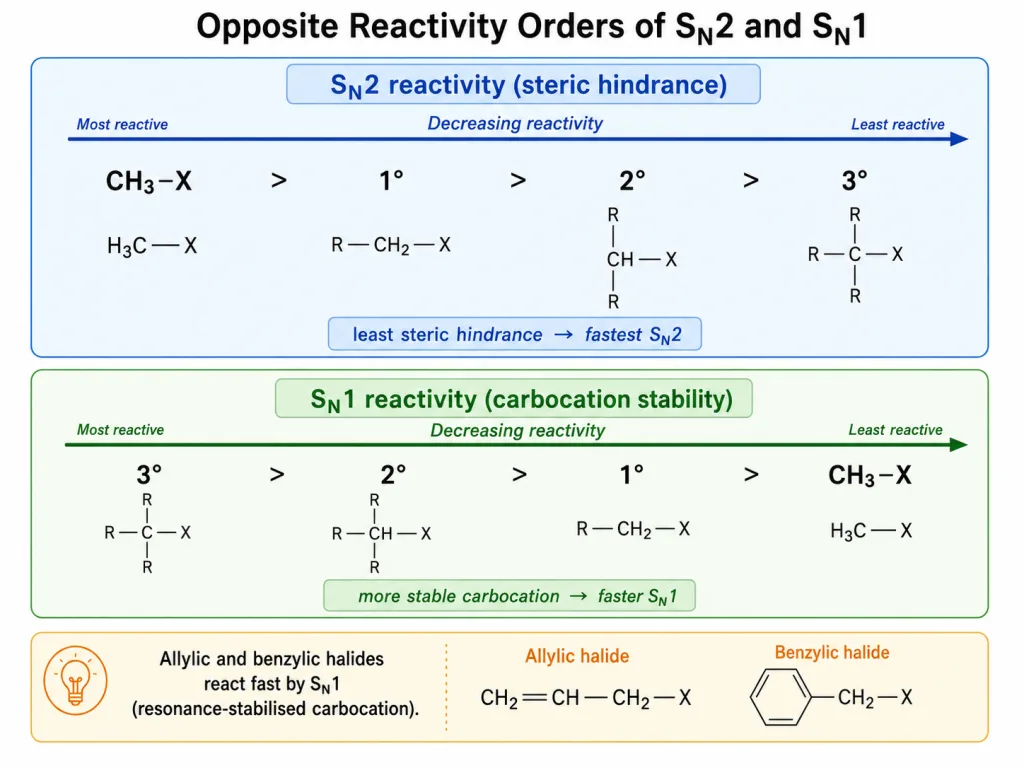
- Reactivity order: CH-X > 1° > 2° > 3°. Steric hindrance decides this: bulky groups around the carbon block the backside attack, so methyl and primary halides react fastest and tertiary slowest.
Worked logic: in CHBr, the small methyl group leaves the backside open, so SN2 is fast. In (CH)CBr, the three methyls block the approach, so SN2 is essentially impossible — it goes by SN1 instead.
The SN1 Mechanism (Unimolecular)
SN1 = Substitution Nucleophilic Unimolecular. It is a two-step reaction that goes through a carbocation intermediate.
- Step 1 (slow, rate-determining): the C-X bond breaks heterolytically to give a carbocation and a halide ion.
- Step 2 (fast): the nucleophile attacks the planar carbocation.
Key features:
- First-order kinetics: rate = k[R-X] — only the halide appears in the rate law (the slow step does not involve the nucleophile), hence "unimolecular."
- Racemisation: the planar carbocation can be attacked from either face, giving a racemic mixture (a mix of both enantiomers).
- Reactivity order: 3° > 2° > 1° > CH-X — governed by carbocation stability (3° carbocations are the most stable, so they form fastest).
Allylic and benzylic halides react very fast by SN1 because their carbocations are resonance-stabilised.
Key Point — the great contrast:
- SN2: one step, rate ∝ [RX][Nu], inversion, 1° fastest (steric).
- SN1: two steps (carbocation), rate ∝ [RX], racemisation, 3° fastest (carbocation stability).
[JEE Tip] To predict the mechanism: primary halide + strong nucleophile → SN2; tertiary halide (or allylic/benzylic) + polar protic solvent → SN1. Secondary halides can go by either, depending on conditions.
Solved Examples
Example 1: Predict the mechanism
By which mechanism does CHCHBr react with OH-, and why?
Solution: SN2. CHCHBr is a primary halide with little steric hindrance, so the nucleophile can attack the backside in a single step. (Primary halides favour SN2.)
Example 2: Tertiary halide mechanism
By which mechanism does (CH)CBr undergo hydrolysis, and why?
Solution: SN1. The tertiary carbon is too hindered for backside attack, but it forms a stable 3° carbocation, so it reacts via the two-step SN1 mechanism.
Example 3: SN2 reactivity order
Arrange CHBr, CHCHBr, (CH)CHBr, (CH)CBr in decreasing order of SN2 reactivity.
Solution: Steric hindrance increases from methyl to tertiary, so SN2 rate decreases: CHBr > CHCHBr > (CH)CHBr > (CH)CBr.
Example 4: SN1 reactivity order
Arrange the same four bromides in decreasing order of SN1 reactivity.
Solution: Carbocation stability increases from methyl to tertiary, so SN1 rate increases: (CH)CBr > (CH)CHBr > CHCHBr > CHBr.
Example 5: Kinetics distinguishes the mechanisms
A substitution reaction is found to be first order (rate = k[R-X]). Which mechanism is operating?
Solution: SN1. First-order kinetics (rate depending only on the halide) indicates the slow step is the unimolecular formation of a carbocation.
Example 6: Why allylic halides are reactive in SN1
Why does an allylic halide (e.g. CH=CH-CH-Cl) react rapidly by SN1?
Solution: Its carbocation is resonance-stabilised (the positive charge is delocalised over the allylic system), so it forms easily, accelerating the rate-determining step of SN1.
Example 7: Effect of nucleophile concentration
In an SN2 reaction, what happens to the rate if the nucleophile concentration is doubled?
Solution: The rate doubles. SN2 is second order: rate = k[R-X][Nu-], so it is first order in the nucleophile.
Example 8: Effect of nucleophile in SN1
In an SN1 reaction, what happens to the rate if the nucleophile concentration is doubled?
Solution: The rate is unchanged. SN1 is first order: rate = k[R-X] — the nucleophile is not in the rate-determining step.
Example 9: Faster hydrolysis
Which is hydrolysed faster by aqueous KOH (SN1): CHCHCl (benzyl chloride) or CHCHCHCl (n-propyl chloride)?
Solution: Benzyl chloride — it forms a resonance-stabilised benzylic carbocation, so it undergoes SN1 much faster than the primary n-propyl chloride.
Example 10: Solvent effect
Why do polar protic solvents (like water) favour SN1?
Solution: Polar protic solvents stabilise the carbocation and the leaving halide ion through solvation, lowering the energy of the rate-determining ionisation step — thereby favouring the SN1 pathway.