
Preparation from Alcohols
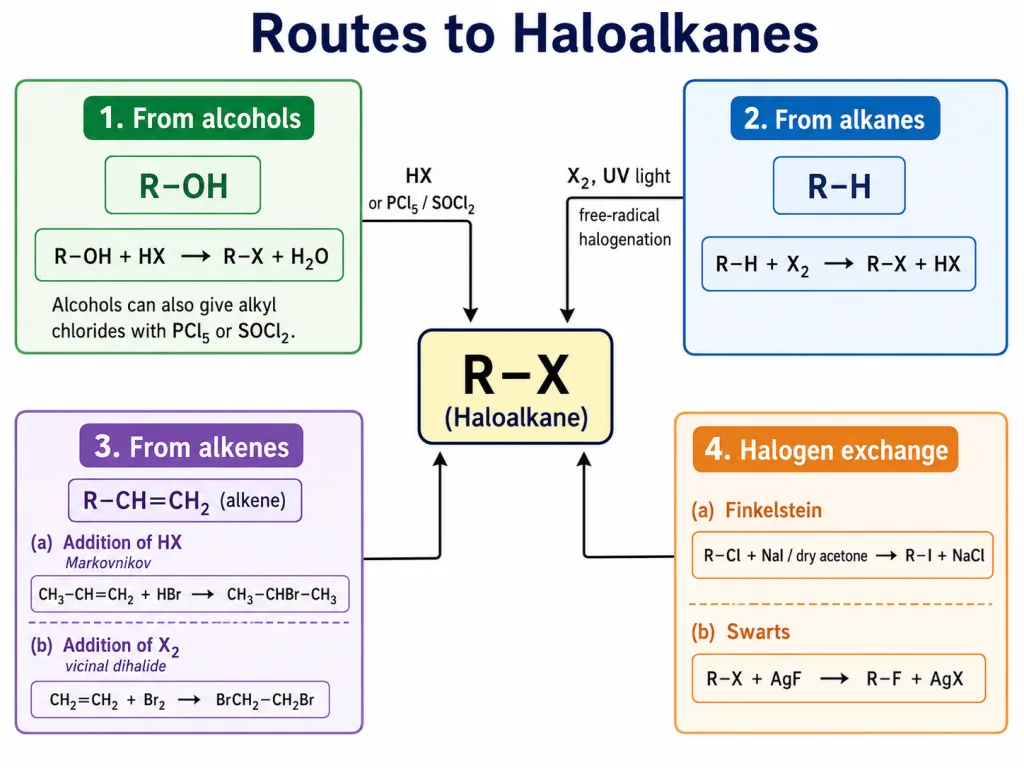
The most common way to make haloalkanes is from alcohols, replacing the -OH by -X. Several reagents do this:
(1) With hydrogen halides (HX): The reactivity order of the alcohols is 3° > 2° > 1°, and of the hydrogen halides is HI > HBr > HCl. (Lucas reagent - conc. HCl + ZnCl - is used to distinguish 1°, 2°, 3° alcohols.)
(2) With phosphorus halides: (PBr and PI, generated in situ from red P + Br/I, give bromides and iodides.)
(3) With thionyl chloride (SOCl) - the preferred lab method, because the by-products are gases that escape, leaving pure alkyl chloride:
Preparation from Hydrocarbons
(1) From alkanes — free-radical halogenation: Alkanes react with Cl or Br in the presence of UV light or heat to give a mixture of haloalkanes (substitution of H by X): This gives mixtures (mono-, di-, poly-substituted), so it is of limited preparative use.
(2) From alkenes:
- Addition of HX (Markovnikov's rule - H adds to the carbon with more H's): With peroxides, HBr adds anti-Markovnikov (peroxide/Kharasch effect) giving CH-CH-CHBr.
- Addition of halogens (X) gives vicinal dihalides: (The decolourisation of bromine water is a test for unsaturation.)
Halogen Exchange Reactions
Two named reactions interconvert one halide for another:
(1) Finkelstein reaction — makes alkyl iodides from chlorides/bromides: This works because NaCl and NaBr are insoluble in dry acetone but NaI is soluble - so the equilibrium is pulled toward the iodide as NaCl/NaBr precipitates.
(2) Swarts reaction - makes alkyl fluorides: Heating an alkyl chloride/bromide with a metallic fluoride replaces the halogen with fluorine.
Key Point — three named preparations to memorise:
- Finkelstein: R-X + NaI / dry acetone → R-I (makes iodides).
- Swarts: R-X + AgF/metal fluoride → R-F (makes fluorides).
- From alcohols: SOCl is best (gaseous by-products → pure product).
[NEET Important] "Why dry acetone in the Finkelstein reaction?" — because NaI is soluble in acetone but NaCl/NaBr are not, so they precipitate and drive the reaction forward. This exact reasoning is frequently asked.
Solved Examples
Example 1: Finkelstein reaction
How would you convert 1-chlorobutane to 1-iodobutane?
Solution: Use the Finkelstein reaction — treat 1-chlorobutane with NaI in dry acetone: CHCHCHCHCl + NaI → CHCHCHCHI + NaCl↓.
Example 2: Why dry acetone?
Why is dry acetone used as the solvent in the Finkelstein reaction?
Solution: NaI is soluble in acetone, but NaCl (and NaBr) are not. As the reaction proceeds, NaCl precipitates out, shifting the equilibrium toward the formation of the alkyl iodide.
Example 3: Swarts reaction
How is an alkyl fluoride prepared from an alkyl bromide?
Solution: By the Swarts reaction — heat the alkyl bromide with a metallic fluoride such as AgF, HgF, CoF or SbF: R-Br + AgF → R-F + AgBr.
Example 4: Alcohol with SOCl
Why is thionyl chloride preferred for converting an alcohol to an alkyl chloride?
Solution: R-OH + SOCl → R-Cl + SO↑ + HCl↑. The by-products SO and HCl are gases that escape, leaving a pure alkyl chloride with no contamination — making this the best laboratory method.
Example 5: Markovnikov addition
What is the major product when propene reacts with HBr (no peroxide)?
Solution: By Markovnikov's rule, H adds to the carbon with more hydrogens, so Br goes to the more substituted carbon: CH-CH=CH + HBr → CH-CHBr-CH (2-bromopropane).
Example 6: Peroxide effect
What is the product when propene reacts with HBr in the presence of peroxide?
Solution: The peroxide (Kharasch) effect gives anti-Markovnikov addition: CH-CH=CH + HBr/peroxide → CH-CH-CHBr (1-bromopropane). (Note: only HBr shows the peroxide effect, not HCl or HI.)
Example 7: Reactivity order of alcohols with HX
Arrange 1°, 2° and 3° alcohols in order of increasing reactivity with a given haloacid.
Solution: 1° < 2° < 3° — tertiary alcohols react fastest with HX (they form the most stable carbocation).
Example 8: Vicinal dihalide
What is formed when ethene reacts with bromine?
Solution: A vicinal dihalide: CH=CH + Br → BrCH-CHBr (1,2-dibromoethane). The decolourisation of bromine confirms the C=C.
Example 9: Free-radical halogenation limitation
Why is the free-radical chlorination of an alkane not a good preparative method?
Solution: It gives a mixture of mono-, di- and polychlorinated products (plus different positional isomers) that are hard to separate, so it is of limited synthetic use.
Example 10: Preparation of 1-iodobutane
Write two ways to prepare 1-iodobutane from butan-1-ol.
Solution: (1) Direct: butan-1-ol + HI → 1-iodobutane + HO. (2) Two-step: butan-1-ol + SOCl → 1-chlorobutane, then Finkelstein (NaI/dry acetone) → 1-iodobutane.