
Why Haloarenes Are So Unreactive
A striking fact: aryl halides (haloarenes) are far less reactive toward nucleophilic substitution than alkyl halides. Chlorobenzene, for instance, does not react with aqueous NaOH under ordinary conditions, whereas chloroethane reacts readily. Why?
Three reasons, all worth memorising:
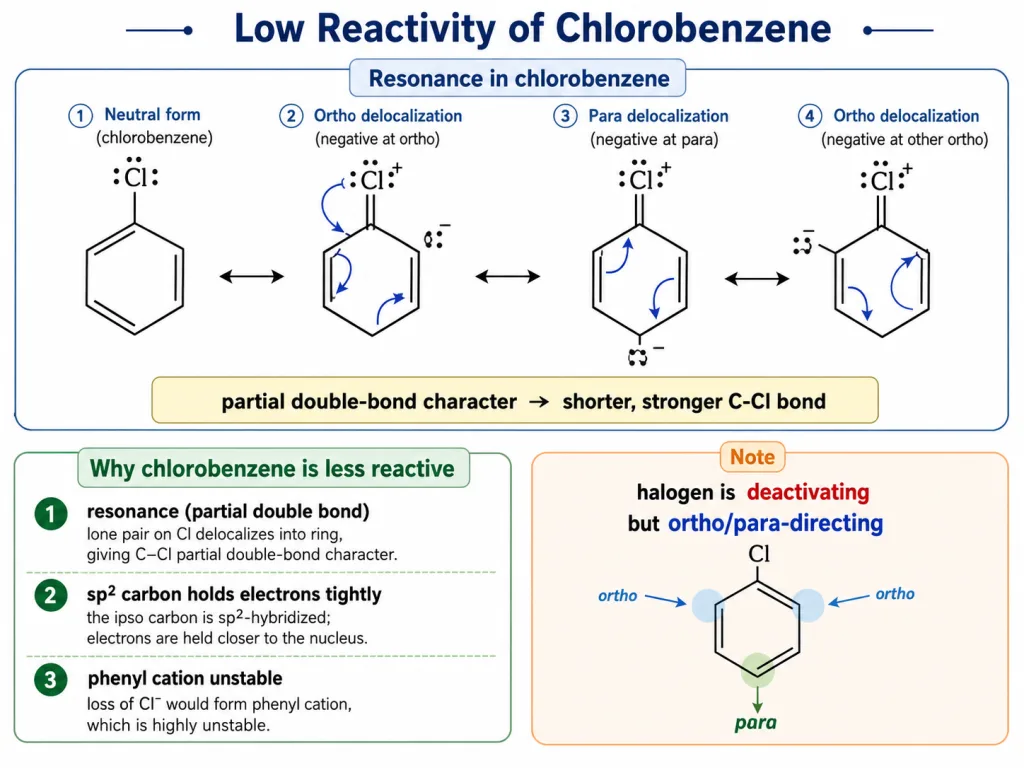
(1) Resonance (partial double-bond character): in a haloarene, a lone pair on the halogen delocalises into the aromatic ring. This gives the C-X bond partial double-bond character, making it shorter and stronger — and therefore hard to break.
(2) sp hybridisation of carbon: the C-X carbon in a haloarene is sp (more s-character), so it holds the bonding electrons closer and more tightly than the sp carbon of a haloalkane — again strengthening the C-X bond.
(3) Instability of the phenyl cation: the SN1 pathway is blocked because the phenyl cation that would form is very unstable (and not resonance-stabilised in a useful way). The SN2 pathway is also blocked because the ring blocks backside attack and the ring's electron cloud repels the incoming nucleophile.
Reactions of Haloarenes
Despite their general inertness, haloarenes do undergo some reactions.
Nucleophilic substitution (only under forcing conditions): chlorobenzene reacts with NaOH only at very high temperature and pressure (e.g. ~623 K and 300 atm) to give phenol. The reaction is greatly accelerated by electron-withdrawing groups (like -NO) at the ortho/para positions, which stabilise the intermediate (e.g. 2,4,6-trinitrochlorobenzene reacts easily).
Electrophilic aromatic substitution: the halogen is a deactivating but ortho/para-directing group. So haloarenes undergo the usual EAS reactions (halogenation, nitration, sulphonation, Friedel-Crafts) but more slowly than benzene, and the new group enters mainly at the ortho and para positions:
- Chlorobenzene + HNO/HSO → mainly o- and p-nitrochlorobenzene.
Reaction with metals:
- Wurtz-Fittig reaction: an aryl halide + an alkyl halide + Na/dry ether → an alkylarene (e.g. toluene from chlorobenzene + methyl chloride).
- Fittig reaction: two aryl halides + Na → a biaryl (e.g. biphenyl from two chlorobenzenes).
The Halogen as an Ortho/Para Director
It seems contradictory: the halogen is deactivating (it withdraws electrons inductively, slowing the ring down) yet ortho/para-directing. The explanation:
- Inductive effect (-I): the electronegative halogen withdraws electron density, deactivating the whole ring (so reactions are slower than for benzene).
- Resonance (+R/mesomeric): the halogen's lone pair donates into the ring, and this donation increases the electron density specifically at the ortho and para positions — so the incoming electrophile goes mainly there.
The inductive effect dominates overall reactivity (deactivation), but resonance controls the position (ortho/para).
Key Point: Haloarenes are less reactive than haloalkanes (resonance + sp carbon + unstable phenyl cation). In electrophilic substitution the halogen is deactivating but ortho/para-directing.
[NEET Important] "Why is chlorobenzene less reactive than chloroethane toward nucleophilic substitution?" — because of resonance (partial double-bond character giving a stronger, shorter C-Cl bond), the sp C holding electrons tightly, and the instability of the phenyl cation. This three-point answer is a recurring 2-3 mark question.
Solved Examples
Example 1: Low reactivity explanation
Why is chlorobenzene less reactive than chloroethane toward nucleophiles?
Solution: In chlorobenzene the C-Cl bond has partial double-bond character (resonance with the ring), making it shorter and stronger; the carbon is sp (holds electrons tightly); and the phenyl cation is unstable. All three make nucleophilic substitution very difficult, unlike the sp C-Cl of chloroethane.
Example 2: Phenol from chlorobenzene
Under what conditions does chlorobenzene react with NaOH to give phenol?
Solution: Only under drastic conditions — high temperature (~623 K) and high pressure (~300 atm) — chlorobenzene + NaOH gives sodium phenoxide, then phenol on acidification.
Example 3: Directing effect
When chlorobenzene is nitrated, where does the nitro group mainly go?
Solution: Mainly to the ortho and para positions. The halogen is ortho/para-directing (through its resonance/mesomeric donation), giving o- and p-nitrochlorobenzene.
Example 4: Deactivating yet o/p-directing
How can the halogen be both deactivating and ortho/para-directing?
Solution: Its strong inductive (-I) effect withdraws electrons and deactivates the ring (slows reaction), but its resonance (+R) donation raises electron density mainly at the ortho and para positions, so the electrophile goes there. Inductive controls rate; resonance controls position.
Example 5: Wurtz-Fittig reaction
What is formed when chlorobenzene reacts with methyl chloride and sodium in dry ether?
Solution: The Wurtz-Fittig reaction couples an aryl and an alkyl group to give an alkylarene: CHCl + CHCl + 2 Na → CH-CH (toluene) + 2 NaCl.
Example 6: Fittig reaction
What is formed when two molecules of chlorobenzene react with sodium?
Solution: The Fittig reaction gives a biaryl: 2 CHCl + 2 Na → CH-CH (biphenyl) + 2 NaCl.
Example 7: Activating the ring for substitution
Why does 2,4-dinitrochlorobenzene undergo nucleophilic substitution far more easily than chlorobenzene?
Solution: The electron-withdrawing -NO groups at the ortho and para positions stabilise the negative-charged intermediate (carbanion) formed when the nucleophile adds, so the substitution proceeds much more readily than in chlorobenzene (which has no such stabilising groups).
Example 8: C-X bond length comparison
Is the C-Cl bond shorter in chlorobenzene or in chloroethane?
Solution: Chlorobenzene has the shorter C-Cl bond, because resonance gives it partial double-bond character (and the sp carbon contributes), whereas chloroethane has a normal single sp C-Cl bond.
Example 9: Reactivity comparison
Arrange chlorobenzene, benzyl chloride and chloroethane in increasing order of reactivity toward nucleophilic substitution.
Solution: Chlorobenzene < chloroethane < benzyl chloride. Chlorobenzene (aryl halide) is least reactive; benzyl chloride is highly reactive because the benzylic carbocation and transition state are resonance-stabilised.
Example 10: Effect of -NO position
Does a -NO group at the meta position activate chlorobenzene toward nucleophilic substitution as effectively as at ortho/para?
Solution: No. Only ortho and para -NO groups can stabilise the intermediate by resonance. A meta -NO cannot delocalise the negative charge onto the nitro group, so it has little activating effect.