
The Whole Chapter in One Glance
Haloalkanes (sp C-X) and haloarenes (sp C-X) have a polar C-X bond. We name them by IUPAC rules, prepare them by named reactions (Finkelstein, Swarts, Sandmeyer), and study their reactivity: nucleophilic substitution (SN1 vs SN2), the stereochemistry of those reactions (inversion, racemisation), elimination (Saytzeff), reactions with metals (Wurtz, Grignard), the low reactivity of haloarenes, and the uses of polyhalogen compounds.
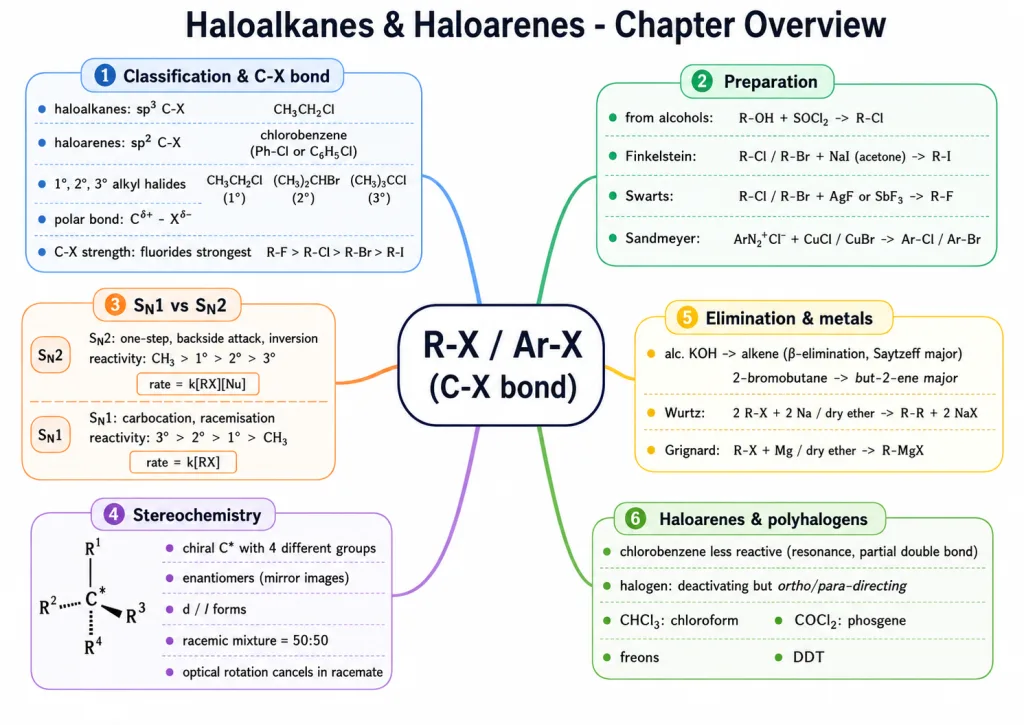
Slot every fact into one of these branches.
Master Facts Sheet
Classification: sp C-X (alkyl, allylic, benzylic) vs sp C-X (vinylic, aryl); alkyl halides are 1°, 2° or 3°.
C-X bond: polar (Cδ+, Xδ-); bond length increases F to I, bond strength decreases F to I; reactivity as leaving groups: R-I > R-Br > R-Cl > R-F.
Preparation: from alcohols (HX, PCl, SOCl); from alkanes (free-radical halogenation); from alkenes (Markovnikov addition of HX; peroxide effect only with HBr; X gives vicinal dihalide); halogen exchange - Finkelstein (NaI/dry acetone -> R-I), Swarts (AgF -> R-F). Haloarenes are prepared by EAS (X/Lewis acid) and Sandmeyer.
Nucleophilic substitution: SN2 (one step, rate = k[RX][Nu], inversion, CH > 1 > 2 > 3); SN1 (two steps via carbocation, rate = k[RX], racemisation, 3 > 2 > 1 > CH).
Stereochemistry: chirality, enantiomers (d/l), racemic mixture (inactive), SN2 -> inversion, SN1 -> racemisation.
Elimination: alcoholic KOH -> alkene (Saytzeff: more substituted major); aqueous KOH -> alcohol. Metals: Wurtz (R-R), Grignard (RMgX).
Haloarenes: less reactive (resonance, sp carbon, unstable phenyl cation); halogen is deactivating but o/p-directing.
Polyhalogens: dichloromethane/chloroform as solvents (chloroform can form phosgene on standing in air and light); iodoform antiseptic (releases iodine); carbon tetrachloride as solvent; freons deplete ozone; DDT is a persistent insecticide.
SN1 vs SN2 Comparison Table
| Feature | SN1 | SN2 |
|---|---|---|
| Steps | Two (via carbocation) | One |
| Molecularity | Unimolecular | Bimolecular |
| Rate law | k[RX] | k[RX][Nu] |
| Stereochemistry | Racemisation | Inversion |
| Substrate order | 3 > 2 > 1 > CH | CH > 1 > 2 > 3 |
| Favoured by | Polar protic solvent, stable carbocation | Strong nucleophile, primary substrate |
Named reactions to remember: Finkelstein (R-I), Swarts (R-F), Sandmeyer (aryl-X), Wurtz (R-R), Wurtz-Fittig (alkylarene), Fittig (biaryl).
Last-Minute Memory Hooks
- sp C-X = haloalkane (reactive); sp C-X = haloarene/vinylic (unreactive).
- C-X polarity: C is δ+, attacked by nucleophiles. R-I most reactive (weakest bond, best leaving group).
- Aqueous KOH = substitution (alcohol); alcoholic KOH = elimination (alkene, Saytzeff).
- SN2: one step, inversion, CH > 1 > 2 > 3 (steric). SN1: carbocation, racemisation, 3 > 2 > 1 > CH (cation stability). Allylic/benzylic are fast in SN1.
- Named reactions: Finkelstein (NaI/acetone -> iodide), Swarts (AgF -> fluoride), Sandmeyer (CuX/HX -> aryl halide), Wurtz (Na -> R-R).
- Chirality: 4 different groups on C = chiral; enantiomers = mirror images; racemic = inactive.
- Haloarenes unreactive: resonance + sp C + unstable phenyl cation; halogen deactivating but o/p-directing.
- Polyhalogens: chloroform can form phosgene, so store it in dark bottles with a small amount of ethanol; freons -> ozone depletion; DDT -> persistent insecticide.
One-line revision flow: classification -> nomenclature/C-X bond -> preparation (named reactions) -> SN1/SN2 -> stereochemistry -> elimination/metals -> haloarene reactivity -> polyhalogen uses.